2025 AIChE Annual Meeting
(550f) Electroadhesion with Bottlebrush Polymers
Authors
Intanon Lapkriengkri, University of California, Santa Barbara
Michael L. Chabinyc, University of California, Santa Barbara
Christopher M. Bates, University of California, Santa Barbara
Megan T. Valentine, University of California Santa Barbara
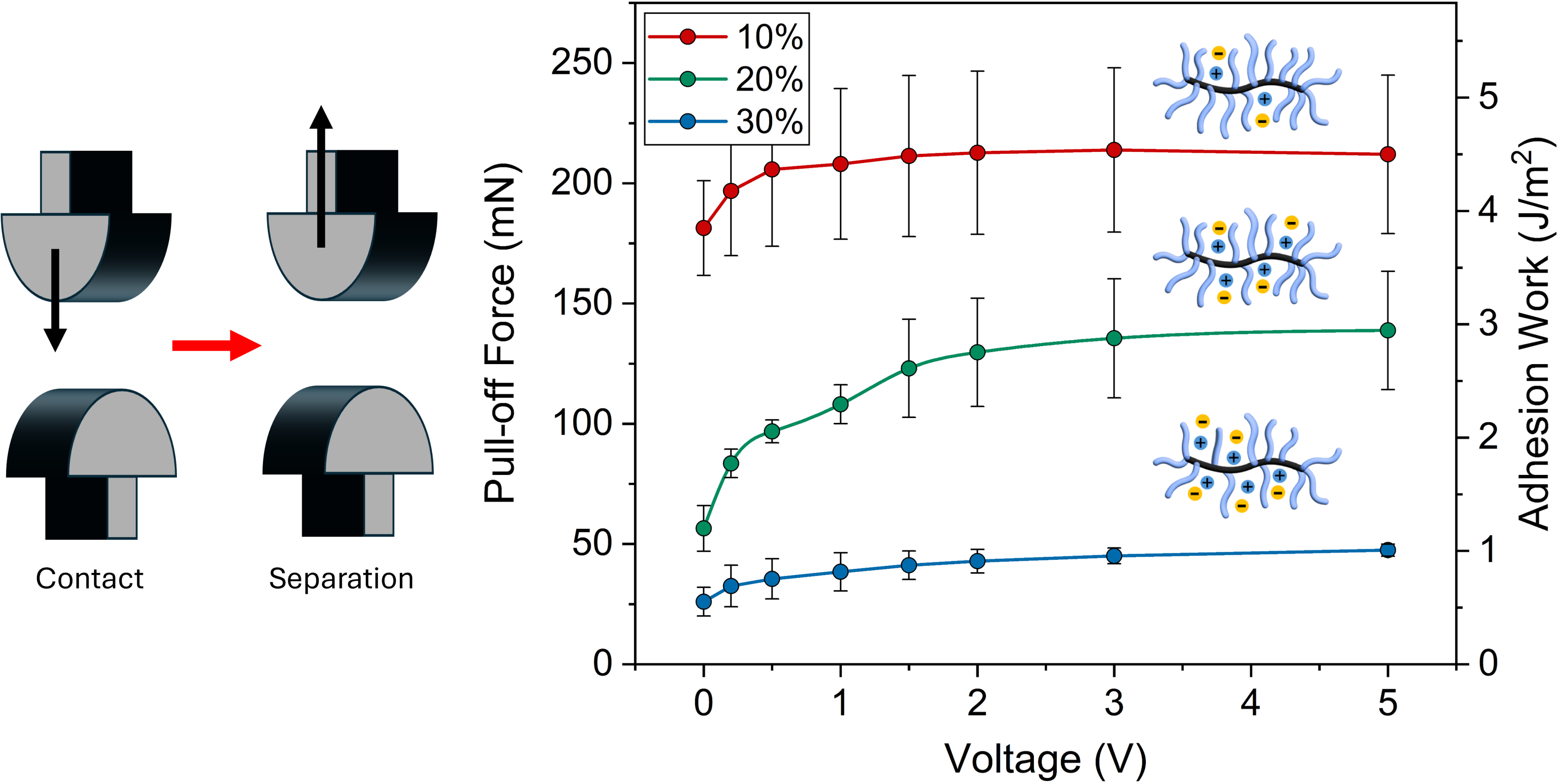
Electroadhesion is of significant importance due to its reversibility and tunability in a wide range of engineering applications, such as soft robotics, haptic devices, and biomedicine. Bottlebrush polymers, which consist of a polymeric backbone with polymeric side chains extending from many (if not all) of the backbone repeat units, offer exceptional functionality, making them promising candidates for electroadhesives. Two complementary bottlebrush polymers were synthesized containing pendant anions and cations via ring-opening metathesis polymerization. The as-prepared polymers are soft, compatible with various substrates, and exhibit high fracture toughness. Upon contact, these oppositely charged ion-containing polymers form a heterojunction at the interface, generating electrostatic forces that effectively enhance adhesion. Through indentation experiments on a custom-built Johnson-Kendall-Roberts (JKR) setup, we showed that the adhesion can be effectively tripled under modest external bias of up to 5 V. Interestingly, this adhesion enhancement is nonmonotonic with increasing cation density, demonstrating strong adhesion at low charge density that is reduced at higher charge densities, perhaps due to surface degradation from excessive ionic bonding. The insights developed for this new class of electroadhesives could impact a wide range of engineering applications.