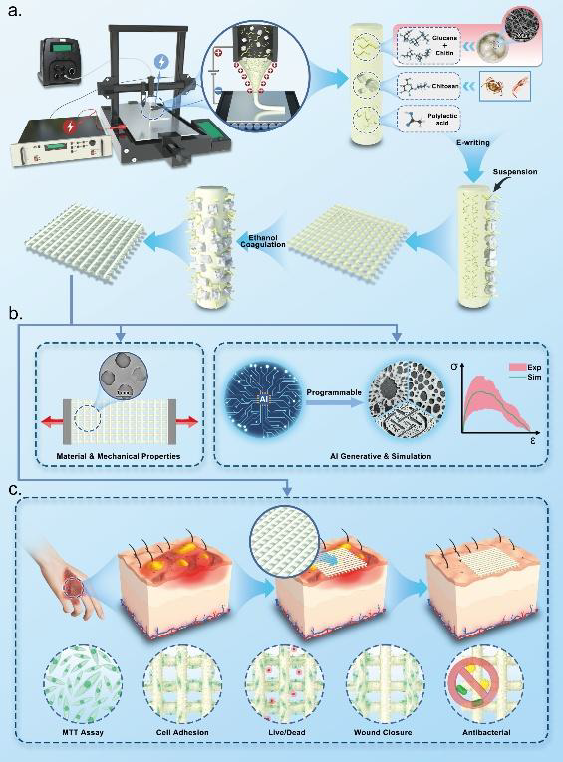
Severe burn injuries pose substantial clinical challenges due to disrupted tissue mechanics, persistent inflammation, heightened infection risk, and impaired regenerative capacity. Conventional treatment approaches often fall short in addressing the complex physiological demands of these wounds, leading to prolonged healing and compromised tissue function [1]. This study presents a biodegradable scaffold system fabricated via electro-writing (e-writing) 3D printing, designed to address these limitations. The scaffold incorporates poly(lactic acid) (PLA), chitosan, and Ganoderma lucidum mycelium, which collectively provide mechanical support, antimicrobial activity, and immunomodulatory bio-functionality [2]. The e-writing technique facilitates the fabrication of tunable micro-architecture scaffolds through a high-voltage electric field, enabling nanoscale fiber deposition with greater precision than conventional 3D printing methods [3]. Biocompatibility was validated through a series of assays, including MTT cell viability, cell adhesion, live/dead staining, and scratch assays. These tests demonstrate the scaffold’s ability to support cell proliferation, adhesion, and migration, which are critical processes for tissue regeneration and wound healing. Preliminary in vivo studies using a murine second-degree burn model indicate accelerated wound closure, reduced inflammation, and enhanced angiogenesis and tissue remodeling. Overall, this multifunctional scaffold platform offers a promising step toward scalable, bioactive, and mechanically optimized wound healing strategies with broad relevance to regenerative medicine and translational biomaterial applications.
Key Words: Electro-writing (E-writing) 3D Printing, Biodegradable Scaffolds, Tissue Regeneration, Wound Healing Mechanics
[1] M. G. Jeschke, M. E. van Baar, M. A. Choudhry, K. K. Chung, N. S. Gibran, and S. Logsetty, “Burn injury,” Nat Rev Dis Primers, vol. 6, no. 1, p. 11, 2020, doi: 10.1038/s41572-020-0145-5.
[2] L. Yang, D. Park, and Z. Qin, “Material Function of Mycelium-Based Bio-Composite: A Review,” Front Mater, vol. 8, pp. 1–17, 2021, doi: 10.3389/fmats.2021.737377.
[3] G. Zhang, L. Qian, J. Zhao, H. Zhou, and Hongbo Lan, “High-Resolution Electric-Field-Driven Jet 3D Printing and Applications,” in 3D Printing, D. Cvetković, Ed., Rijeka: IntechOpen, 2018, p. Ch. 2. doi: 10.5772/intechopen.78143.
Figure 1. Schematic overview of the integrated E-writing platform and its application in programmable scaffold fabrication for wound healing. a. Electrically assisted direct ink writing (E-writing) of a mycelium-based bio-ink composed of glucans, chitin, chitosan, and polylactic acid (PLA). b. AI-powered generative design enables the development of programmable architecture, which is validated through mechanical characterization and structure–property simulations to optimize scaffold performance. c. The resulting bioactive scaffolds are assessed for regenerative wound healing applications to demonstrate their multifunctionality and therapeutic potential.