2025 AIChE Annual Meeting
(240b) Efficient Ethanol-to-Acetone Reaction Using Induction Heating
Authors
Ryan Thompson, University of California, Irvine
Erdem Sasmaz, University of California, Irvine
Carlos Lizandara-Pueyo, BASF
Roel Sanchez-Carrera, BASF
Jianping Chen, BASF
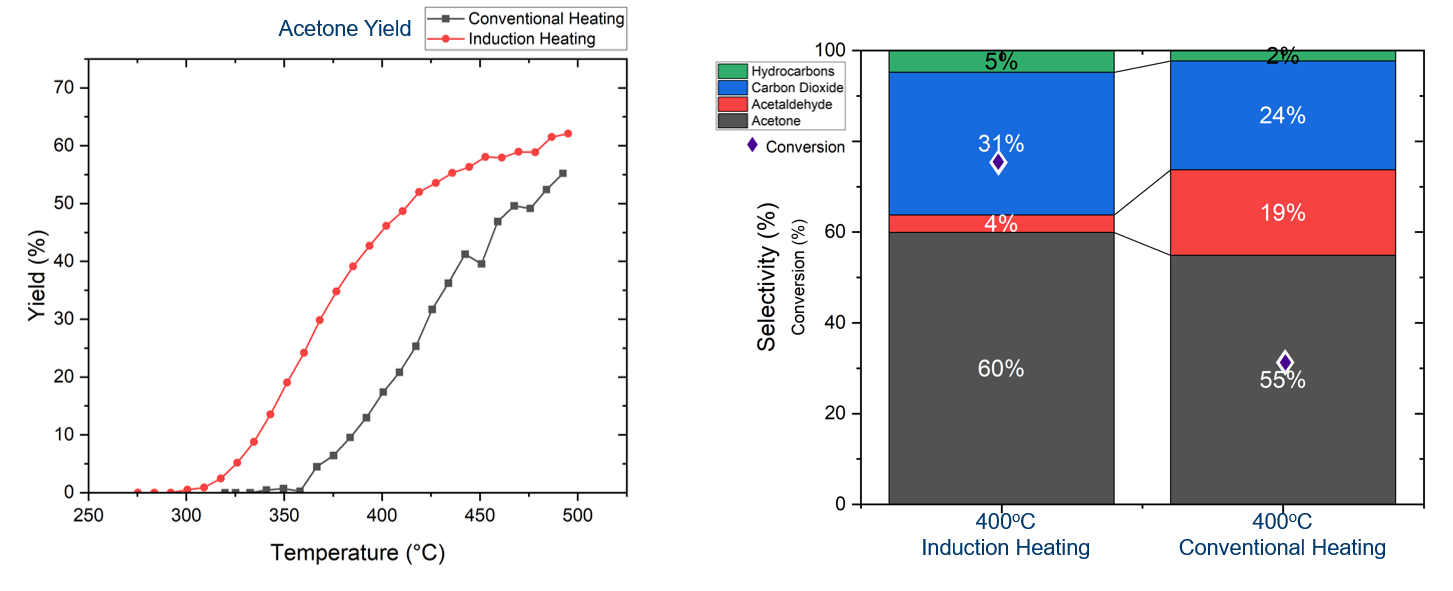
The widespread usage of fossil fuels to supply heat to industrial processes contributes to 8% of the United States’ energy-related carbon dioxide emissions. Induction heating (IH) has emerged as an alternative method to supply heating for industrial processes. By using alternating electric currents to produce oscillating magnetic fields, IH heats ferromagnetic materials with high efficiency. Additionally, IH has been demonstrated to improve catalyst activity in chemical reactions compared to conventional heating (CH), and its application in the synthesis of acetone from ethanol is of interest to the chemical industry. Acetone is a vital industrial solvent, and since acetone is typically produced from petroleum-derived chemicals through the cumene process, it is desirable to use more sustainable feedstocks to minimize the environmental impacts of its production. Bio-ethanol and water above 350°C with a Fe2O3-ZnO catalyst can produce acetone in high-selectivity and high conversion. In this study, the effect of induction heating on the selectivity and conversion of the thermocatalytic ethanol-to-acetone reaction was investigated. The catalyst and stainless steel susceptor beads were placed in a packed-bed reactor, into which a gaseous mixture of ethanol, water, and nitrogen was fed. Time-on-stream and temperature-sweep experiments were performed using a copper solenoid for IH and a furnace for CH. The reaction products were analyzed via gas chromatography. Although both heating methods exhibited similar selectivity and deactivation trends in time-on-stream experiments, temperature-sweep experiments revealed high ethanol conversion and acetone selectivity with IH at lower temperatures than CH. As a result of the alternating magnetic field, IH causes both the stainless steel susceptor beads and ferrimagnetic catalyst to generate heat within the catalyst bed. This internal heat generation enhances heat transfer compared to CH, which heats the reactor externally. The benefits of improved heat transfer, reduced process temperature, and electrified heating.