2025 AIChE Annual Meeting

(477c) Effect of Polyanions on the Early Aggregation of Amyloid-? (16-22) Peptides: A Molecular Simulation Study

Authors

Ethayaraja Mani, Indian Institute of Technology Madras
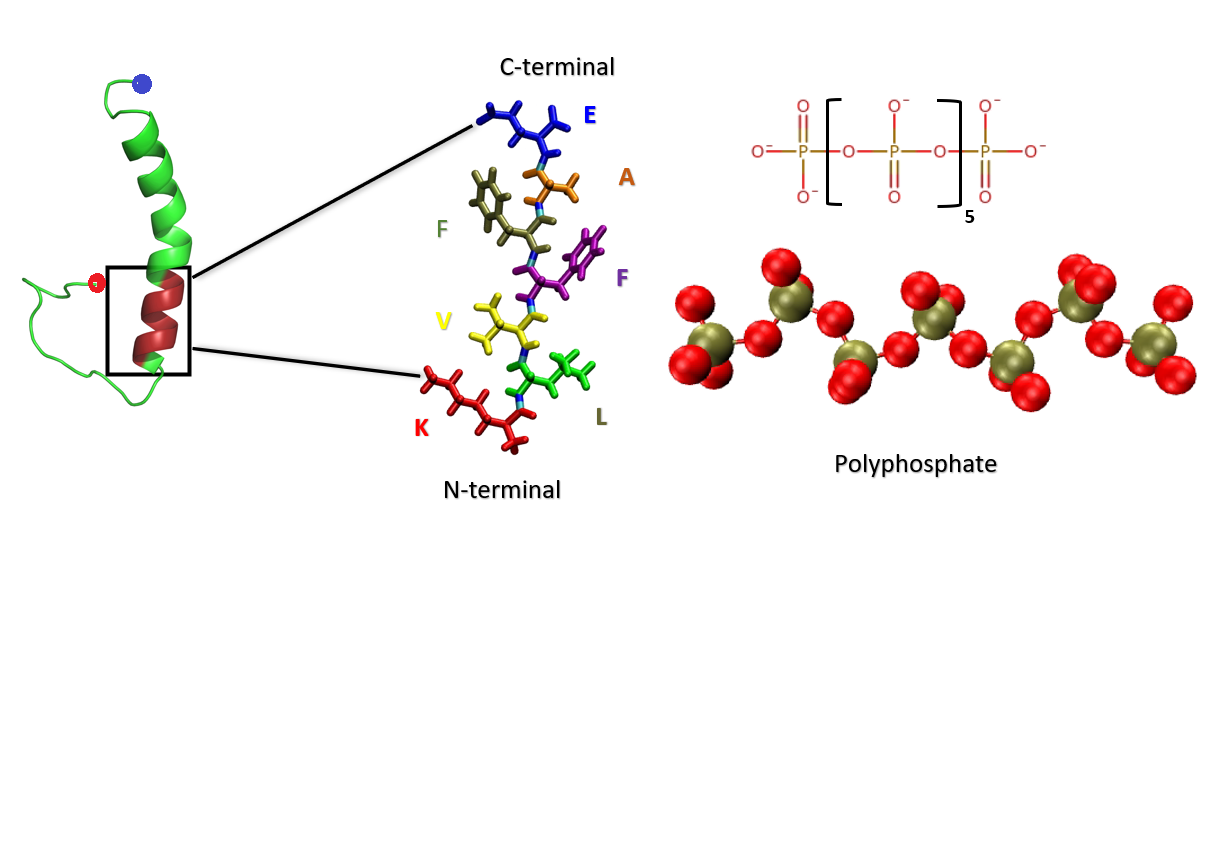
Amyloid-β is the hallmark protein responsible for the cause of Alzheimer’s disease. It is the most prevalent among several other neurodegenerative diseases. Amyloid-β (16-22) is a seven residue amyloidogenic peptide – containing the sequence KLVFFAE. Aβ peptide consists of 40 to 42 amino acid residues. Aβ(1-40) consists of N-terminal, central region and C-terminal regions which comprises of the full-length protein. However, the central region is short and tends to aggregate more than the full length Aβ protein. It is the central fibril forming core region of the full length Aβ protein. This part of the peptide contains the hydrophobic amino acid residues and is responsible for intermolecular β- sheet of the Aβ fibril. Studies reveal that anionic biopolymers can modulate the fibrillation kinetics which are linked to the neurodegenerative diseases depending upon their local concentrations and pH. Polyphosphate (PolyP) is an anionic biopolymer, which is responsible for various cellular physiological processes in our human body and induces fibrillation in many amyloidogenic proteins. Experimental investigations reveal the dual role of polyphosphate in the fibrillation kinetics of Aβ (1-40) depending upon the pH value. At pH7, polyP inhibits the amyloid-fibril formation in a dose-dependent manner similar to negatively charged nanoparticles, whereas at pH3 polyP accelerates amyloid fibrillation via liquid-liquid phase separation (LLPS).

In this study, we employ molecular dynamics simulations to study the aggregation behaviour of Amyloid- β (16-22) with polyphosphate. At pH 7, lysine is negatively charged (-1 charge) and glutamic acid is positively charged (+1 charge). The electrostatic interactions between these residues and the negatively charged anionic polymer inhibit amyloid aggregation. However, at acidic pH3, the lysine is protonated to carry (+2 charge) and glutamic acid is deprotonated (-1 charge). This leads to aggregation behaviour of amyloid-beta in the presence of polyphosphates. Electrostatic interactions between protonated lysine and other negatively charged molecules play a significant role in amyloid aggregation. Additionally, we investigated the system at pH11, which has not been explored in previous studies. At basic pH11, the protonation states of the KLVFFAE peptide is influenced by pKa value of its ionizable residues. As a result, lysine is positively charged (+1) and glutamic acid is deprotonated and negatively charged (-2). The analysis has been studied based on secondary structure analysis, hydrogen bonding, cluster-size analysis, β–sheet content comparison at various pH values. Hence, PolyP can be a beneficial therapeutic molecule to redirect amyloid aggregation towards lesser toxicity pathways.