2025 AIChE Annual Meeting
(298a) Effect of Moisture (2mol%) on CO2 Enhanced Desorption from Nano-Dispersed Na2o/Al2O3 for Direct Air Capture
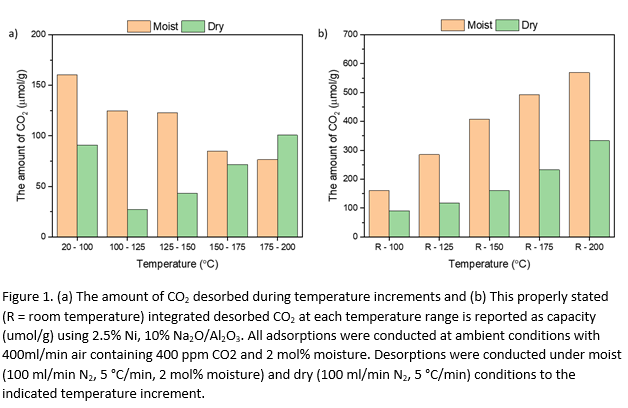
This study demonstrates enhanced amount and rate of CO2 desorption at low temperature from nano-dispersed “Na2O”/r-Al2O3 using a low moisture (2 mol% H2O) content purge gas generated from the vapor pressure of H2O at 20 °C, = 17 mm Hg relative to a dry purge. Ni is added to catalytically hydrogenate the Na2CO3/Al2O3 precursor to highly active CO2 and Na2O/Al2O3. Multi-cycle aging tests conducted over 317 hours (60-cycles aging) and varying capture conditions confirmed the stability. This allows a decrease in energy consumption in desorbing the CO2. Figure 1a shows that a moist purge (orange) enhances the amount and rate of CO2 desorbed relative to a dry purge at lower temperature, and Figure 1b demonstrates moist conditions desorb more CO2 than dry at the same temperature.
Figure 1a shows that a moist purge (orange) enhances the amount and rate of CO2 desorbed relative to a dry purge at lower temperature, and Figure 1b demonstrates moist conditions desorb more CO2 than dry at the same temperature.