2025 AIChE Annual Meeting
(178k) Effect of Liquid Surface Tension on the Initial Bubble Size in Molten Metal Bubble Reactors
Authors
This work aims to determine the effect of the physical properties of the liquid medium, more specifically of surface tension, on the initial bubble size, i.e., right after its detachment from the inlet orifice. This, in turn will have an effect on the average bubble size in the bulk of the liquid. The work is founded on the following premises:
- in their study on bubble swarms in liquid metals, Sano and Mori [1] found a dependence of the average bubble diameter on liquid density and surface tension;
- in the present work, we find that this finding is in agreement with the average size of methane bubbles in a molten SnNi alloy at 1000°C, as experimentally determined in [2];
- a completely predictive model for the determination of the initial bubble size based on elementary force balances has been reported by Geary and Rice [3] and validated experimentally in air-water systems [4];
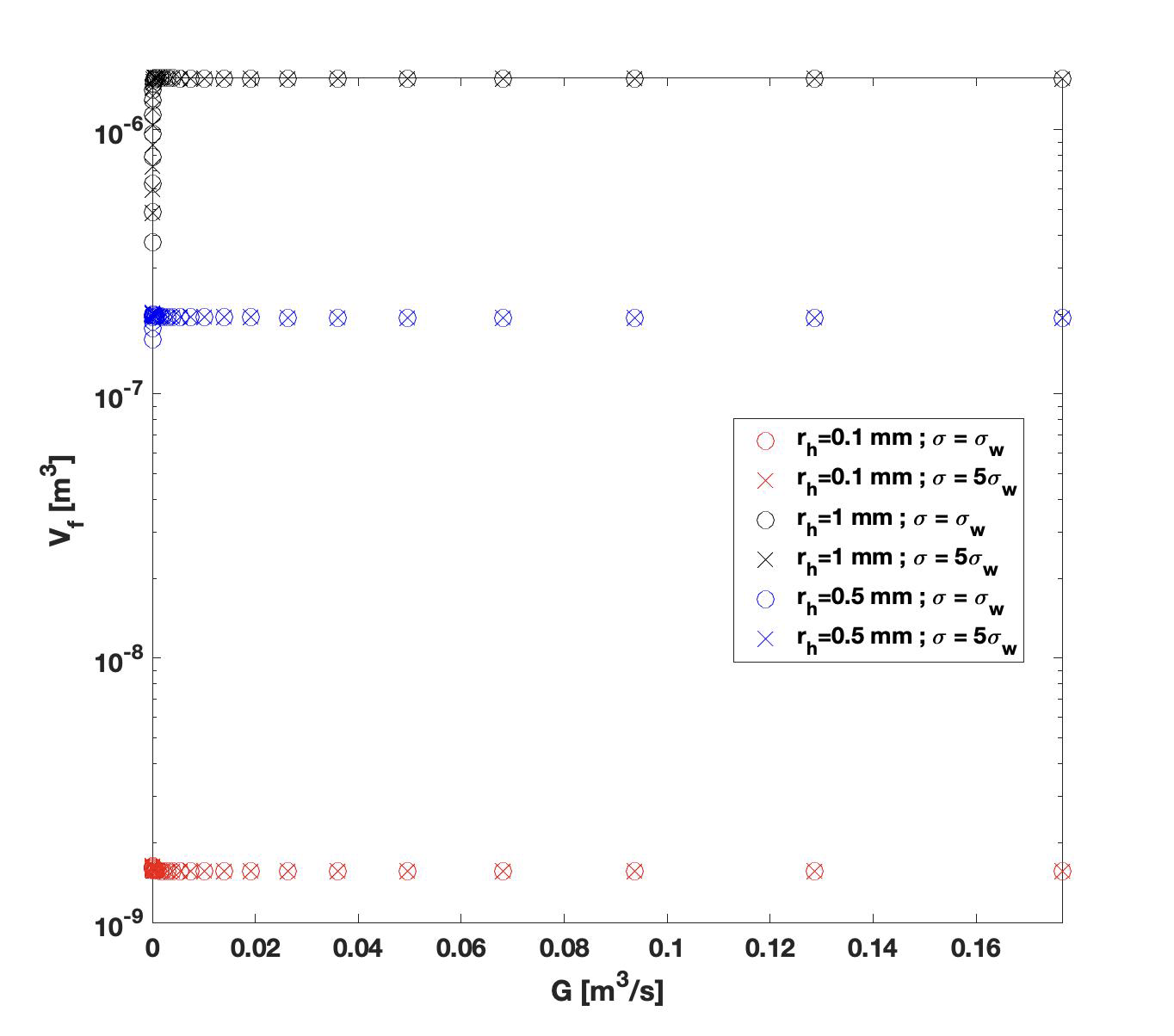
- when compared to the findings of Sano and Mori [1], Geary and Rice's model [3] underestimates the effect of liquid surface tension, as shown in Figure 1.
Here, we attempt to reconcile the results found in [1] and [3], by modifying the dependence of the initial bubble size on the liquid surface tension, taking into account the early onset of coalescence and break-up phenomena, as well as detachment time.
Figure 1 caption. Bubble volume after detachment as predicted by Geary and Rice [3] for different sparger orifice radii, rh, and liquid viscosities, σ.
References
- Sano, M., Mori, K., Dynamics of Bubble Swarms in Liquid Metals, 1980, Transactions ISIJ, 20, 669.
- Kim, J., Oh, C., Oh, H., Lee, Y., Seo, H., Kim, Y.K., Catalytic methane pyrolysis for simultaneous production of hydrogen and graphitic carbon using a ceramic sparger in a molten NiSn alloy, 2023, Carbon, 207, 1-12.
- Geary, N.W., Rice, R.G., Bubble Size Prediction for Rigid and Flexible Spargers, 1991, AIChE Journal, 37, 161.
- Polli, M., Di Stanislao, M., Bagatin, R., Abu Bakr, E., Masi, M., Bubble Size Distribution in the Sparger Region of Bubble Columns, 2002, Chemical Engineering Science, 57, 197.