
2025 AIChE Annual Meeting
(178l) Effect of Dense Internals on Liquid Velocity and Turbulence in Bubble Columns for Fischer–Tropsch Synthesis Using Radioactive Particle Tracking
Authors
Mohammed Almesfer, King Khalid University
Ahmed Jasim, Missouri University of Science and Technology
Muthanna Al-Dahhan, Missouri University of Science & Technology-Rolla
This study experimentally explores the influence of dense vertical internals on the liquid velocity field and turbulence parameters, including Reynolds stresses, turbulent kinetic energy, and turbulent eddy diffusivities, utilizing the advanced Radioactive Particle Tracking (RPT) technique for the first time. The experiments were performed in a Plexiglas bubble column with a diameter of 5.5 inches (0.14 m) and a height of 72 inches (1.83 m) using an air-water system. The setup included thirty vertical Plexiglas internals, each with an outer diameter of 0.5 inches (0.0127 m), occupying approximately 25% of the column’s total cross-sectional area and arranged in a triangular pitch of 0.84 inches (0.0214 m). The study considered superficial gas velocities calculated based on both the total cross-sectional area and the free cross-sectional area available for flow (0.08, 0.2, and 0.45 m/s), covering the transition and churn-turbulent flow regimes relevant to Fischer–Tropsch synthesis. The experimental findings indicate that, at a given superficial gas velocity, the presence of internals enhances axial centerline liquid velocity while significantly reducing turbulence parameters. However, as the superficial gas velocity increases in the presence of internals, both axial centerline liquid velocities and turbulence parameters also increase. The data obtained is highly reliable and provides a valuable benchmark for validating computational fluid dynamics (CFD) simulations and models.
Figure Caption: The Radioactive Particle Tracking (RPT) Technique.
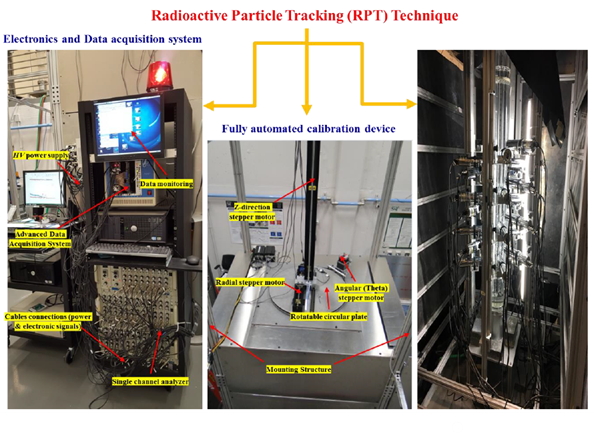
Figure Caption: The Radioactive Particle Tracking (RPT) Technique.