2025 AIChE Annual Meeting
(184o) Durable, Thermally Stable, Plant-Based Moisture-Protective Wax Coatings
Authors
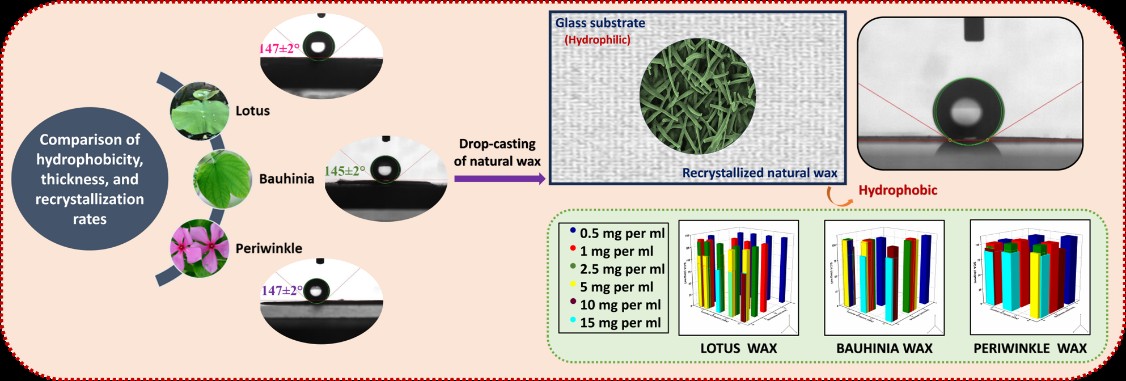
Lotus leaves, Bauhinia leaves, and Periwinkle flower petals, were found to have respective wax yields in order of 0.18 mg/cm², 0.021 mg/cm², and 0.018 mg/cm². The solid wax obtained was then used to prepare individual wax solutions of different concentrations. The wax solutions of each concentration were drop cast separately onto cleaned glass substrates and allowed to recrystallize for 35 days before performing further characterization.
Among the three, wax derived from Lotus leaves demonstrated the most promising results. Lotus wax coatings formed nanorods resembling natural Lotus leaves, while Periwinkle and Bauhinia waxes failed to replicate their natural micro/nano structures. Lotus wax coatings exhibited a static contact angle (SCA) of ~150°, roll-off angle of ~8°, and self-cleaning properties. In comparison, wax coatings extracted from Periwinkle and Bauhinia sources did not replicate their native surface architectures as successfully. The resulting recrystallized surfaces lacked the hierarchical roughness required for superhydrophobicity. Consequently, these coatings showed significantly lower SCAs, averaging around 110°, indicating a more modest level of water repellency. The disparities in surface morphology and performance are likely attributed to intrinsic differences in wax chemical composition, molecular mass, intermolecular interactions, initial coating solution properties, wax distribution on the substrate, and molecular mobility during solvent evaporation and recrystallization. These factors highlight the need for further research to better understand the self-assembly processes governing natural wax behavior.
Despite the differences in surface texture and contact angles, all three wax coatings demonstrated impressive long-term durability and stability across various environmental conditions. The coatings preserved their original WCA values for up to 180 days, indicating excellent temporal stability. They also remained thermally stable after exposure to elevated temperatures up to 100 °C. Chemically, the coatings resisted degradation across a wide pH range from 2.6 to 11.5 and withstood the impact of 3000 water droplets without significant loss in water repellency. Additionally, the coatings had low moisture absorption rates: Periwinkle (5.5×10⁻⁴ wt.%/day) < Bauhinia (6.75×10⁻⁴ wt.%/day) < Lotus (1.075×10⁻³ wt.%/day). These low absorption rates indicate strong resistance to moisture permeation, further supporting their practical viability and making them ideal for applications like food packaging and protective wood finishes. In food packaging, they can prevent moisture infiltration, preserving freshness and preventing spoilage. As for wood finishes, they can create a moisture-repellent barrier that protects against swelling, warping, and fungal growth, enhancing durability.
This research illustrates that both hydrophobic and quasi-superhydrophobic surface characteristics can be successfully achieved by using wax extracts obtained from Lotus leaves, Bauhinia leaves, and Periwinkle flower petals. Among the three, wax derived from Lotus leaves exhibited superhydrophobic properties along with self-cleaning performance, attributed to its ability to form well-defined nanostructures during recrystallization. In contrast, waxes extracted from Bauhinia leaves and Periwinkle petals, although having comparatively lower water contact angles, demonstrated greater resistance to moisture absorption over time, highlighting their effectiveness in minimizing water uptake under humid conditions. The findings also emphasize that the functional performance of wax-based coatings can vary significantly depending on the source and specific composition of the wax. As such, by modifying and optimizing parameters such as wax concentration, layer thickness, recrystallization duration, it becomes possible to finely tune the surface properties of these natural coatings. This level of customization enables the creation of functional coatings that are tailored to specific application needs—whether prioritizing high water repellency, reduced moisture permeability, or a balance of both.
Taken together, the outcomes of this study underscore the considerable potential of naturally derived waxes as environmentally friendly and renewable alternatives to synthetic water-repellent coatings. Their impressive performance, combined with long-term stability, thermal and chemical resistance, and adaptability, positions them as highly promising candidates for use in a wide range of practical applications. These may include moisture-resistant packaging materials, protective biomedical coatings, and formulations for cosmetic products, where effective management of water interaction is essential. The sustainable nature of these bio-based coatings further enhances their appeal for future developments in green material science and surface engineering.
For further reading: https://doi.org/10.1021/acsabm.4c01672