2025 AIChE Annual Meeting
(301b) Does Seeding Always Preserve Solid Form? Cross-Nucleation Study of ?- and ?- Glycine
Authors
During primary nucleation, as new crystals are formed from solution, there is a possibility of different solid forms being generated concomitantly. However, the mechanisms governing secondary nucleation and their influence on polymorphic outcome remain poorly understood. In the literature, two main mechanisms have been proposed to explain the origin of secondary nuclei based on mechanical impact and fluid shear effects. Secondary nucleation induced by mechanical impact suggests that new crystals arise from the detachment of fragments from parent crystals due to collision-induced attrition or breakage, with the resulting crystals typically retaining the solid form of the seed unless a solvent-mediated transformation occurs. Alternatively, secondary nucleation induced by fluid shear suggests that solute clusters displaced from the boundary layer surrounding a growing crystal can give rise to nuclei of a different solid form. The ability to distinguish between these two mechanisms is crucial for developing a deeper understanding of the interplay between crystal nucleation, growth and polymorphism.
In this study, we employed a "seed-on-a-stick" technique [3] to isolate the effects of fluid shear on secondary nucleation by fixing a pre-washed single glycine crystal within a supersaturated solution under isothermal conditions. Both metastable α-glycine and thermodynamically stable γ-glycine crystals were used for seeding. Experiments were conducted in agitated vials using a Crystalline platform with in situ imaging and transmissivity measurements. Control and unseeded experiments were also conducted under the same conditions to assess the contribution of alternative nucleation pathways. Control experiments tested whether nucleation occurred due to external surfaces introduced into the solution in the process of seeding, while unseeded experiments evaluated the influence of primary nucleation in the crystallization vessel.
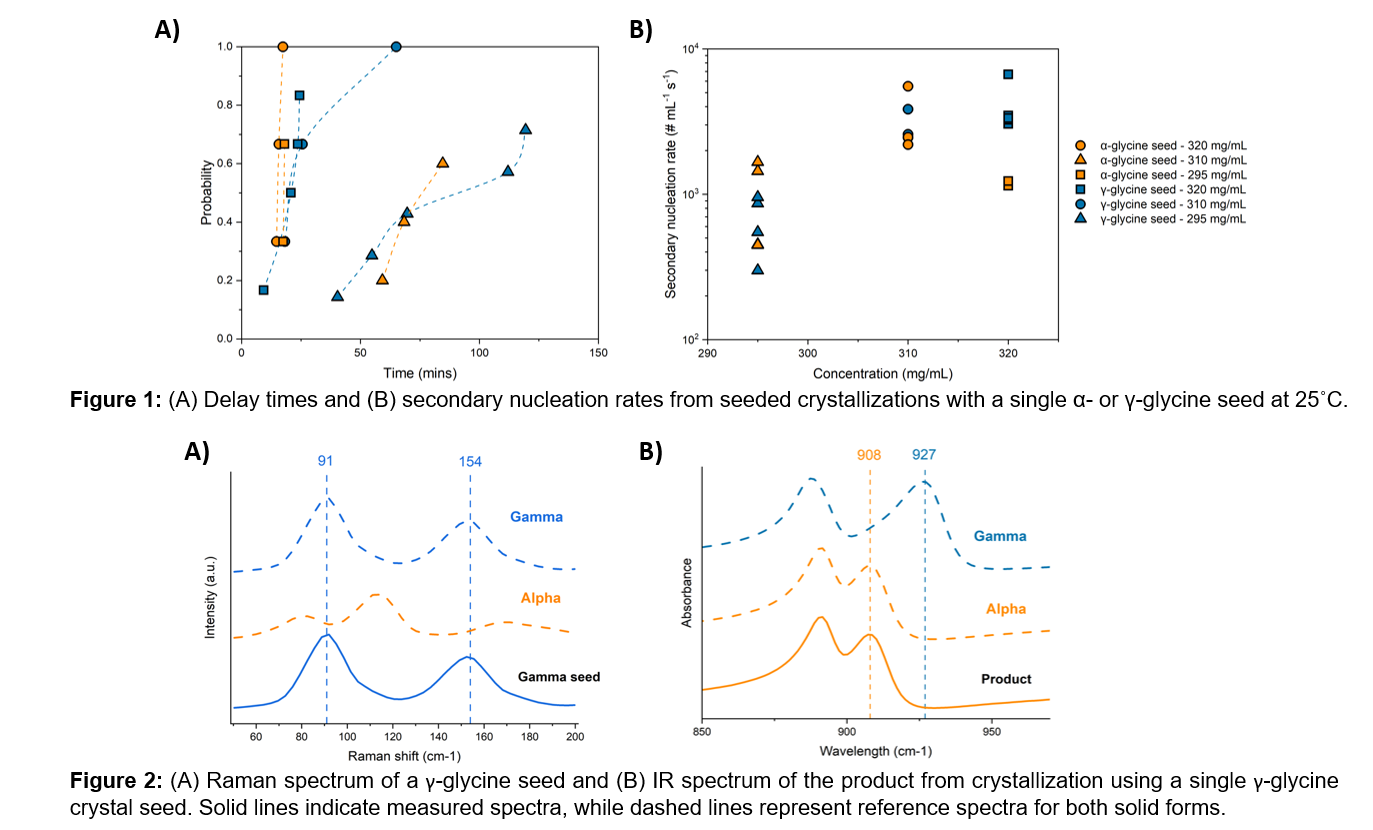
Delay times between seed introduction and the onset of crystallisation in seeded experiments and induction times in control and unseeded experiments were determined from transmissivity measurements. Delay times in seeded experiments were found to be significantly shorter than induction times in control and unseeded experiments, confirming that fluid shear alone was sufficient to induce secondary nucleation.Secondary nucleation kinetics were estimated using time dependence of particle number density obtained from in situ imaging using Crystalline image analysis. No significant differences in delay times or nucleation rates (see Figure 1) were found between α- and γ-glycine seeds. However, α-glycine crystals were always produced irrespective of the solid form of the seed crystal used. This was confirmed by spectroscopic analysis comparing the seed and crystallized product, where cross-nucleation was observed with stable γ-glycine seeds, which consistently yielded metastable α-glycine crystals as shown in Figure 2.
Overall, our results demonstrate that fluid shear alone can drive secondary nucleation of glycine for both α- and γ-glycine seeds. Seeding with γ-glycine lead to cross-nucleation, where α-glycine crystals were produced, challenging the assumption that seeding always preserves the solid form of the parent crystal. These findings highlight the critical role of fluid shear in crystallisation processes and polymorphic selectivity, underscoring the need to further refine seeding strategies. A deeper understanding of secondary nucleation mechanisms can enhance crystallization process development and improve polymorphic control in pharmaceutical manufacturing.
References
1) Cui, Y. and Myerson, A.S. (2014). Experimental evaluation of contact secondary nucleation mechanisms. Crystal Growth and Design, 14(10), pp. 5152–5157.
2) Yu, L. (2007). Survival of the fittest polymorph: How fast nucleater can lose to fast grower. CrystEngComm, 9(10), 847–851.
3) Cashmore, A., Georgoulas, K., Boyle, C., Lee, M., Haw, M. D., & Sefcik, J. (2024). Secondary Nucleation of α-Glycine Induced by Fluid Shear Investigated Using a Couette Flow Cell. Crystal Growth and Design, 24(12), 4975–4984.