2025 AIChE Annual Meeting
(307a) Disease Screening Pills: Oral Administration of Dual Near-Infrared Imaging Agents Using a Mouse Model for Breast Cancer Screening
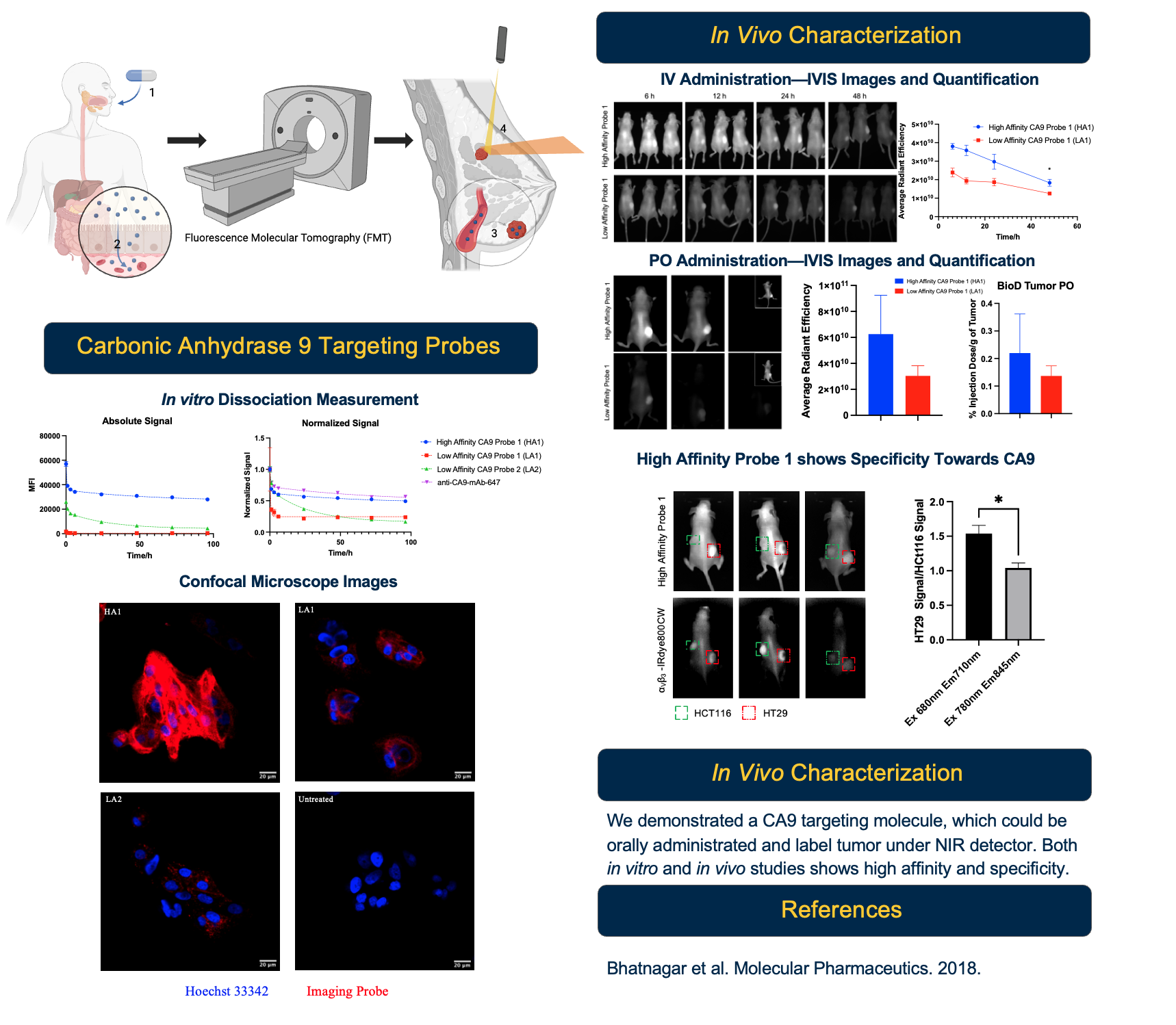
Early detection of breast cancer can dramatically increase survival rates, and annual screening increases the chance of early detection. Traditional cancer detection depends on blood tests to gather molecular information or imaging methods such as X-rays for anatomical differences from normal tissue. Molecular imaging surpasses conventional cancer screening by providing both site-specific molecular information and spatial locations. However, the high cost, ionization radiation risk, long acquisition times, and IV injection of most contrast agents make molecular imaging an unfeasible candidate for annual screening. Therefore, developing a cost-effective and lower-risk method for screening is preferred. This study designed a new near-infrared fluorescent carbonic anhydrase 9 (CA9) targeting molecule as an oral administration contrast agent for fluorescent breast cancer screening. The challenge for oral contrast agents is the balance of molecule properties: high lipophilicity and low molecular weight favor oral bioavailability, whereas high molecular weight and low lipophilicity can facilitate efficient targeting and reduce off-target effects. Previous work from our group developed the first oral breast screening pill (αVβ3-IRdye800CW) targeting αVβ3 integrin, which has sufficient oral absorption and contrast to successfully image tumors in a mouse model of breast cancer. However, the potential false positive caused by benign tumors or blood vessels could limit its specificity, so we developed a second agent to improve its application. By selecting the malignant tumor-associated marker CA9 and designing the molecular and optical properties for use with the integrin probe, the new imaging agent shows high specificity and high affinity with low off-target binding. With ~8% oral bioavailability, the imaging molecule is sufficient for in vivo oral delivery and imaging. Oral coadministration of αVβ3-IRdye800CW and this new agent in HT-29 (CA9+, αVβ3+) and HCT116 (CA9-, αVβ3+) tumor-bearing mice demonstrated that the designed agent is an optimal second probe for dual imaging in breast cancer screening.