2025 AIChE Annual Meeting
(290a) Discovery and Uses of Radioactive Materials: Building Literacy and Awareness through a New General Education Course for Students with No Prior Nuclear Experience
Author
Catherine Brewer - Presenter, New Mexico State University
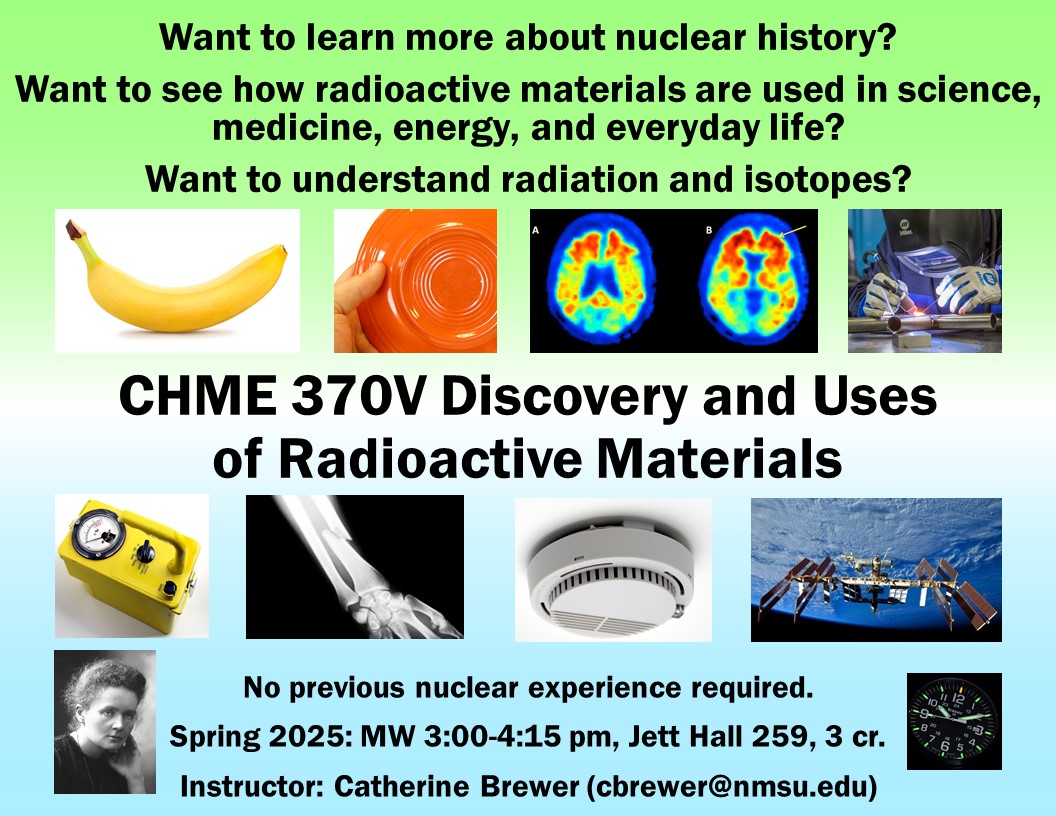
The CHME 370V: Discovery and Uses of Radioactive Materials course was developed as part of the NuChemE Pipeline project’s educational components to expand the range of disciplines participating in the nuclear chemical engineering minor. The course was proposed and accepted in 2024 as a new “Viewing the Wider World” (VWW) course option for the College of Engineering, and taught for the first time in Spring 2025. (A general education requirement for bachelor degrees at New Mexico State University is that all students take two VWW courses, at least one of which must be in a college outside of their major.) The course is intended to raise awareness and increase nuclear literacy among students of all majors. Topics include radioisotopes in the history of science (late 19th century-early 20th century), everyday life, weapons development during WWII and the Cold War, the four generations of nuclear reactors for power, medicine (diagnostic tracers, cancer treatments), industry (radiography, sterilization applications), space operations, and research. Weekly “Technical Practice” exercises familiarize students with radioisotope basics, balancing nuclear reactions, converting between units, working with very small/very large numbers, and putting radiation exposure risks into context. Students prepare comparison essays on the impacts of specific radioisotope discovery/production/use on three different communities, and the perspectives for uses of radioisotopes in three different countries. The culminating course deliverable is a team research project and presentation for “Radionuclide of the Year” to highlight important roles of radioisotopes. The presentation will include examples and lessons learned from the course’s first implementation with students from engineering, chemistry, humanities, and business for consideration by other institutions working to help more graduates “speak nuclear”.