2025 AIChE Annual Meeting

(197b) Direct Propylene Epoxidation By Water Oxidation on PdPtOx Electrocatalysts

Authors

Jason Adams - Presenter, University of Illinois Urbana-Champaign
Minju Chung, Massachusetts Institute of Technology
Kalipada Koner, California Institute of Technology
Benjamin Moss, California Institute of Technology
Chenyu Jiang, California Institute of Technology
Emma Cosner, California Institute of Technology
Yuriy Román-Leshkov, Massachusetts Institute of Technology
Karthish Manthiram, Massachusetts Institute of Technology
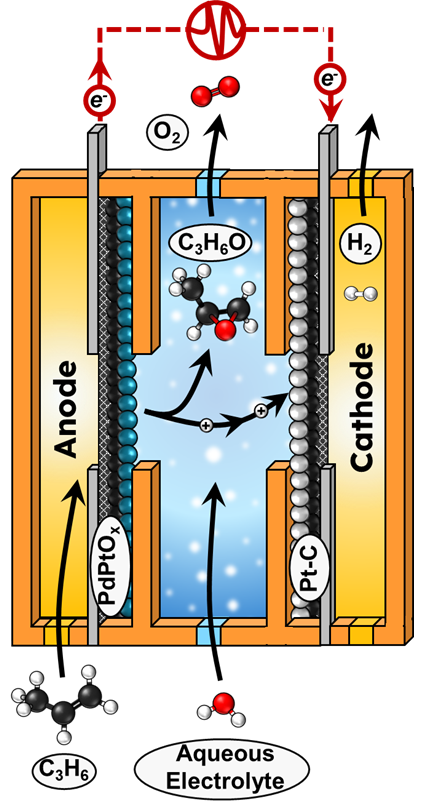
Direct electrochemical propylene epoxidation shows promise in displacing incumbent routes of epoxidation involving hazardous and costly oxidants (peroxides, chlorine) while using renewable electricity. Equimolar Pd and Pt maximize partial current densities and faradaic efficiencies (FE) of propylene oxide formation, greatly exceeding the performance of monometallic PdOx or PtOx. Increasing oxidation temperatures of Pd1Pt1 increases epoxidation FE non-monotonically, maximized at 500°C. This temperature enriches an oxidic tetragonal phase relative to a metallic face-center cubic phase, consistent with XAS showing a maximized Pt–O coordination. However, monometallic Pd and Pt catalysts treated 500°C exist primarily as PdO or metallic Pt, respectively. This conclusion agrees with XPS data showing that>85% of surface Pt exists in a 2+ oxidation state in PdPtOx. Thus, combining Pd and Pt stabilizes PtO-like structures, which are likely the most active sites for water oxidation and O-atom transfer to propylene.

Epoxidation rates increase with H2O concentration with a 2nd-order dependence, suggesting two water molecules participate in the kinetically relevant step (KRS), consistent with (H2O/D2O) kinetic isotope effects. Epoxidation rates increase sublinearly with C3H6 pressure (n=0.4-0.7), consistent with C3H6* species saturating the surface. Rates and FEs of epoxidation increase exponentially with potential in aqueous electrolytes with Tafel slopes of 102 mV dec-1, consistent with one-electron transfer to the most abundant reactive intermediate in the KRS. These findings agree with a mechanism involving the adsorption of H2O and C3H6 to the surface of PtO active sites, which oxidize by sequential proton-coupled electron transfer steps (OH*→O*→OOH*→O2). The KRS, however, likely involves the oxidation of O* to OOH* by two H2O molecules, in which the fate of OOH* determines the selectivity of forming C3H6O or O2 by distinct charge transfer steps. Overall, we elucidate the activate phase of PdPtOx and determine the reaction mechanisms of epoxidation, leading to record epoxidation rates and FEs.