2025 AIChE Annual Meeting
(571b) Direct Carbonylation of Glycerol with CO2 to Organic Carbonates Catalyzed By Zinc Oxide/Zirconium Oxide
Authors
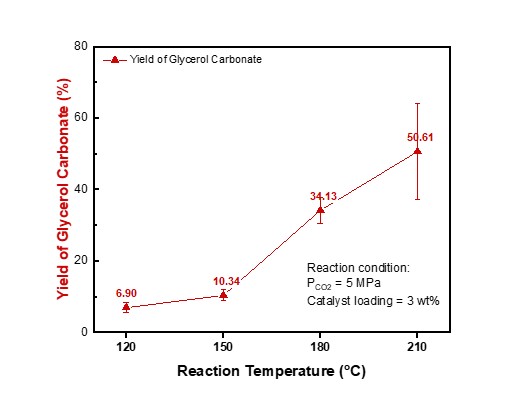
ZnO/ZrO2 catalysts were synthesized with the incipient wetness impregnation method to facilitate the reaction. Specifically, Zn(NO3)2·6H2O was used as the precursor, while ZrO2 served as the support. ZnO was loaded onto ZrO2 via the wet impregnation method, forming a ZnO/ZrO₂ catalyst. The catalyst was characterized using various analytical techniques, including XRD, SEM, EDS, Nitrogen physisorption analyzer, CO₂-TPD, and ICP-OES. The yield of glycerol carbonate was adopted as the response variable, while the optimal reaction condition was sought via the response surface methodology (RSM) with a central composite design (CCD) [3]. Explicitly, a quadratic polynomial equation to describe the yield of glycerol carbonate was obtained by fitting the experimental data. The optimal condition was thus extracted from the established further verified with independent sets of experiments performed in the proximity to the optimal condition.
References:
[1] Liu, J. and D. He, Transformation of CO2 with glycerol to glycerol carbonate by a novel ZnWO4-ZnO catalyst. Journal of CO2 Utilization, 26, 370-379 (2018).
[2] Lukato, S., Kasozi, G.N., Naziriwo, B., Tebandeke, E. Glycerol carbonylation with CO2 to form glycerol carbonate: A review of recent developments and challenges. Current Research in Green and Sustainable Chemistry, 4, 100199 (2021).
[3] Montgomery, D.C., Design and Analysis of Experiments. 2012: Wiley.