2025 AIChE Annual Meeting
(646e) Dimensionless Numbers Defining the Onset of Dispersed Phase Flow Transitions in Microfluidic Flow-Focusing Devices
Authors
Purushottam Soni, Texas Tech University
Jihye Kim, Texas Tech University
Stefan Baier, Motif Foodworks
Michael Boehm, Motif FoodWorks, Inc.
Siva Vanapalli, Texas Tech University
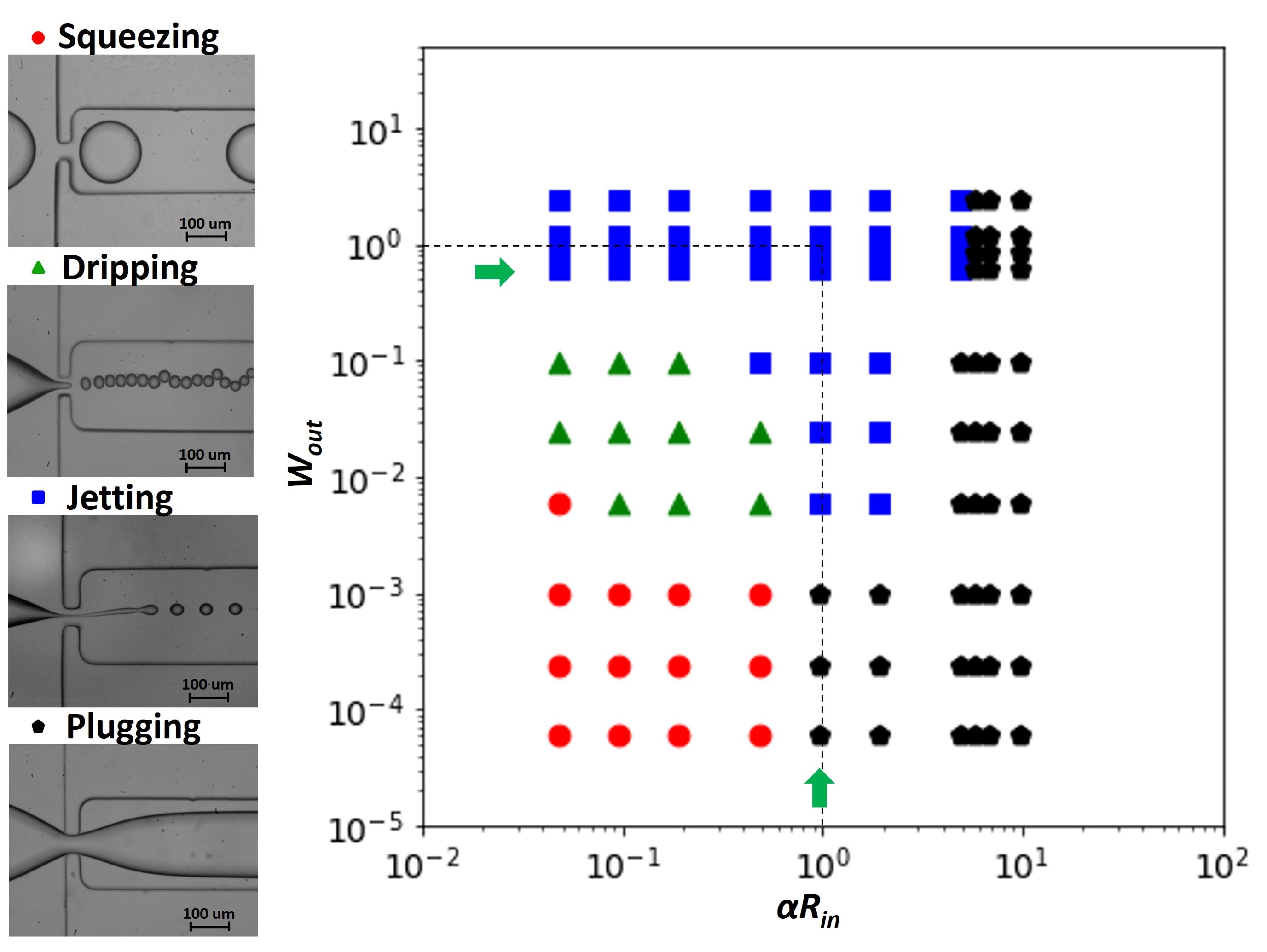
Microfluidic flow-focusing devices (FFD) play a crucial role in enabling precise control and production of emulsions, facilitating a wide spectrum of applications. Numerous studies have been conducted to investigate the flow behaviors in a flow-focusing device, such as squeezing, dripping, jetting and plug flow. Despite this identification, the parameters governing the transitions between these behaviors are not fully known. In this study, we observed dispersed phase transitions experimentally using microfluidic flow-focusing devices (FFDs) by scanning 1800 flow rate conditions spanning two FFDs, two wettability conditions, twenty fluid combinations, four emulsifier systems, and dispersed-to-continuous phase viscosity ratios of 0.03 – 30. Four major patterns of droplet breakup were observed namely, squeezing, dripping, jetting, and plugging. We found that these dispersed phase transitions across the broad can be described using two dimensionless numbers, Weber number based on the continuous phase Wout and Reynolds number based on the inner phase Rin. The squeezing to jetting and dripping to jetting transition occurred at Wout ~ 1. Similarly squeezing to plugging and dripping to plugging occurred at αRin ~ 1, where α is a viscosity dependent pre-factor. We compared our results to literature studies encompassing six FFD geometries, six surfactant systems, and a similar range of viscosity ratio, and find that the identified dimensionless numbers broadly capture the onset of dispersed phased transitions. Collectively, this study unifies a large body of datasets from FFD studies, simplifying the complex operating parameter space of emulsion generation into two dimensionless numbers that define the onset of disperse phase transitions.