2025 AIChE Annual Meeting
(65h) Diffusiophoresis Driven by Gradients of Nanoparticles and Their Counterions
Analogous to diffusion, diffusiophoresis is the motion of particles along the concentration gradient of a different solute type. One mechanism that can cause diffusiophoresis is a gradient in electrolyte concentration. This work seeks experimental evidence and characterisation of diffusiophoresis of colloids in multivalent electrolyte. Whilst this has been explored for small anions and cations of similar sizes, this work studies much larger anions of colloidal size, and thus uncovers a novel diffusiophoretic motion. The particular system studied is the diffusiophoresis of latex in a background dispersion of sodium-stabilised silica [1].
Using a Hele-Shaw cell – parallel plates separated by a narrow gap used for studying laminar flow – a thin layer of a latex dispersion in a sharp concentration gradient of silica nanoparticles is established by filling with three layers: water above a thin layer of latex dispersion above a silica dispersion. If the large latex particles were unaffected by the background concentration gradient, then they would be expected to diffuse symmetrically. Any asymmetry can be measured, and is evidence of diffusiophoresis. The quantification involves turbidity readings from backlit images of the flow cell.
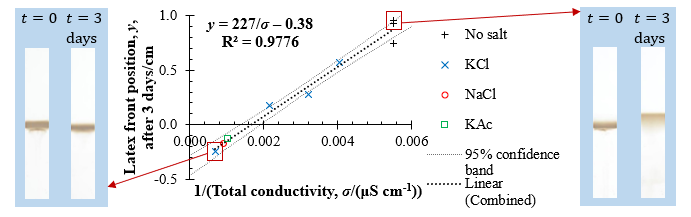
Control and test experiments have been run and analysed with silica and latex particles in different salt concentrations. The experiments show that the large latex particles move down a concentration gradient of small silica particles, which can be explained by diffusiophoresis. Reproducible motion of the latex concentration front with time, approximately following a t1/2 trajectory, is observed. The rate of this motion is inversely proportional to salt concentration, confirming an electrolyte-driven motion (see Figure 1). The evolution of the latex front position is consistent with theory for silica and its stabilising counterion causing the diffusiophoretic motion: a novel mechanism.
Our observation of nanoparticle-driven diffusiophoresis via an electrostatic mechanism suggests that prior studies of diffusiophoresis in binary mixtures of particles should be re-examined. When fully understood, such diffusiophoretic motion can be exploited to enhance particle motion within microchannels for lab-on-a-chip devices or to control particle arrangement in drying films [2,3].
Figure 1. Plot of latex concentration front position against 1/(Total conductivity). Example corresponding images are shown. Left: Addition of sufficient salt arrests the upward motion of the latex. Right: In the absence of background salt, the latex moves upwards over time.
References
[1] J. Colloid Interface Sci. 2023, 649, 364–371
[2] J. Fluid Mech. 2021, 928, A15
[3] IMA J. Appl. Math. 2024, 89(2), 343–373