2025 AIChE Annual Meeting
(571a) Development of Tandem Catalysts for CO2 Hydrogenation to Olefins
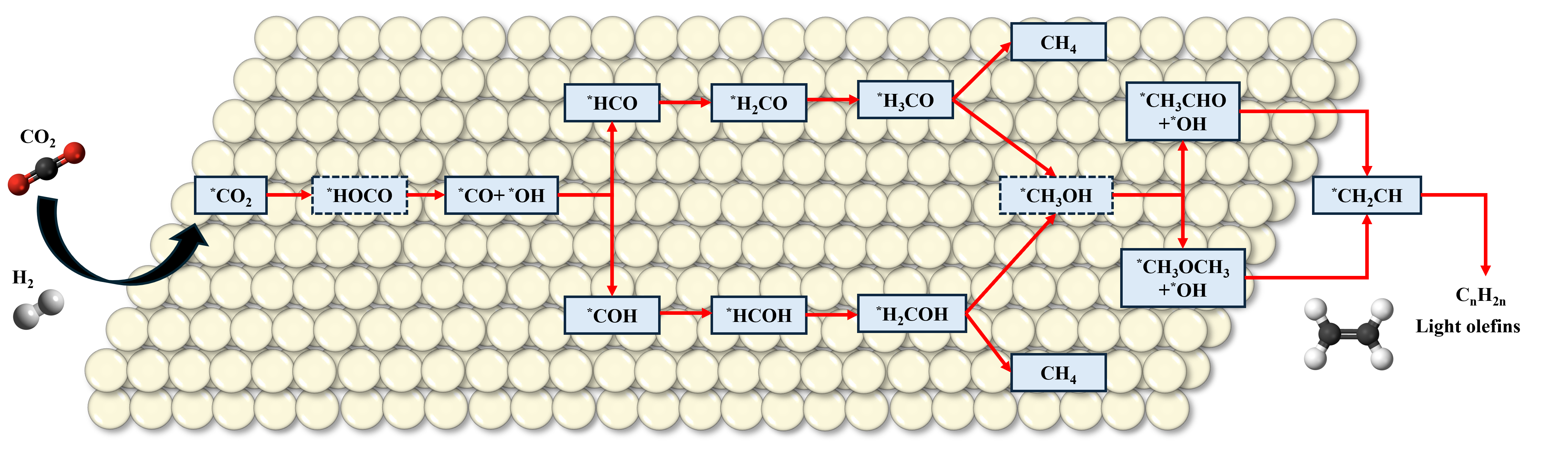
To elucidate the structural and chemical properties that underlie the catalyst’s efficacy, we employed a series of analytical and spectroscopic techniques, including X-ray diffraction (XRD), CO₂ temperature-programmed desorption (CO₂-TPD), Fourier transform infrared spectroscopy (FT-IR), scanning electron microscopy (SEM), in situ Raman spectroscopy, and Brunauer–Emmett–Teller (BET) analyses. The results confirm the presence of highly dispersed Zn and Fe₅C₂ sites, as well as the precise structural arrangement necessary for optimizing CO₂ activation and subsequent hydrocarbon formation. We also observed that the degree of participation of the RWGS route versus direct CO hydrogenation depends on the operating conditions, as the equilibrium limitations for the RWGS reaction strongly affect overall CO₂ conversion.
By strategically engineering the active phases and understanding their interplay in these tandem reactions, our approach offers a viable method for enhancing both conversion and selectivity. This work not only provides deeper insights into the fundamental steps governing CO₂ hydrogenation but also establishes a foundation for the design of next-generation catalysts geared toward sustainable chemical production. Our findings thus contribute to the broader endeavor of green chemistry by proposing a robust and generalizable route for the direct synthesis of value-added chemicals from CO₂.