2025 AIChE Annual Meeting
(669c) Development of a Mathematical Model for Continuous Counter-Current Chromatography
Authors
Eric Gottlieb, Lignolix
Robert M. O'Dea, Center for Plastics Innovation
Gregg T. Beckham, National Renewable Energy Laboratory
Hoon Choi, NREL
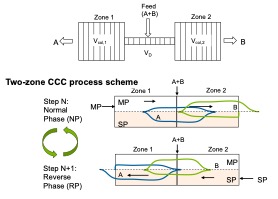
Counter-current chromatography (CCC) is a dynamic liquid-liquid chromatography method that employs a liquid stationary phase retained through the planetary motion of a rotor. CCC can efficiently separate products from one another by enabling normal mobile phase elution and reverse flow of the liquid stationary phase, in a technique called dual-mode elution. By taking advantage of flexible-flow principles, a true moving bed-type continuous CCC process can be realized with two columns, which is referred to as two-zone CCC. This setup (Figure 1) allows binary separations under appropriately tuned operating parameters such as pump flow rates and step times. However, determining optimal conditions often requires extensive trial-and-error experimentation.
To facilitate rational process design, we developed a mathematical model for two-zone CCC, based on our previously established Cell-Utilized Partitioning (CUP) model. This presentation will cover the developed model and its validation through comparisons with both literature data and experimental results from lignin oil fractionation. Furthermore, we will introduce the CUP Modeler, an open-source, user-friendly interface that supports streamlined process design and optimization of liquid-liquid chromatography processes across various operational modes.