2025 AIChE Annual Meeting
(244d) Detection of PFAS Chemicals to Monitor Household Water Systems
Authors
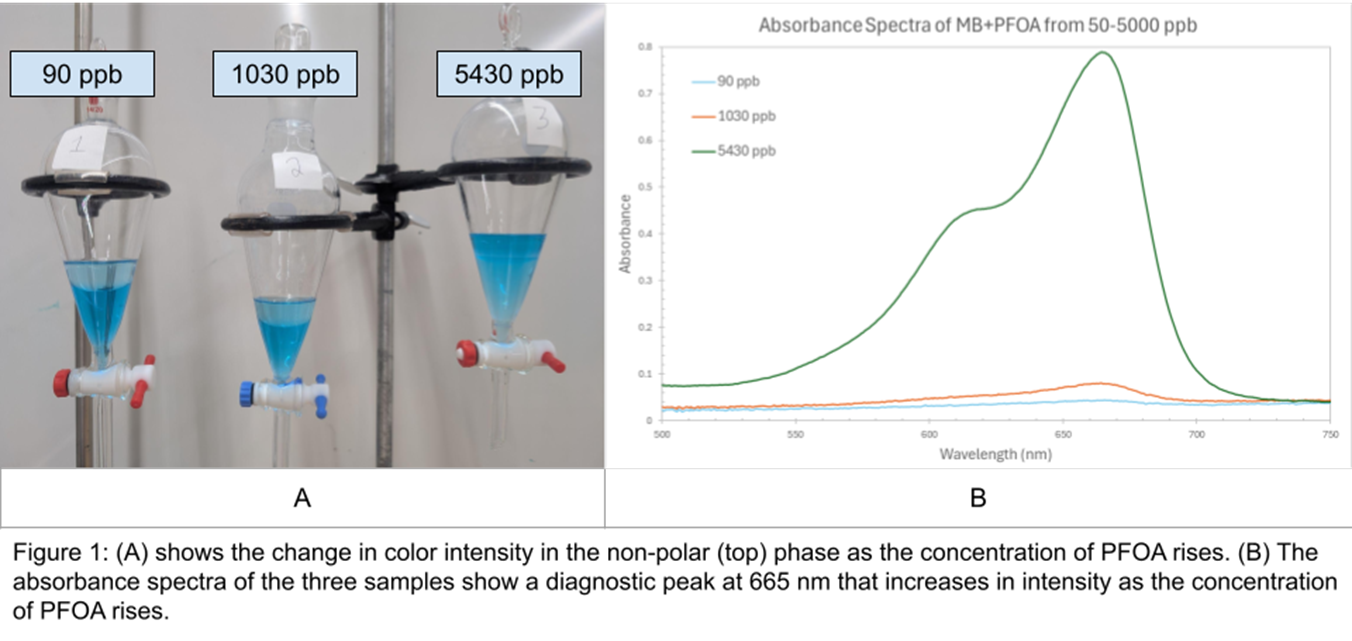
This research offers an efficient and convenient method for concentrating PFAS from a municipal water source followed by a colorimetric method for detecting levels of PFAS in the water. The colorimetric method uses methylene blue indicator, a common and readily available cationic dye that binds with anionic PFAS polar head groups. The ion pair is subsequently extracted into a nonpolar solvent, tributyl phosphate. Accuracy of the colorimetric measurements will be compared with samples tested by LC MS-MS. LC MS-MS is used in EPA Method 537 which defines the approved technique for the determination of concentration of PFAS chemicals in water [3].
We will demonstrate a small adsorbent column that can connect to most typical household faucets and isolate PFAS that is present in the water stream. We will show the different results from various adsorbents and different water flow rates. Preliminary results using PFOA suggest that colorimetric detection will be possible in the 50 to 5000 ppb range. The adsorbent column will be responsible for concentrating the PFAS chemicals in the water stream three to four orders of magnitude to reach this range. This method is a quick and easy technique for acquiring results that can be a supplement to LC MS-MS. This is a robust method that municipalities or organizations could use to make repeatable measurements that estimate a useful approximation of the concentration.
References:
1. Bartell, S. M., Calafat, A. M., Lyu, C., Kato, K., Ryan, P. B., & Steenland, K. (2010). Rate of Decline in Serum PFOA Concentrations after Granular Activated Carbon Filtration at Two Public Water Systems in Ohio and West Virginia. Environmental Health Perspectives, 118(2), 222–228. https://doi.org/10.1289/ehp.0901252
2. United States Environmental Protection Agency. (2024). PFAS National Primary Drinking Water Regulation. EPA Fact Sheet. https://www.epa.gov/system/files/documents/2024-04/pfas-npdwr_fact-sheet_general_4.9.24v1.pdf
3. Shoemaker, J. AND Dan Tettenhorst. (2020). Method 537.1 Determination of Selected Per- and Polyfluorinated Alkyl Substances in Drinking Water by Solid Phase Extraction and Liquid Chromatography/Tandem Mass Spectrometry (LC/MS/MS). U.S. Environmental Protection Agency, Washington, DC. https://cfpub.epa.gov/si/si_public_record_report.cfm?Lab=NERL&dirEntryId=348508