2025 AIChE Annual Meeting
(521c) Designing Supported Metal Nanoparticle Catalysts Leveraging Hydrogen Bonding Interactions and a New Class of Supramolecular Supports
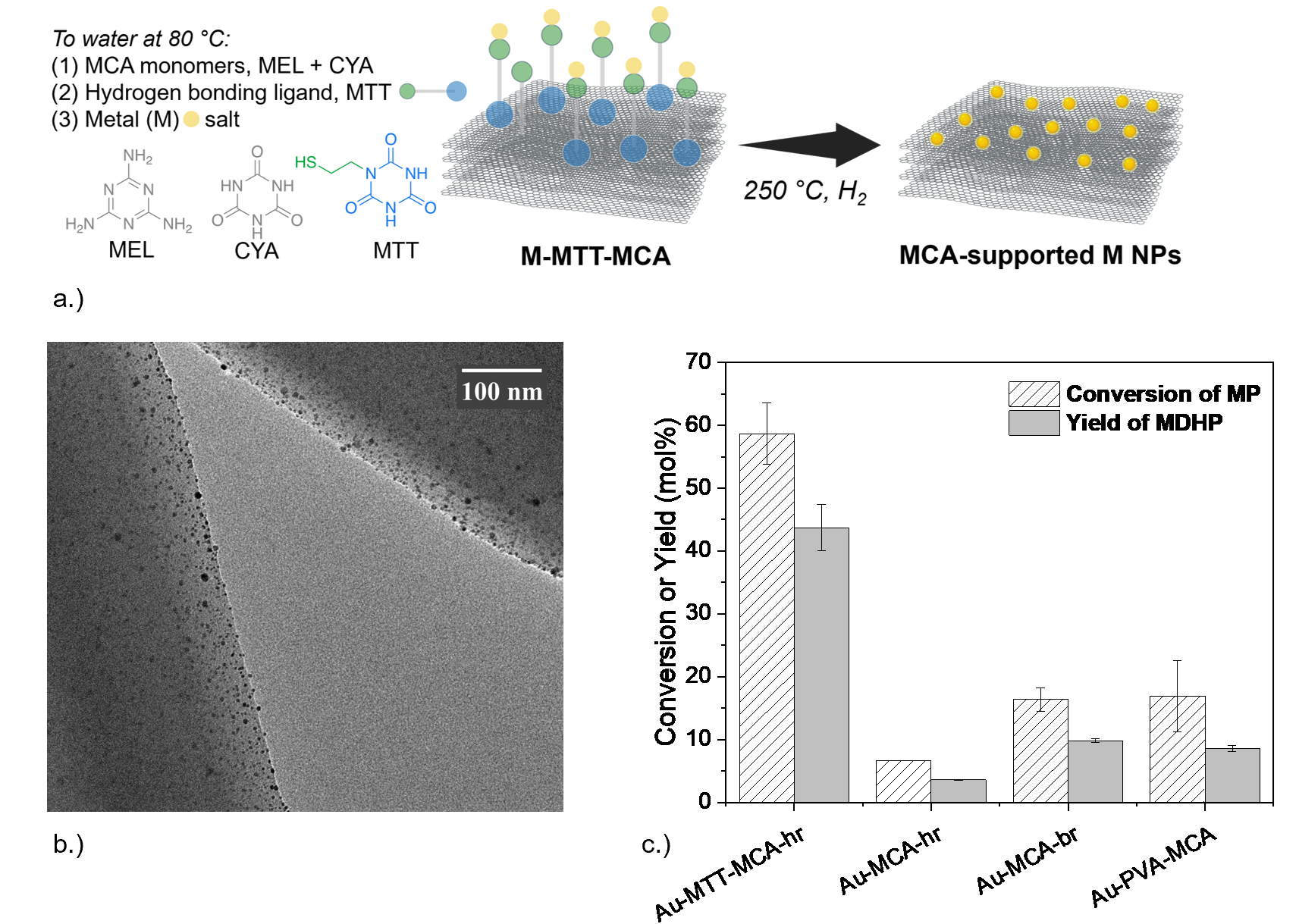
To sidestep these challenges, in this talk, we will present a new synthetic protocol to functionalize a supramolecular support, melamine cyanurate (MCA), with metal NPs leveraging hydrogen bonding interactions at mild conditions (aqueous solvent, 80 °C). We show that by using a functionalized N-heterocycle ligand, MTT (Figure 1a), we can anchor and disperse metal precursors onto the MCA support at the thiol functionality, and obtain small, uniform, and highly dispersed ~3 nm NPs upon thermal treatment in H2 (Figure 1b). We will show that MCA-supported Au NPs prepared in this way outperform conventional synthesis methods in the aerobic oxidation of piperidone as a model test reaction (Figure 1c). High-resolution XPS analysis reveals that while the Au NPs and MCA lack SMSIs, the Au-MCA interface redistributes charge in the N and O atoms in MCA that may contribute to impressive NP stability, even in the absence of SMSIs and/or ligands. Finally, we will demonstrate how this approach generalizes to creating NPs of different size and with different compositions. More broadly, we expect this to outline a versatile strategy to preparing supported NP catalysts with highly tailored properties, leveraging hydrogen bonding interactions as a design lever.