2025 AIChE Annual Meeting
(553d) Designing Soft and Tough Multiple-Network Elastomers: Impact of Reversible Radical Deactivation on Filler Network Architecture and Fracture Toughness
Authors
Aaliyah Dookhith - Presenter, The University of Texas at Austin
Zidan Zhang, The University of Texas at Austin
Venkatraghav Ganesan, The University of Texas at Austin
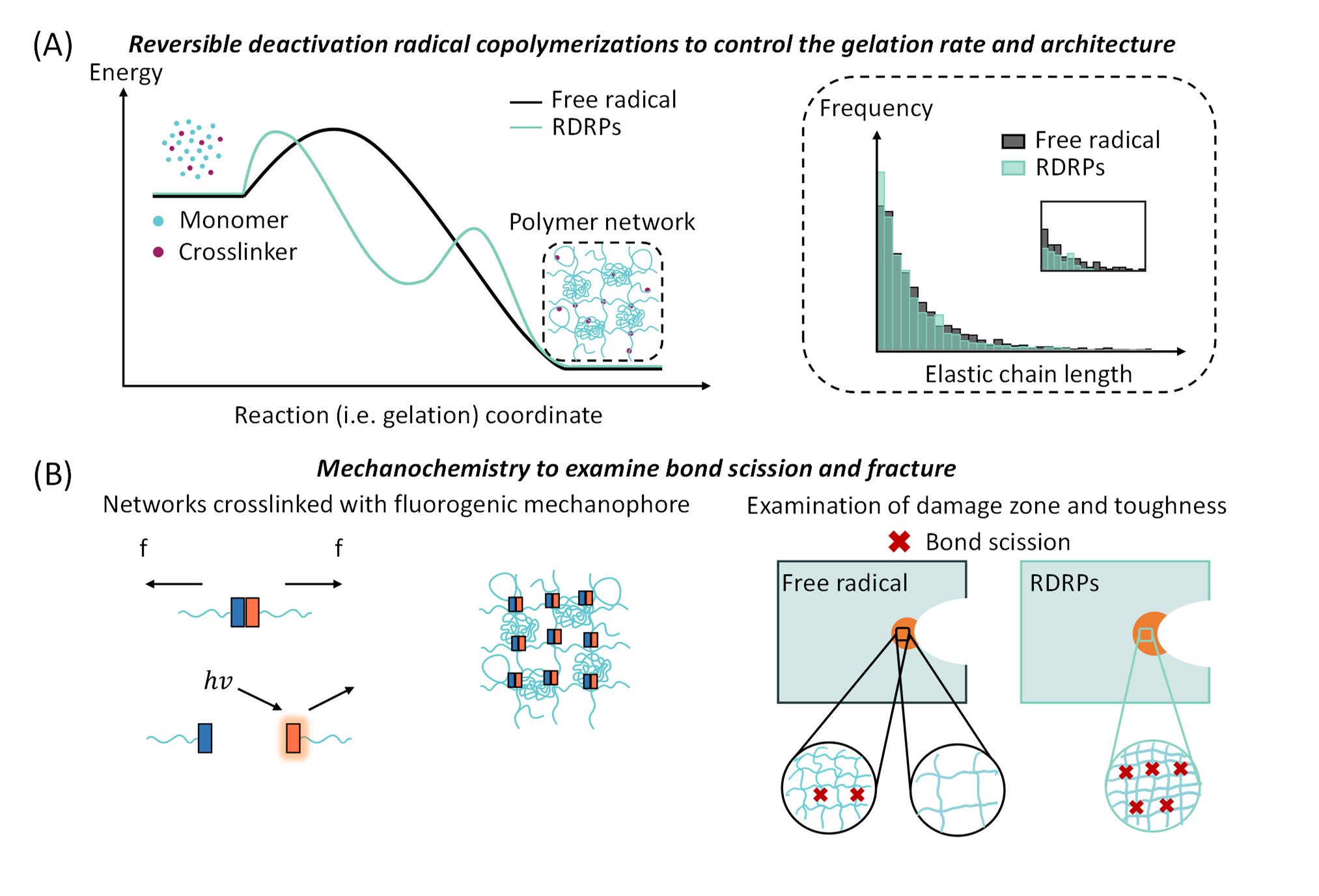
Polymer networks are crucial for engineering and biomedical applications. However, their excessive brittleness under negligible viscoelastic dissipation, limits their use in applications requiring high temperatures and water concentrations. Multiple-networks, consisting of a stiff and pre-stretched “filler” network embedded within a soft and extensible “matrix” network, could address this limitation. However, the relationship between their “filler” network architecture and fracture toughness remains unknown. In this study, we investigated this question by synthesizing three poly(ethyl acrylate) “filler” networks through free radical polymerization (FRP), RAFT, and ATRP, incorporating fluorogenic mechanophores at the crosslinking points to assess the interplay between “filler” network architecture, irreversible chain breakage, and fracture. These networks had similar elastic chain densities but distinct distributions and mesoscopic structures. They were used to prepare multiple-networks, whose structure and mechanical properties were evaluated using mechanical testing, confocal microscopy, reactive Monte-Carlo (RMC) and coarse-grained molecular dynamics (CGMD) simulations. Our results reveal that “filler” networks synthesized by RAFT and ATRP result in more brittle multiple-networks than those made by FRP primarily due to the reduced average extensibility of their “filler” network chains. Their narrower chain length distributions in the load-bearing phase promote strain hardening but compromise energy dissipation both through frictional interactions and irreversible chain breakage. Overall, these results underscore the need for developing advanced gelation methods that offer control over the elastic chain distribution, as using RAFT and ATRP without such improvements may result in long curing times, opacity, and a higher tendency to initiate and grow cracks.