2025 AIChE Annual Meeting
(382bh) Designing Catalysts for Carbon Utilization: A Machine Learning and Computational Chemistry Approach
Author
Computational catalysis, heterogeneous catalysis, machine learning, deep learning, AI for material discovery, carbon utilization, Fischer-Tropsch synthesis, electrocatalysis, CO2 electroreduction, dilute alloy stability.
Abstract
Simple does not always mean easy. This holds in heterogeneous catalysis where, despite the apparent simplicity of many catalyst-driven reactions, inherent complexities such as variations in active sites, or intricated reaction mechanisms ultimately dictate experimental performance. Throughout my PhD studies, I have investigated these complexities using computational chemistry simulations to accelerate catalyst design, reduce trial-and-error experimentation, and enhance carbon utilization processes (electro- and thermo-catalytically).
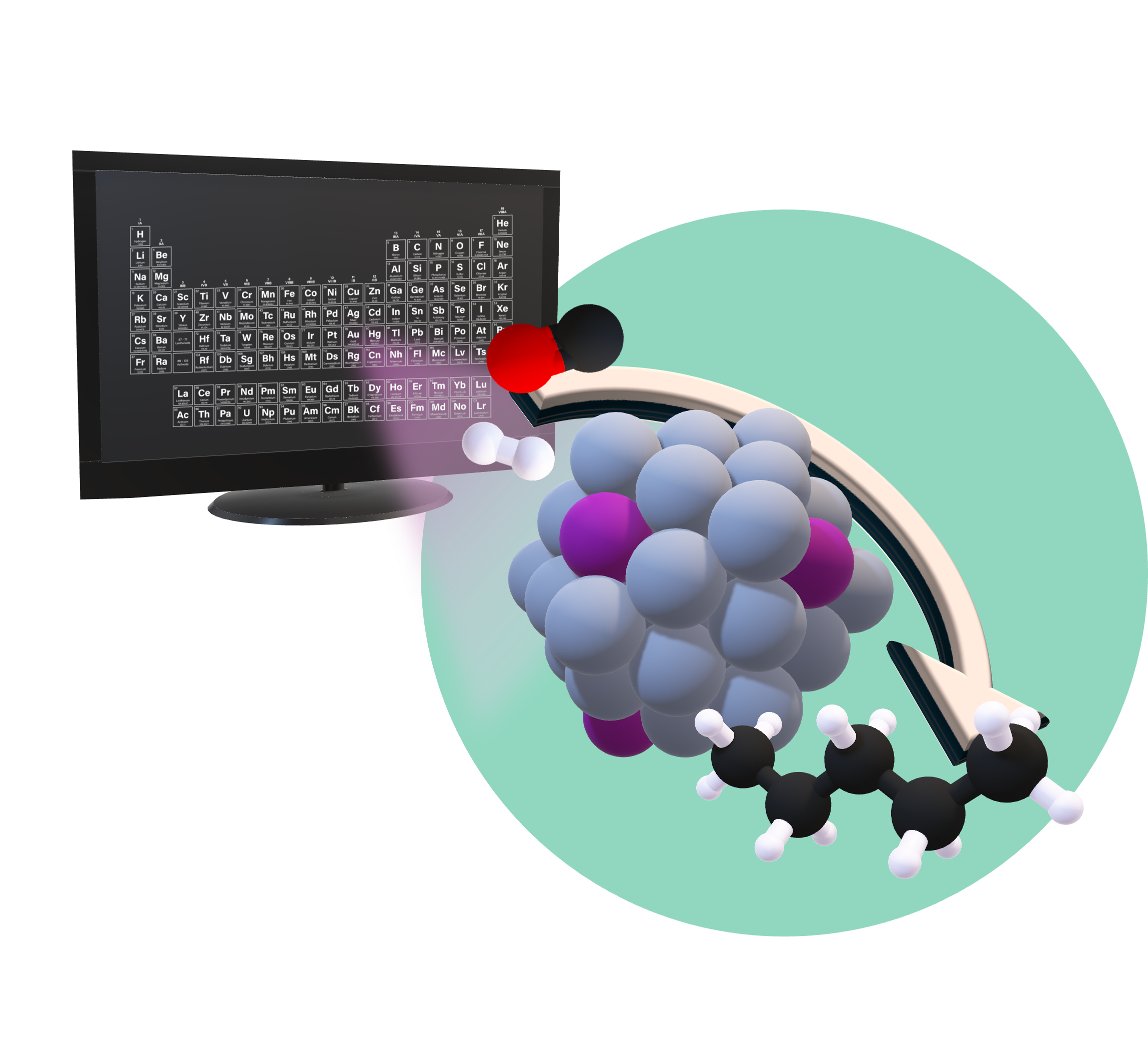
In this poster presentation, I will introduce some of my work designing single-atom alloy (SAA) catalysts, in which isolated atoms of an active promoter are dispersed on the surface of a more selective host. Our initial investigations focused on SAAs for the reactive separation of CO and CO2 mixtures through Fischer-Tropsch synthesis (FTS: CO + 2H2 → -(CH2)- + H2O), relevant for CO2 upscaling through the reverse water gas shift reaction (CO2 + 4H2 → CH4 + 2H2O). Density functional theory (DFT) calculations of oxygen-vacancy formation energies demonstrated the role of isolated Ru atoms in enhancing the reducibility of Ru-doped Co SAAs. Further comparisons of reaction energetics for selected FTS elementary steps revealed that the isolated Ru atoms do not enhance FTS kinetics. These observations were later verified through a series of characterization and temperature-programmed reactor experiments. Additional screening through DFT revealed V-doped and Re-doped Co SAAs to be cost-effective replacements for the Ru-doped SAA. Overall, the investigated SAAs were able to sustain a good catalytic performance while reducing the use of promoter metals by 90% compared to traditional, co-impregnated catalysts.
To extend our SAA work to other processes, graph neural network architectures, originally trained on intermetallic data, were fine-tuned using a small SAA dataset (fewer than 1,000 data points). This dataset included several combinations of coinage metal hosts (Cu, Au, Ag), transition metal promoters, and adsorbates, achieving highly accurate adsorption energy predictions. Besides accelerating SAA screening, this work highlights the effectiveness of transfer learning approaches to extend foundational catalysis models to small datasets.
Additional research experiences, which I will be happy to discuss further, include the investigation of electrode oxidation effects on the electrocatalytic reduction of CO2, as well as the role of grain boundaries in the oxidation of Cu nanoparticles under CO oxidation atmospheres. Beyond my scientific endeavors, I am also passionate about leadership, with past experiences in the Harvard World Model of United Nations and, currently, serving as the Young Professional Liaison of AIChE’s Management division. I look forward to collaborating with cross-functional teams and innovating in materials design, catalysis screening, and machine learning. More importantly, I am eager to be part of the next chapter of chemical engineering, maximizing process outputs and sustainability.
Skills
- Programming: Python (Pandas, NumPy, scikit-learn, PyTorch, Ray), R, computational chemistry, slurm, Bash, database management (SQL, Neo4j), Git, GitHub, MATLAB
- Computational modeling: DFT (CP2K, VASP, ASE, Pymatgen), Simulink, process modeling (AVEVA PRO/II), Fluid Dynamics (COMSOL), visualization (Blender, Pov-Ray)
- Machine Learning: Deep learning, graph neural networks, Bayesian linear regression, decision trees, gradient boosting
- Languages: Spanish (native), English (fluent)
Selected Publications
A complete list of publications and oral presentations at national conferences can be found in my Google Scholar profile (https://scholar.google.com/citations?user=B962iIEAAAAJ&hl=en).
* = Corresponding author | † = Equal contribution ORCID: 0000-0003-0777-3316.
- El Berch, J., Salem, M., and Mpourmpakis*, G. Advances in Simulating Dilute-Alloy Nanoparticles for Catalysis (minireview). Nanoscale. 2025, Advance Science. DOI: 1039/D4NR03761H
- Nilsson, S.*, El Berch, J., Albinsson, D., Fritzsche, J., Mpourmpakis, G.*, and Langhammer, C.* The Role of Grain Boundary Sites for the Oxidation of Copper Catalysts during the CO Oxidation Reaction. ACS Nano. 2023, 17, 20, 20284-20298. DOI: 1021/acsnano.3c06282.
- Liu, R.†, El Berch, J.†, House, S., Meil, S., Mpourmpakis, G.*, and Porosoff, M.* Reactive Separations of CO/CO2 Mixtures over Ru-Co Single Atom Alloys. ACS Catalysis. 2023, 13, 4, 2449-2461. DOI: 1021/acscatal.2c05110.