2025 AIChE Annual Meeting
(370a) Design and Synthesis of Polymer Membranes Based on Theoretical Principles: Part II
Authors
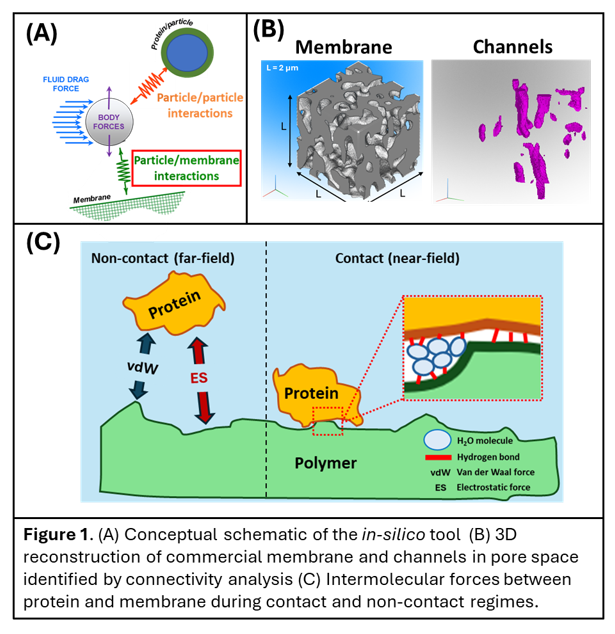
The in-silico tool comprises computational particle drag mechanics combined with particle/membrane force measurements in aqueous solutions that are modeled by the DLVO theory to measure particle intrusion and capture in polymer membranes (Fig. 1A). We previously demonstrated that the 2D in-silico tool predictions for a commercial membrane exhibited substantial flow channeling and negatively affects selectivity (Sorci et al. (2020) JMS, 594). This tool is now extended to 3D and used to quantify channeling, i.e., regions in the pore space corresponding to velocity outliers, and identify and calculate connectivity parameters.
We have conducted extensive intermolecular force measurements between streptavidin coated on a polystyrene sphere, and two commercial hydrophilized microfiltration poly(ether sulfone) and poly(vinylidene difluoride) membranes. These force measurements were performed under various conditions of pH and ionic strength. The 3D microstructure of a commercial microfiltration membrane was obtained through focused ion beam–scanning electron microscopy (FIB-SEM). A new class of membranes with tunable pore size and low channeling were synthesized from microspheres using a bottom-up approach.
In-silico studies on the reconstructed commercial PVDF membrane showed the presence of channels extending in length nearly 4 times the mean pore size (Fig. 1B). From intermolecular force measurements, we found that hydrogen bonding is the key contributor to protein-polymer membrane adhesion after the removal of adsorbed interfacial water (Fig. 1C). in-silico analysis of fused microsphere membranes revealed low channeling, narrow PSD and improved selectivity. Further, experimental testing of these membranes revealed the potential for exhibiting higher selectivity and permeability than commercial membranes of same mean pore size.
Acknowledgments: Part of this work was supported by Pall Corp., MilliporeSigma and Belfort’s RPI endowed chair fund. Surya Karla thanks Howard P. Isermann for first year graduate student fellowship at RPI.