2025 AIChE Annual Meeting
(3hz) The Design and Discovery of Nanoporous Materials for Energy Applications: A Computational Lens
Author
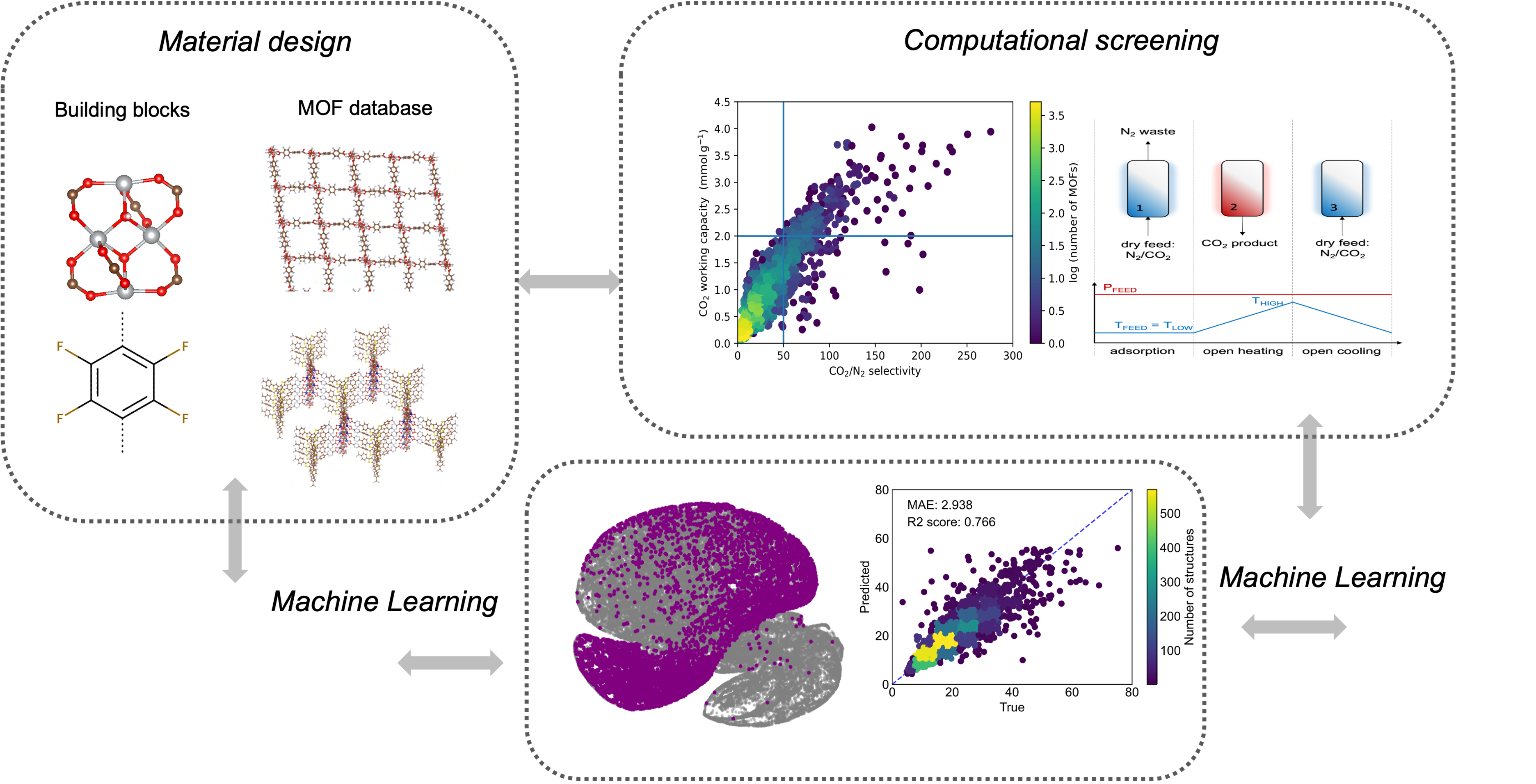
My research interests lie at the intersection of fundamental molecular simulations and their practical application in addressing pressing industrial challenges, particularly in the realm of sustainable energy materials. This involves a balanced approach, considering both the overarching "big picture" of energy dominance and the crucial, smaller scientific questions that drive innovation. As part of my toolbox, I am keen on understanding, applying, and advancing a range of molecular simulation techniques, including Monte Carlo (MC) and Molecular Dynamics (MD), as well as leveraging the power of machine learning (ML) through supervised, unsupervised, and reinforcement learning methodologies. Furthermore, I am interested in accelerating ab initio calculations through the deployment of machine learning interatomic potentials (MLIPs) to advance material design and high-throughput screening efforts, ultimately leading to industry-applicable solutions. My focus areas within industries include the oil and gas, steel, and cement sectors, with a particular emphasis on understanding and mitigating their different flue gas emissions for effective carbon avoidance strategies. Recognizing the multidisciplinary nature of this challenge, I aim to actively collaborate with industry specialists to ensure the feasibility and impact of developed solutions. This vision aligns with the broader goal of AI-driven material discovery for sustainable energy applications such as hydrogen storage [8], lithium/sodium-ion batteries [1-2], carbon capture[6,8-9], and photocatalytic water splitting [3,4].
For instance, a curiosity that lurks in my mind and something I believe is a very important research question in the gas adsorption community is how the different components of a real industrial flue gas would affect the gas adsorption/separation performance of a material that has been identified as a promising candidate from a screening study [9]. This would require us to calculate multicomponent—CO2/N2/H2O/SOx/H2S/NOx adsorption isotherms with reasonable accuracy and estimate the resultant performance metrics of the material such as working capacities, selectivities, purities. What makes this even more challenging is the estimation of the molecular interactions between these different components and the materials with a forcefield--H2O and SO2 being highly polar gases would have a complex interaction mode with a nanomaterial, especially for the Coulombic interaction part. This leads to another interesting research question: could we fine-tune current machine learning interatomic potentials (with few DFT-level data points since they are very expensive to compute) to accurately compute the interactions between the polar gas components and the nanoporous materials?
Personally, I have a long-standing aspiration to dedicate a significant portion of my career to advancing climate change mitigation technologies such as the ones mentioned above. I believe in the strength of my candidacy due to a unique and humble perspective that combines a drive for scientific advancement with a commitment to giving back to our society and planet. This approach has helped me learn and contribute through several journal and conference publications, invited talks and seminars, science communication and public outreach activities. Through this approach, I was also fortunate enough to be adjudged the World Champion in FameLab International 2020, where I had only three minutes to present my PhD research work. My style of work is adaptable, having had the opportunity to thrive both independently and collaboratively within a team environment. I genuinely enjoy creating and working within team environments, where I strive to maintain a balance between the collective success of the team and the individual growth of its members. Ultimately, through my research, I aim to link the behavior of atoms at the microscopic scale to their performance in macroscopic industrial settings, across different energy sectors.
Teaching Interests
Over the course of my academic journey starting from India to Europe and the United States, I have developed a genuine passion for teaching. I have had the privilege of instructing both undergraduate and graduate students in a range of subjects, including chemical engineering thermodynamics, molecular simulations, and machine learning for chemistry and chemical engineering. During my Ph.D., I was responsible for designing the curriculum for a new doctoral course on Computational Methods in Chemistry and Chemical Engineering, which was especially significant during the pandemic, as it gave experimental researchers an accessible entry point into the computational domain of research. These diverse teaching experiences have enriched my perspective on pedagogy and helped me understand the varying needs of students at different academic levels.
Throughout my teaching career, I have taken on a variety of roles that have enriched my ways of teaching as well as my understanding of the subject. At IIT Kanpur, I was responsible for setting and evaluating exams for a graduate-level thermodynamics course Fluid Phase Equilibria under the National Programme on Technology Enhanced Learning (NPTEL) framework, which highlighted the importance of effective assessment methods in higher education. As a Teaching Assistant (TA) at EPFL, I was actively involved in tutorial sessions for a Master’s course on Understanding Advanced Molecular Simulations, and in designing course content for a Bachelor’s Computational/Modeling laboratory. I have also supervised a Master’s thesis on the Computational Design Of Conductive Metal-Organic Framework Structures. My curiosity in teaching activities also led me to participate in a fun team-activity with my labmates as part of a hackathon. This ultimately led to a publication that throws light on how we can incorporate and leverage large language models in our coursework [7].
Beyond delivering subject-specific knowledge, I enjoy teaching broader life skills by encouraging hands-on projects like the Chem-e Car competition, where students learn real-world applications of classroom concepts as well as essential teamwork and problem-solving skills. Personally, I found that actively engaging in teaching hours—helping students with questions and leading group discussions—deepened my own understanding of molecular simulations and helped form ideas to advance the field. Moreover, I am interested in offering a course to students on enhancing their research presentation and knowledge transfer skills, which I believe are very important components of a student/researcher’s life. Moving forward, I remain comfortable teaching both undergraduate and graduate courses in the chemical engineering curriculum, particularly in the areas of thermodynamics, molecular simulations, and machine learning.
References
- Machine learning accelerated tailoring of nanopores for Li/Na-ion diffusion, S Majumdar, S Roy, K Jun, M. Steiner and R Gomez-Bombarelli, Under preparation, (2025)
- Machine learning interatomic potentials for modeling phenomena in solid-state batteries”, K Phuthi, S Majumdar,...,R Gomez-Bombarelli, S Ong, Under preparation, (2025)
- Exploring the chemical space of metal-organic frameworks for photocatalysis, B Mouriño#, S Majumdar#, X Jin, F McIlwaine, J Van Herck, A Ortega-Guerrero, S Garcia, and B Smit, Chemical Science, accepted (2025), (#Equal contribution)
- Assessment of fine-tuned large language models for real-world chemistry and material science applications, J Van Herck, KM Jablonka, MV Gil,.. S Majumdar,.. B Smit, Chemical Science, 16 (2), 670-684, (2025)
- Nonuniform chiralization of metal–organic frameworks using imine chemistry, BÁ Novotny, S Majumdar, A Ortega-Guerrero, KM Jablonka, E Moubarak,..., and B.Smit, ACS Materials Au 5 (3), 491-501(2025)
- Inverse design of metal-organic frameworks for direct air capture of CO2 via deep reinforcement learning, H Park#, S Majumdar#, X Zhang, J Kim, and B Smit, Digital Discovery, 3, 728-741, (2024) (#Equal contribution); 2024 Digital Discovery highly cited article
- 14 examples of how LLMs can transform materials science and chemistry: a reflection on a large language model hackathon, KM Jablonka,.. S Majumdar, B Smit et al., Digital Discovery, 2, 1233-1250, (2023)
- Diversifying databases of metal-organic frameworks for high-throughput computational screening, S Majumdar, SM Moosavi, KM Jablonka, D Ongari, and B Smit, ACS Applied Materials & Interfaces, 13, 51, 61004–61014, (2021)
- Adsorptive separation of CO2 from multicomponent mixtures of flue gas in carbon nanotube arrays: a grand canonical monte carlo study, S Majumdar, M Maurya, and JK Singh, Energy & Fuels, 32, 5, 6090-6097, (2018)