2025 AIChE Annual Meeting
(392bn) Democratizing Experimental Design: A User-Friendly Doe Software for Experimental Information Analysis
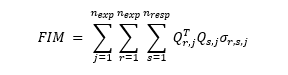
Where and represent the sensitivity matrices for the responses r and s in the j-th experiment, and is the measurement error covariance between responses r and s in the j-th experiment. The major drawback of MBDoE and FIM-driven methodologies is that they require an in-depth understanding of their underlying statistical principles to be implemented correctly. This statistical complexity creates a significant barrier to entry for many researchers who lack specialised training in experimental design methods, limiting the widespread adoption of these powerful approaches across different research fields. This work introduces XOpt, a software solution designed to democratize access to DoE methodologies and MBDoE methods by simplifying experimental design while maintaining key analytical capabilities. XOpt features an intuitive Graphical User Interface (GUI) that guides users with limited statistical and mathematical background through the experimental design process, from defining criteria and design spaces to selecting optimal experiments based on the desired goal.
Most importantly, the software allows users to easily incorporate both algebraic and differential models and to integrate DoE techniques with information analysis using the knowledge given by the mathematical model employed to describe the system under analysis. This analysis allows optimization of the experimental selection methodologies while retaining an explorative part in order not to be constrained to a local optimum. The software also offers the possibility to apply standard model-free methodologies, such as Latin Hypercube Sampling, without having to implement them from zero using software such as Python or MATLAB.
The software supports model discrimination through comparing multiple candidate model structures and quantifying their fitting performance and model complexity, uncertainty propagation, and FIM-driven experimental ranking (Galvanin et al., 2016; Galvanin et al., 2017), making advanced statistical tools accessible to researchers with limited statistical and mathematical backgrounds. The implementation enables efficient comparison of candidate model structures, and it identifies experiments that maximize the expected information gain. This approach streamlines the experimental selection process for model discrimination, parameter identification, and output uncertainty reduction making it fast, simple, and accessible without compromising analytical rigor. Future developments in the software will include integration with autonomous model identification platforms capabilities and implementation of robust MBDoE approaches.
References
Montgomery, D., C., “Design and Analysis of Experiments”, Jhon Wiley & Sons, Incorporated, 2017
Franceschini, G., Macchietto, S., “Model-based design of experiments for parameter precision: State of the art”, Chemical Engineering Science, Volume 63, Issue 19, 2008
Friso A., Galvanin F., “An optimization-free Fisher information driven approach for online design of experiments”, Computers & Chemical Engineering, Volume 187, 2024
Galvanin F., Cao E., Al-Rifai N., Gavriilidis A., Dua V., “A joint model-based experimental design approach for the identification of kinetic models in continuous flow laboratory reactors”, Computers & Chemical Engineering, Volume 95, 2016
Galvanin F., Psyrraki C., Morris T., Gavriilidis A., “Development of a kinetic model of ethylene methoxycarbonylation with homogeneous Pd catalyst using a capillary microreactor”, Chemical Engineering Journal, Volume 329, 2017,