2025 AIChE Annual Meeting

(639a) A Deep Learning-Guided Exploration of Sulfur Poisoning of High Entropy Alloy Catalysts

Authors

Madison Bird, Purdue University
Jeffrey Greeley, Purdue University
Many heterogeneous catalysts employed in industrially relevant reactions, such as hydrocarbon conversion, are susceptible to sulfur poisoning, typically induced by trace contaminants such as hydrogen sulfide (H2S) present in hydrocarbon feeds. The binding of these contaminants causes active site blocking and ultimately results in catalyst deactivation. Numerous strategies, such as alloying, have been explored previously to mitigate the pernicious effects of sulfur poisoning. For instance, it has been reported that Pt-Rh alloy catalysts are more sulfur tolerant than pure Rh in the context of partial methane oxidation. While prior experimental and computational studies have investigated the sulfur tolerance of bimetallic alloys, the combinatorial space of alloys beyond bimetallics is yet to be explored. Specifically, recent studies have demonstrated exceptional catalytic activity of multi-metallic high-entropy alloys (HEAs) for various thermal and electrochemical reactions. Moreover, HEAs have shown increased resistance toward oxidation and nitridation under reaction conditions. Their stability in the context of sulfidation is, however, yet to be investigated.

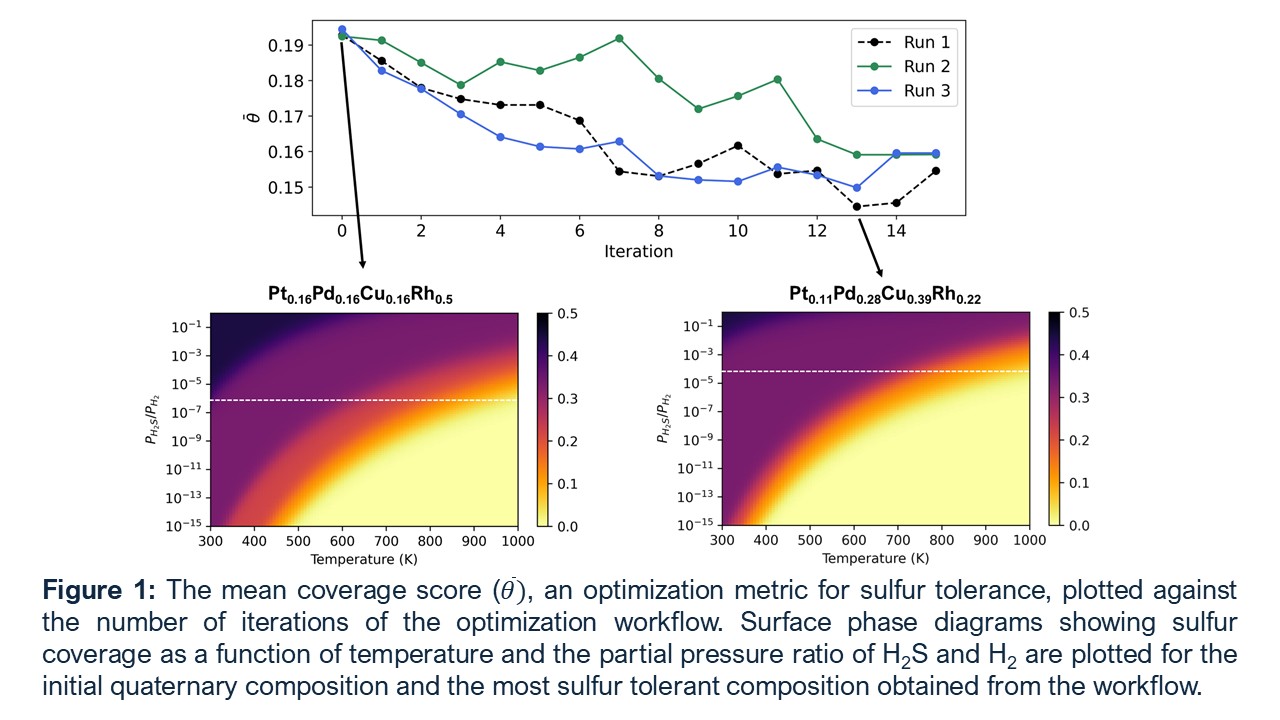
In this work, we analyze the sulfur poisoning characteristics of a quaternary alloy system consisting of Pt, Rh, Pd, and Cu using a deep learning-based framework. First, we introduce a multi-property graph convolutional network called SlabGCN to rapidly estimate binding energies of sulfur and surface energies of various disordered alloy configurations. Second, we train SlabGCN on DFT-estimated energetics of binary alloy configurations and show that it can reasonably extrapolate to ternary and quaternary configurations without incorporation of additional data. Third, we combine SlabGCN with a surface sampling algorithm to generate surface phase diagrams delineating sulfur coverage as a function of reaction conditions and elucidate important differences in sulfur binding characteristics between bimetallics and HEAs. Lastly, we employ SlabGCN as a surrogate model in an optimization workflow to discover a more sulfur tolerant alloy composition from a given starting composition.