2025 AIChE Annual Meeting
(4f) Deciphering the Multiphase Challenge of Tungsten Carbide for Carbon Dioxide Hydrogenation
Authors
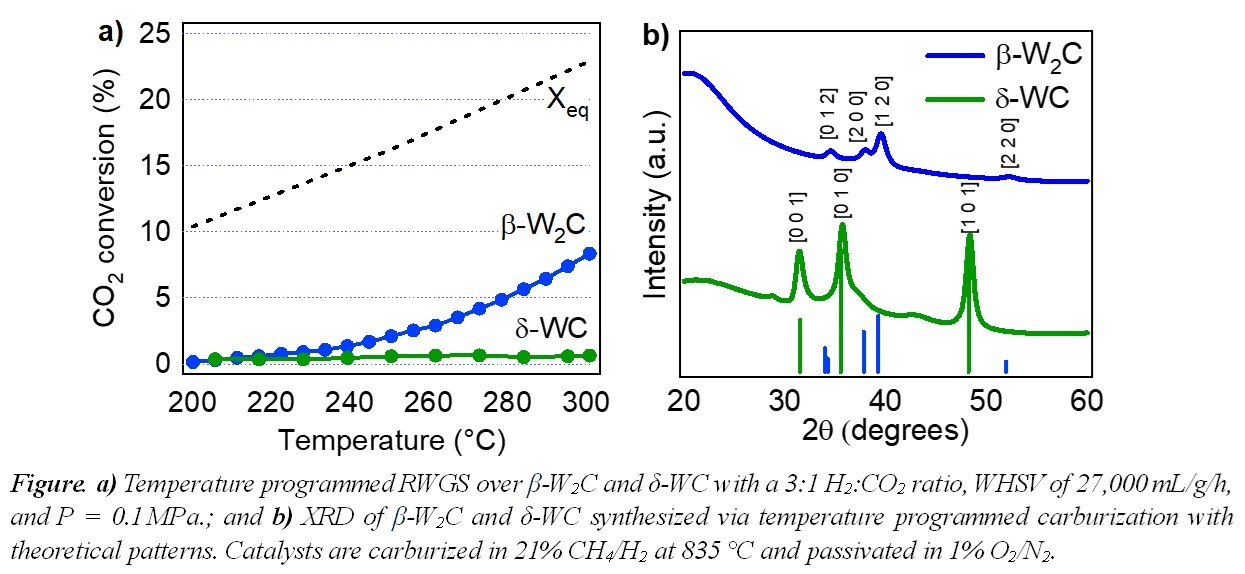
This study tackles the polymorphic complexity of WxC by refining synthetic approaches through temperature-programmed carburization (TPC). Phase-pure β-W2C is selectively synthesized on a silica support at 835 °C. TEM analysis shows uniformly dispersed β-W2C nanoparticles, aligning with computational studies that β-W2C is thermodynamically favorable at particle sizes ≤10 nm. X-ray photoelectron spectroscopy (XPS) indicates that the surface primarily consists of W2C (64%) and WO3 (36%), with the formation of tungsten oxide due to passivation, a necessary step because of the pyrophoric nature of TMCs. We also synthesize phase-pure hexagonal δ-WC by increasing the tungsten loading and carburization time, leading to larger agglomerates and more favorable conditions for accessing the thermodynamically favored bulk WxC phase. These findings are supported by X-ray diffraction (XRD) of the synthesized phases, highlighting successful control of synthesis parameters to achieve specific WxC phases.
Catalytic tests in a packed bed reactor support our hypothesis that β-W2C is the active phase for CO2 hydrogenation, evidenced by the performance of ex-situ synthesized β-W2C compared to δ-WC catalysts, after normalizing for tungsten content, Figure. Furthermore, in situ synthesized β-W2C exhibits higher catalytic activity due to the absence of inactive surface oxides formed during passivation. Our results address the challenges associated with the complex polymorphism in TMC-based catalysts, which are fundamentally and industrially significant and can likely be extended to the full TMC library.