2025 AIChE Annual Meeting
(3kl) Decarbonizing and Sustainability of Multi-Phase Reactor Systems: Bridging Fundamental Research and Scalable Innovation for a Sustainable Future
Author
My current role is a Research Collaborator in the Department of Chemical Engineering at the University of Illinois Chicago, USA with Prof. Meenesh R Singh. I am working towards DOE carbon negative shot by decarbonization of E-Crude synthesis from CO2 using electrochemical reactors and renewable energy sources. In addition to this, I am developing a high throughput fully automated screening system to screen multiple catalysts and reaction conditions for accelerating the discovery of novel catalysts and micro-kinetic environment for electrochemical CO2 conversion.
In my previous role as a Senior CAE specialist at Whirlpool corporation, I have developed nature inspired engineering solutions for energy efficient home appliances using experimental and computational efforts. The new designs help in achieving DOE efforts towards reduce energy consumption and sustainability of home appliances.
I completed my PhD in Nuclear Engineering from Homi Bhabha National Institute, India. My doctoral research was directed towards revolutionizing the design of passive safety systems for advanced nuclear reactor. In comparison to conventional design, the novel design developed in this research ensures (i) 40% enhanced heat transfer; (ii) complete mitigation of thermal stratification and (iii) uniform steam distribution inside the system. The new design was indeed possible due to an excellent understanding of turbulence phenomena and its role in controlling momentum and energy transfer. Key highlights from my research:
Research Interests
My research work is based on the theme of “From Nature For Nature”. The goal is to revolutionize the design of multi-phase reactors such as electrochemical reactors and home appliances to mitigate challenges such as decarbonization, reduced energy consumption and renewable energy sources.
The first reactor needs to be optimized is the electrochemical reactor for DOE carbon negative shot. The overarching goal here is to overcome challenges by establishing an automated and fully integrated system that combines CO2 capture and conversion into a single, sustainable, and more energy-efficient process. The central hypothesis based on preliminary results in the lab where unique high single-pass conversion system and proven CO2 capture technology will enable cost-competitive, carbon-negative ethylene production that can be further applied to the synthesis of other value-added chemicals such as ethanol. To achieve this goal, an integrated approach that combines multi-scale modelling of the process, including transport of reactant and product, materials and process optimization, and modular CO2 capture/conversion experiments using electrodialysis stacks, ultimately leading to design and assembly of modular, fully automated and scalable CO2 capture and conversion systems.
The second reactor category belongs to home appliances such as Dishwashers for DOE efforts towards reduce energy consumption and sustainability of home appliances. The objective here is to revolutionize the drying phenomena in dishwashers by employing nature inspired engineering solutions which ensures reduced energy consumption and enhance drying. The idea is to integrate smart materials such as thermos-responsive polymers on tub (steel/plastic) surfaces of dishwashers. These smart materials are capable of dynamically switching wettability based on stimulus such as temperature, pH, UV light, electric field, magnetic field and mechanical stress. The smart materials helps in achieving maximum condensation on tub surface and minimum retention of water on dish load items. In the presence of thermal polymer, the tub surface behaves as hydrophobic during the wash cycle and behaves as a hydrophilic material during the dry phase. The hydrophobic behavior during the wash cycle prevents the wetting of the tub surface and hence water jets will be directed towards dish load items for better wash performance. Whereas the hydrophilic behavior during the dry cycle leads to enhanced condensation on the tub surface and hence enhances drying in dishwashers.
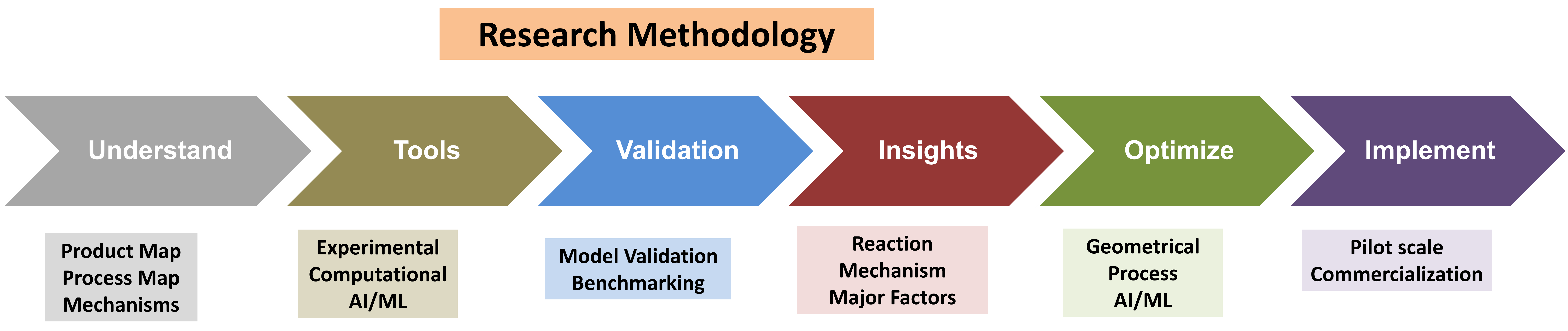
In both these reactors, the central theme is to optimize the design using advancements in experiments, computational, material science and machine learning. Once developed, the next step is to publish the work in reputed journals, filling patents and provide the knowledge to bigger community through releasing the developed models as an open source. I firmly believe that University-Industry partnership will play an important role in the commercialization of this technology. Therefore, the final step is to collaborate with industry people, policymakers and other funding agencies for successful commercialization of these technologies.
Industrial Research
In my previous role as a Senior CAE specialist at Whirlpool corporation, I have developed a system performance model for predicting the energy consumption and drying performance of dishwasher using 1D system code by getting insights from 3D CFD and experiments. This industrial experience gave me an opportunity to transform my previous research knowledge to design industrial equipment. I have worked upon variety of projects such as: (i) Transition to higher energy class in dishwasher; (ii) Reducing energy consumption and carbon footprints of home appliances; (iii) Develop nature inspired engineering solutions for improved and sustainable design of home appliances; (iv) Develop novel dishwashers with adsorbent drying technology and (v) Develop mini dishwasher for faster cleaning and water conservation using scrub clean technology. Further, I have developed a response surface models for optimizing the design of these appliances.
Science for Society
I have not restricted myself to academics only and made efforts to disseminate my research experience and knowledge for the benefits of society. In India, 30% of the total available energy is consumed in cooking only. Hence, there is a huge responsibility to optimize the cooking procedures and develop new technologies for achieving significant reduction in energy consumption and the environmental impact. Three billion people in the world still dependent on solid biomass fuel for cooking purpose having maximum achievable thermal efficiency using forced draft cook stoves is 35%. In addition to improved cook stoves, significant attention must be given to design of cooking vessels which consists of a fixed bed of solid particles (item to be cooked) at the bottom and free water at the top. In majority of the cases, bottom heating is used to cook food which results into Rayleigh-Bernard convection consists of multiple convective cells inside the vessel. The Rayleigh Bernard convection and resistance due to bed expansion create non-uniform temperature distribution inside the vessel which further results into non-uniform cooking. As a result, some portion of food remains uncooked or partially cooked known as dead zone. As the cooking progress, the size of this dead zone increases. Therefore, this research work focus on designing an energy efficient cook stoves and cooking vessels by developing advanced multiscale computational fluid dynamics (CFD) model consists of micro, meso, and macro-scale simulations. In this project, a multiphase eulerian two-fluid model was used to simulate the solid-liquid flow in the vessel and evaluate the influence of various geometrical parameters inside the vessel on elimination of dead zones and uniform cooking. The novel approach used in this project will result in revolutionizing the cook stoves design.
Teaching Interest
My vision for teaching emphasizes a balanced approach that integrates both traditional methods like using a chalkboard for personal interaction and newer technologies such as computer presentations for visual aids. This blend ensures that students receive comprehensive learning experiences that cater to different learning styles and preferences. Smart phones are powerful instruments that have become ubiquitous in today’s society, with smart phone ownership in the U.S. at 96% for adults in the age range 18-29 and 88 % for high schoolers Despite their constantly-improving computing and imaging capabilities, smart phones are underutilized as a tool for teaching and learning in STEM. Rather than discourage the use of phones in class, this project will develop hands-on lab activities that leverage phone cameras as microscopes and spectrometers to teach students about materials science and nanotechnology. In order to encourage student engagements, various methods like Q&A sessions, team activities, and mini-projects will be arranges. These activities not only encourage active participation but also enhance collaboration, critical thinking, and practical application of knowledge, thereby enriching the learning experience. Overall, my teaching philosophy focused on creating an inclusive and dynamic learning environment where students are motivated to engage deeply with the subject matter and take ownership of their learning journey.