2025 AIChE Annual Meeting
(360a) Control over Nanoparticle Dispersibility in Polymer Matrix Via Surface Modification
Authors
Keishi Suga - Presenter, Osaka University
Hikaru Namigata, Tohoku University
Tom A. J. Welling, Tohoku University
Kanako Watanabe, Tohoku University
Daisuke Nagao, Tohoku University
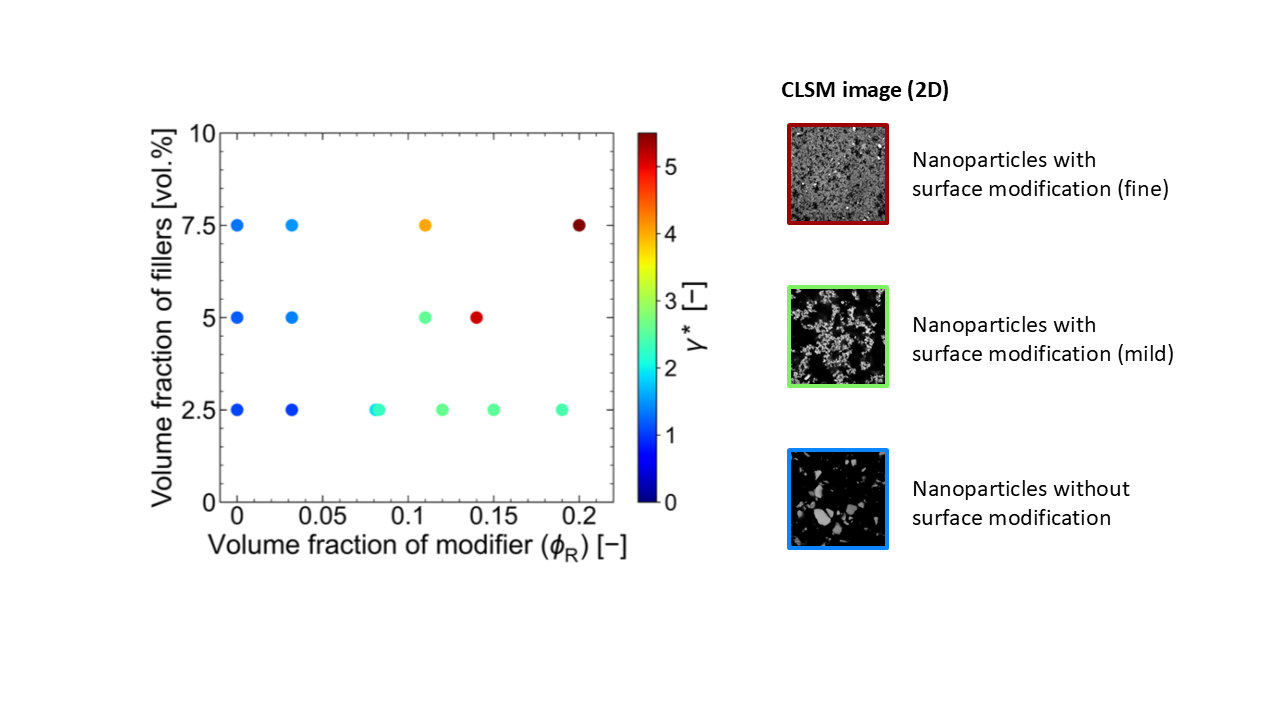
Oxide nanoparticles (NPs) such as silica nanoparticles (SiO2) are widely used to functionalize polymer materials. Basically, NPs easily aggregate in polymer matrix due to the lack of affinity, and the loading of NPs might rather detract from the functionalities of nanocomposites, such as homogeneity and mechanical property, when aggregates happen. The surface modification is one of promising approaches to control the surface property of nanoparticles [1]. In this talk, we report on the effects of the surface modification degree of NPs and loading amounts of NPs on the NPs’ dispersibility in polymer. The surface modification degree was quantitatively characterized by employing the volume fraction of modifier-to-particle (𝜙R). Polydimethylsiloxane (PDMS) nanocomposites were observed via a confocal laser scanning microscope (CLSM), then the particle dispersibility was analyzed by relative specific interfacial lengths (γ*). Without surface modification, large aggregates (size > 1μm) happened independent to loading amount. By increasing the surface modification degree, the particle dispersibility was improved. Based on the results, a correlation of surface modification degree, loading amount, and particle dispersibility is summarized in Figure 1.
[1] T. Mochizuki, S. Sampei, K. Suga, K. Watanabe, T. A. J. Welling, D. Nagao, Anal. Chem. (2024), doi:10.1021/ACS.ANALCHEM.3C03593.