2025 AIChE Annual Meeting
(287i) Comsol Multiphysics Modeling and Simulation of Dielectrophoretic Biotransport for High-Throughput Sorting of Tenogenically Differentiating Mesenchymal Stem Cells
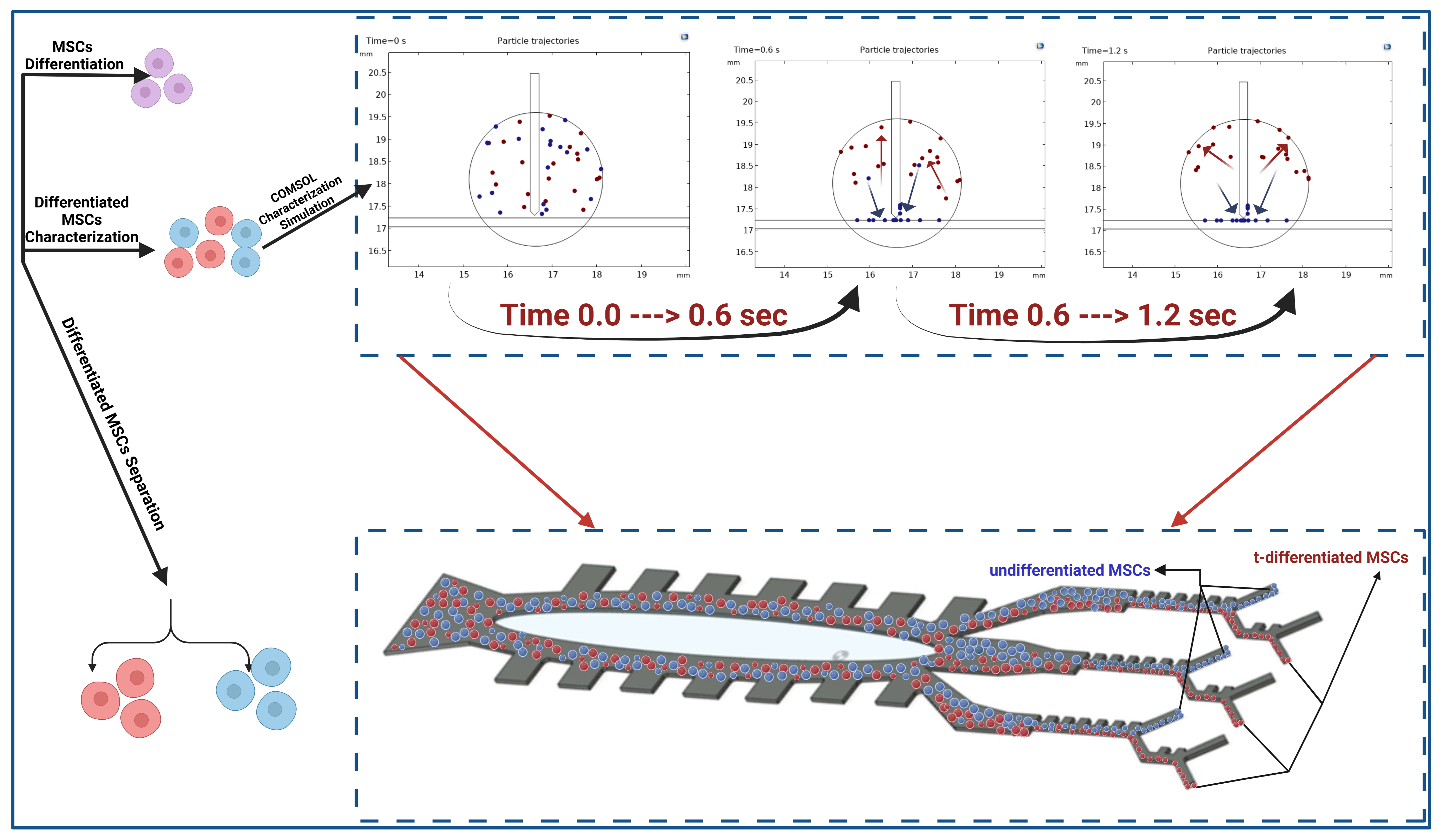
We are using the quantified dielectric signatures of differentiating tenogenic and non-tenogenic MSCs on the third day of differentiation using dielectrophoresis (DEP)—an electrokinetic method that uses nonuniform fields—reported in our preliminary study, which focused on their crossover frequencies, the frequencies at which the net DEP forces acting on the cells are zero. Here, we further estimated that the values for membrane capacitance, conductivity, and permittivity after 3-day treatment of undifferentiated cells to yield differentiated tenogenic MSCs are 2.46±0.1 pF, 0.82±0.01 S/m, and 1.97±0.05, respectively, and cytoplasm conductivity is 0.82±0.02 S/m. The estimated properties from the dielectrophoretic characterization are crucial in designing a DEP-based enrichment microdevice to collect homogeneous differentiated mesenchymal stem cell populations, i.e., tenocytes for tendon repair. Using particle tracing, creeping flow (transport of diluted species model), and electric current physics in the COMSOL Multiphysics simulation software package, we simulated the separation process within a two-stage microfluidic device operating at a sorting frequency of 160 kHz. The simulation results show that optimal separation efficiency and purity are achieved at an inlet velocity of 400 - 1000 µm/s, with specific voltage configurations, enabling recovery of one million t-differentiated MSCs in approximately 3 hours. Our results show a near-linear relationship between recovery time and particle count at the outlet boundaries and selected surfaces, indicating consistent throughput across varying conditions. This study demonstrates that DEP can offer a scalable, efficient, and label-free method for enriching MSC populations with high selectivity, enhancing more prospects for MSC-based tendon therapies and advancing the development of microfluidic sorting devices for regenerative medicine applications.
Biomaterials: Graduate Student Award Session (Invited Talks)
I kindly request that my abstract be considered for this prestigious award. Our preliminary results from this study have been published in a high-impact journal, and we are currently in the advanced stages of the research.