2025 AIChE Annual Meeting
Computational Investigation of Solubility and Solvation Energetics of Estradiol Using Molecular Dynamics
To investigate the molecular mechanisms governing solubility and solvation, we employed classical molecular dynamics (MD) simulations using OpenMM. The solubility of estradiol was explored using two complementary approaches: (1) direct calculation of solvation energy via energy differences between vacuum and solvent environments, and (2) estimation of Hildebrand solubility parameters from cohesive energy densities.
The solvation energy was calculated through three simulations: (1) the estradiol molecule in vacuum to obtain its intramolecular energy baseline, (2) a bulk solvent box (water or methanol) to determine the cohesive energy of the pure phase, and (3) estradiol solvated in that solvent to capture solute–solvent interactions. As a benchmark, the average potential energy per water molecule in a cubic TIP3P water box (3 × 3 × 3 nm³, ~887 molecules) was computed under periodic boundary conditions, with long-range electrostatics handled via Particle Mesh Ewald (PME) and hydrogen bond constraints applied. Langevin dynamics at 298 K combined with a Monte Carlo barostat ensured equilibration and production sampling. The resulting potential energy per water molecule, −9.59 kcal/mol, closely matches the literature TIP3P value of −9.86 kcal/mol, with a relative error of 2.74%, validating the simulation protocol.2
Hildebrand solubility parameters (δ) were computed for TIP3P water and methanol from three independent replicates. For water, δ = 46.802 MPa¹ᐟ², compared to a literature value of 47.8 MPa¹ᐟ², corresponding to a 2.09% relative difference.3 The 95% confidence interval, calculated from the replicate standard deviation, confirms good agreement and indicates that the energy-based approach provides a reasonable estimate of molecular cohesion. The methanol parameter is currently being calculated to further explore solvent selection for estradiol formulations.
Overall, this work demonstrates how molecular dynamics simulations, combined with classical solubility parameter analysis, can quantify solute–solvent energetics, guide solvent selection, and inform formulation strategies for poorly soluble hydrophobic compounds. By integrating direct solvation energy calculations and Hildebrand parameter estimation, the study provides a cohesive framework for predicting molecular compatibility and designing controlled-release small-molecule drug formulations.
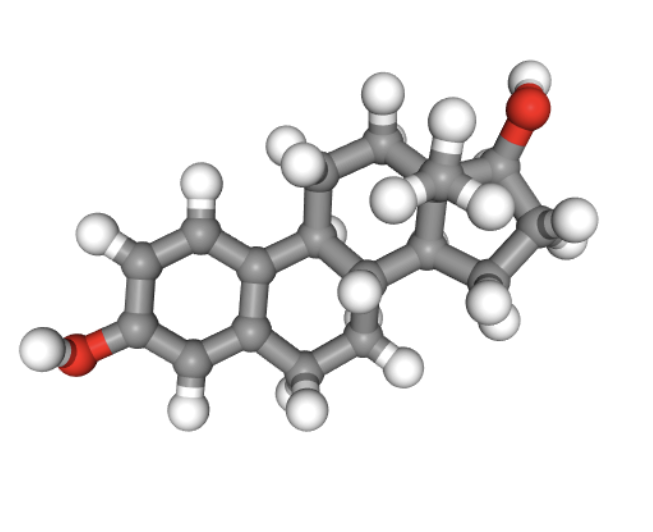
Figure 1: 17β-estradiol molecule visualized in NGLView.