2025 AIChE Annual Meeting
(647f) Comparing Giant Vesicle Interactions with Simulated Environmentally Weathered Vs. Pristine Nanoplastics.
Authors
Sara Zachariah - Presenter, University of Southern California
Noah Malmstadt, University of Southern California
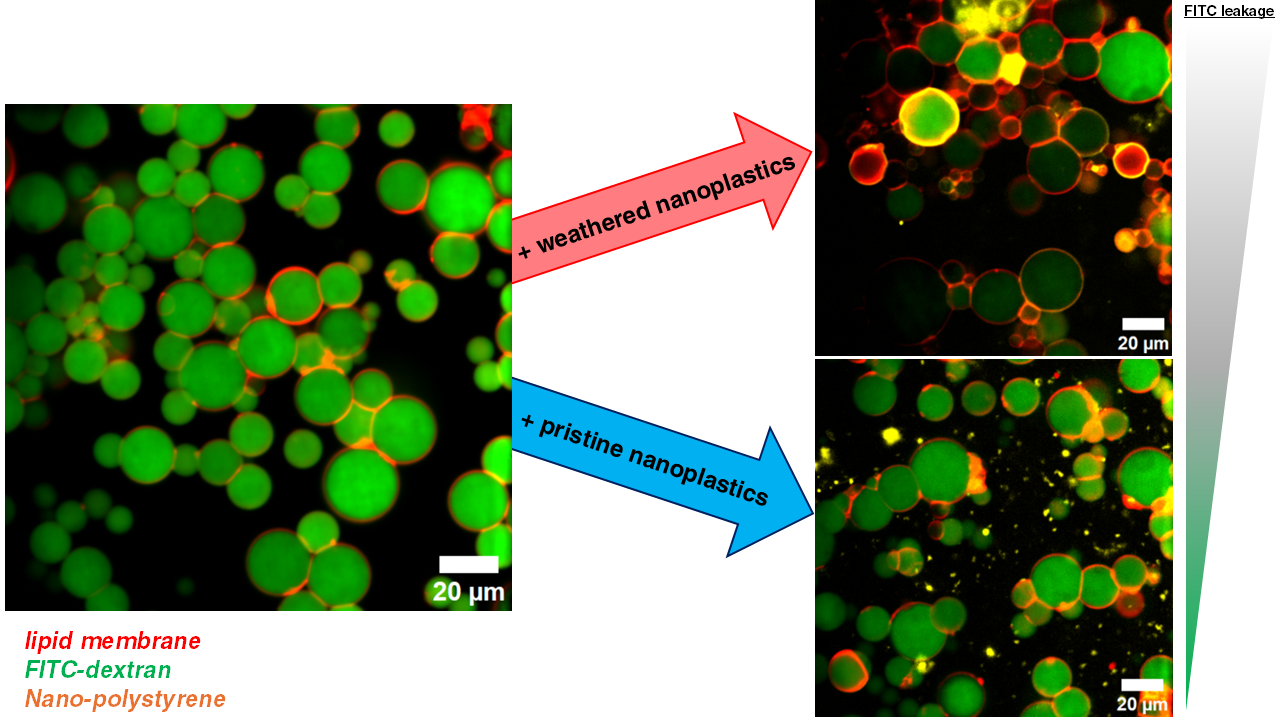
Plastic pollution is a major global issue, with more than 250,000 tons of plastic waste persisting in the world’s waterways. As this waste is weathered by the environment, into micro- (0.01-1 mm) and eventually nano- (< 1 μm) plastic fractions, it becomes increasingly able to infiltrate and be taken up by living cells. This can be extremely detrimental to those living processes since nanoplastics are accumulators and carriers of toxic substances and might even be inherently toxic themselves. Despite this, most current studies employ pristine, manufactured material of uniform size and shape. These model plastics, most often polystyrene (PS) beads, are convenient to work with and widely commercially available, but do not capture the full complexity of true environmental plastic pollution, which have a variety of different shapes, sizes, and chemical makeups due to ambient ageing. To bridge this discrepancy, we compare the extent of giant unilammelar vesicle (GUV) membrane damage due to interaction with pristine engineered nano-polystyrene (nPS, Dp ~ 300 nm) spheres, vs. that due to lab-weathered nPS. We observed a statistically significant (p < 0.05) leakage of 1-palmitoyl-2-oleoyl-sn-glycero-3-phospocholine (POPC)-based GUV lumina for pristine nPS interacting with 50 mol% positive lipids (46% mean leakage) and pure neutral lipid (20% leakage) but not for 50 mol% negative lipids. In contrast, significant leakage was observed for negative, positive, and neutral lipid GUVs (91%, 87%, and 24% respectively) of those same compositions incubated with weathered nPS. Furthermore, the inclusion of cholesterol to the lipid membrane mitigated the average GUV leakage against pristine nPS (20% to virtually 0%), but increased leakage against weathered nPS (25% up to 80%). Adding 1,2-dioleyl-sn-glycero-3-phospocholine (DOPC), a lipid which enhances membrane fluidity, decreased average GUV leakage against pristine nPS, but had a more variable effect on leakage against weathered nPS exposure. In addition, we quantify the shape difference between various types of weathered nPS (transparent, opaque, and foam) and pristine nPS spheres, and show how the membrane disruption potential tends to increase with sharper-cornered, more angular particle shapes (controlling for size). Overall, this work highlights the importance of selecting environmentally relevant nanoplastics for study, as the true biological effects of NP pollution cannot truly be captured by using pristine materials alone.