2025 AIChE Annual Meeting
(168f) Comparative Study of Image Stitching Methods and Stitched Image Quality Assessment Methods for Non-Overlapping Biomedical Images
Conventional stitching techniques, such as feature-based and correlation-based methods, have been used for stitching non-overlapping biomedical images [6]. Recently, there has been a shift towards deep learning-based approaches [7]. Additionally, stitching algorithms for non-overlapping images have been developed for different fields [3]. In practice, non-overlapping images often have no ground truth. Therefore, to automate the stitching process for these images, it is crucial to employ an objective and quantitative metric that does not rely on a reference. These no-reference quantitative metrics have difficulty with subtle nuances that are easily distinguishable by humans and may fail to capture certain types of distortions, such as ghosting or blurring [8].
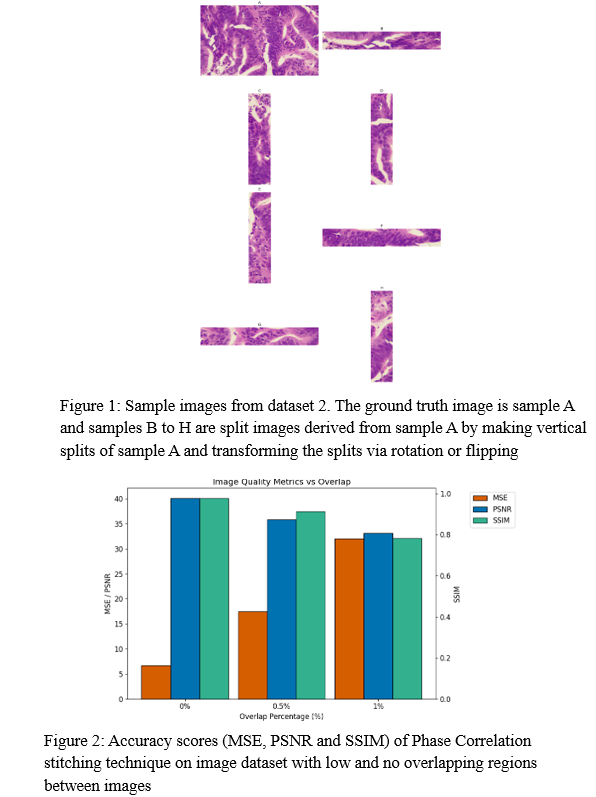
This study evaluates the effectiveness of various image stitching methods, including those previously applied to non-overlapping images and those used in other fields, when applied to non-overlapping biomedical image datasets. The performance of each stitching method is assessed by comparing the stitching outputs with ground truth images and by using no-reference stitched image quality assessment (NR-SIQA) methods. NR-SIQA methods are used to assess the quality of stitched images without requiring a reference image [9]. The study further investigates the correlation between NR-SIQA scores and human visual assessments to identify the most reliable methods for evaluating stitched biomedical images. We created three datasets for our study: the first consists of images with low or no overlapping regions, the second dataset includes images with varying orientations, and the third contains images with missing pixels or inpainting issues. Figure 1 shows some images from Dataset 2.
We developed a stitching algorithm using phase correlation for image registration and using the histogram of gradient features to determine the correct orientation of the individual images prior to stitching. The various stitching algorithms were applied to the datasets, and the stitched images were evaluated using several NR-SIQA methods such as Blind/Referenceless Image Spatial Quality Evaluator (BRISQUE), Natural Image Quality Evaluator (NIQE) and Spatial-Spectral Entropy-based Quality (SSEQ). The scores from these methods were then compared with human visual quality scores and ground truth assessment metrics such as peak signal-to-noise ratio (PSNR) to rank the NR-SIQA methods based on their reliability. Figure 2 illustrates the performance of the developed stitching method on dataset 1, using ground truth assessment metrics. This presentation will discuss our analysis of the performance of feature-based, correlation-based, and extrapolation stitching methods across various datasets to identify the most effective stitching method for addressing the specific challenges posed by each dataset. Also, it will provide a ranking of various NR-SIQA methods, including BRISQUE, NIQE, and SSEQ, by evaluating how well they match ground truth assessment metrics and human visual assessments to determine the most suitable NR-SIQA method.
References
- Fuerst, B., Fotouhi, J. and Navab, N., 2015. Vision-based intraoperative cone-beam ct stitching for non-overlapping volumes. In Medical Image Computing and Computer-Assisted Intervention--MICCAI 2015: 18th International Conference, Munich, Germany, October 5-9, 2015, Proceedings, Part I 18(pp. 387-395). Springer International Publishing.
- Mohammadi, F.S., Mohammadi, S.E., Mojarad Adi, P., Mirkarimi, S.M.A. and Shabani, H., 2024. A comparative analysis of pairwise image stitching techniques for microscopy images. Scientific Reports, 14(1), p.9215.
- Poleg, Y. and Peleg, S., 2012, April. Alignment and mosaicing of non-overlapping images. In 2012 IEEE International Conference on Computational Photography (ICCP)(pp. 1-8). IEEE.
- Pandey, A. and Pati, U.C., 2013, December. A novel technique for non-overlapping image mosaicing based on pyramid method. In 2013 Annual IEEE India Conference (INDICON)(pp. 1-6). IEEE.
- Tang, Q., Jiang, H. and Li, S., 2024. An efficient stitching algorithm for aerial images with low-overlap. International Journal of Computational Science and Engineering, 27(6), pp.654-662.
- Samsudin, S., Adwan, S., Arof, H., Mokhtar, N. and Ibrahim, F., 2013. Development of automated image stitching system for radiographic images. Journal of digital imaging, 26, pp.361-370.
- Zhao, B., Song, M., Liu, S., Sun, L., Jiang, W., Qian, H., Zhang, X.Y., Zhang, Y. and Jiang, T., 2023, July. MosaicNet: A deep-learning-based multi-tile biomedical image stitching method. In 2023 45th Annual International Conference of the IEEE Engineering in Medicine & Biology Society (EMBC)(pp. 1-4). IEEE.
- Pinson, M.H., 2022. Why no reference metrics for image and video quality lack accuracy and reproducibility. IEEE Transactions on Broadcasting, 69(1), pp.97-117.
- Tian, C., Chai, X. and Shao, F., 2021. Stitched image quality assessment based on local measurement errors and global statistical properties. Journal of Visual Communication and Image Representation, 81, p.103324.