2025 AIChE Annual Meeting
(609c) Combined Experimental and Computational Framework Towards Optimizing Microalgae Culture on Food Waste
Authors
According to FAO, food wastes along the production chain account for 14% of the entire food production volumes [1]. For this purpose, the utilization of organic carbon-based streams by heterotrophic and mixotrophic microalgal strains can potentially lead to an alternative residues valorization route. Indeed, the resulting biomass can be used for food-related applications due to their high protein content [2], but the presence of high-value metabolites as essential amino-acids, antioxidants and pigments opens the path also to medical applications [3], [4]. However, their applicability still relies on extensive laboratory campaigns to fill knowledge gaps on organic carbon metabolism, further complicated by photosynthesis in the case of mixotrophic species. For this reason, experimental and computational methods are synergistically combined in this work to provide deeper mechanistic insights on these underlying phenomena, reducing laboratory efforts and time costs for scaling up the technology.
Methodology and expected results
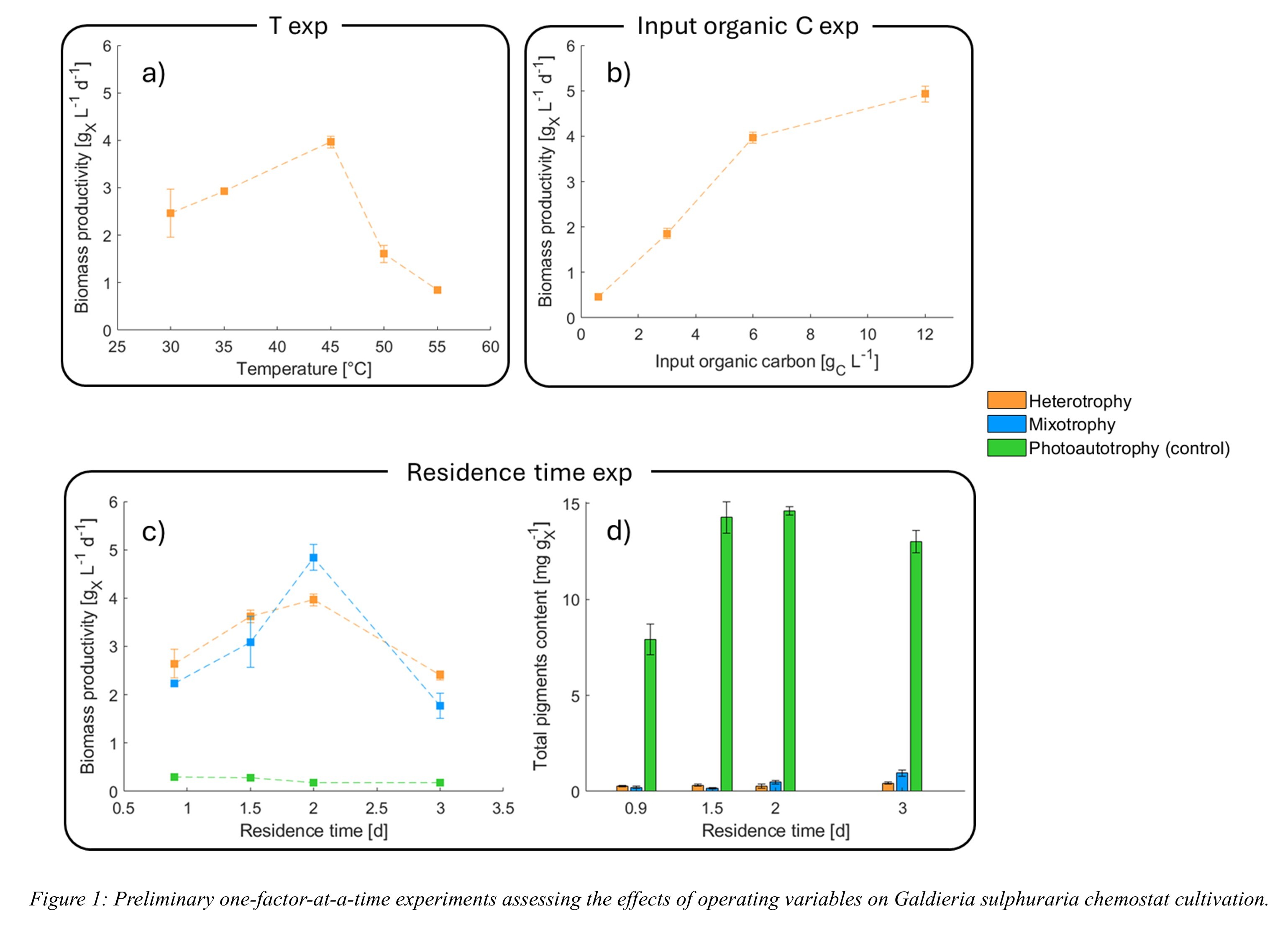
A preliminary experimental campaign on the extremophilic microalga Galdieria sulphuraria is formulated through a one-factor-at-a-time approach, assessing the effects of residence time, temperature, pH, organic carbon and light intensity availability on both heterotrophic and mixotrophic chemostat experiments. The collection of data focuses on biomass concentration and productivity, as well as proteins, carbohydrates and pigments to investigate the feasibility of high-quality biomass production. The experiments show that a proper tuning of these operating variables can lead to significant improvements in cultivation outcomes (Fig. 1a-c). However, when specifically dealing with mixotrophic experiments for enriched-in-pigments biomass, these results do not show relevant proofs supporting the coexistence of photosynthesis and organic carbon uptake in this metabolism (Fig. 1d). To deal with that, a Design of Experiment (DoE) rationale investigates combinations of different light intensity and input substrate levels: by inducing a growth limiting environment with respect to the organic substrate, the species is forced to enhance its pigmentation for improved photons capture and further growth sustainment. The data thus collected are then employed for the development of first-principles models describing cultivation performances under both heterotrophic and mixotrophic conditions, looking for optimal simulation fidelity and minimal mathematical complexity. For the mixotrophic case, where the inner biological complexity requires more attention on the computational side, data-driven models are integrated into the deterministic foundation to capture hidden phenomena and thus improve the reliability of resulting forecasts. To remark once more the combined experiments-modeling rationale of this work, a Model-Based Design of Experiments (MBDoE) approach is implemented for refining the mixotrophic model according to computationally driven experiments.
Conclusions
This work aims at delving deeper into heterotrophic and mixotrophic microalgae cultivation for commercial food applications, bridging the gap between biological behavior and its mathematical codification through a combination of experiments and computational methods. This approach not only reduces time and cost expenses related to extensive experimental efforts, but the reliability of the resulting models can also be exploited in optimization problems, aimed at finding the most suitable operating conditions levels to maximize the production of certain byproducts of interest, which is pivotal for scale up purposes.
References
[1] “The State of Food and Agriculture - 2019.” Accessed: Mar. 23, 2025. [Online]. Available: https://www.fao.org/interactive/state-of-food-agriculture/2019/en/
[2] C. Galasso et al., “Microalgal Derivatives as Potential Nutraceutical and Food Supplements for Human Health: A Focus on Cancer Prevention and Interception,” Nutrients, vol. 11, no. 6, p. 1226, Jun. 2019, doi: 10.3390/NU11061226.
[3] A. P. Batista, L. Gouveia, N. M. Bandarra, J. M. Franco, and A. Raymundo, “Comparison of microalgal biomass profiles as novel functional ingredient for food products,” Algal Res, vol. 2, no. 2, pp. 164–173, Mar. 2013, doi: 10.1016/J.ALGAL.2013.01.004.
[4] V. K. Kannaujiya, S. Sundaram, and R. P. Sinha, “Phycobiliproteins: Recent developments and future applications,” Phycobiliproteins: Recent Developments and Future Applications, pp. 1–151, Dec. 2017, doi: 10.1007/978-981-10-6460-9/COVER.