2025 AIChE Annual Meeting
(332j) Colloid–Polymer Depletion Interactions Measured Through an Inverse Method
Polymer depletion interactions can cause apparent attraction between colloidal particles when polymers are added to the dispersion. Knowing the interaction potential between particles as a function of distance, u(r), is beneficial for developing formulations – many of which contain mixtures of colloidal particles and polymers. We apply an efficient method [1], as a new way to infer these interactions between colloidal particles in polymer solution.
The interaction potential, u(r), is found by an inverse method, which matches the radial distribution function, g(r), found from two different methods: the traditional distance–histogram and a newer test-particle insertion method [2]. The inverse method has previously been demonstrated using simulated equilibrium configurations of passive particles. We now find that the method can successfully measure colloid–polymer depletion interactions, enabling them to be studied in more detail. In our experimental system, a glass cell is filled with a dispersion of colloidal particles and polymer. The colloidal particles are denser than the solvent, and so they sediment into a monolayer. The particles are allowed to settle into equilibrium, then a series of images taken with an optical microscope. Image analysis obtains the coordinates of the centre of each particle, for input into the inverse method.
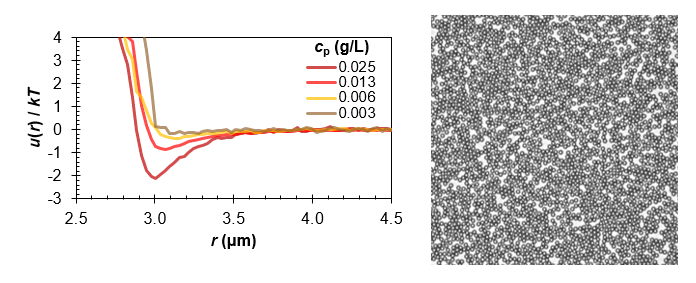
This presentation shows how u(r) varies with the polymer, colloid and salt concentrations, in dispersions of melamine formaldehyde particles (colloid) and xanthan gum (a natural polymer with many industrial applications). We observe the depletion interaction strengthening as the polymer concentration is increased (see Figure 1, Left), as expected by theory. With this system, as the colloid concentration is varied, we do not see obvious many-body effects; this is due to the ratio of the polymer and colloid sizes. A complex trend is observed with salt concentration, since xanthan gum is a polyelectrolyte. A comparison with simple theory for ideal polymers – the Asakura–Oosawa model – reasonably well predicts the range and strength of the depletion interaction. However, a modified model for semi-flexible polyelectrolytes would be required to fully explain the shape of u(r).
Figure 1. Left: Example measurements of the interaction potential between colloidal particles in the presence of polymer, at different polymer concentrations, cp. The interaction potential is scaled by the thermal energy, kT. Right: An example experimental snapshot of particle positions.
References
[1] J. Chem. Phys. 2025, 162, 074103.
[2] Phys. Rev. Lett. 2019, 123, 098002.