2025 AIChE Annual Meeting
(151b) Characterizing the Chemical Environment of Electrochemical Interfaces Using Cryogenic Spectroscopy
Authors
Important understanding of the SEI can be obtained using X-ray photoelectron spectroscopy (XPS), and XPS has been commonly used to probe the SEI in battery studies. However, the room temperature (RT) and ultra-high vacuum (UHV) conditions used during XPS measurement can induce major SEI evolution from reactions and volatilization during XPS. Subsequently, a new technique is necessary for SEI stabilization.
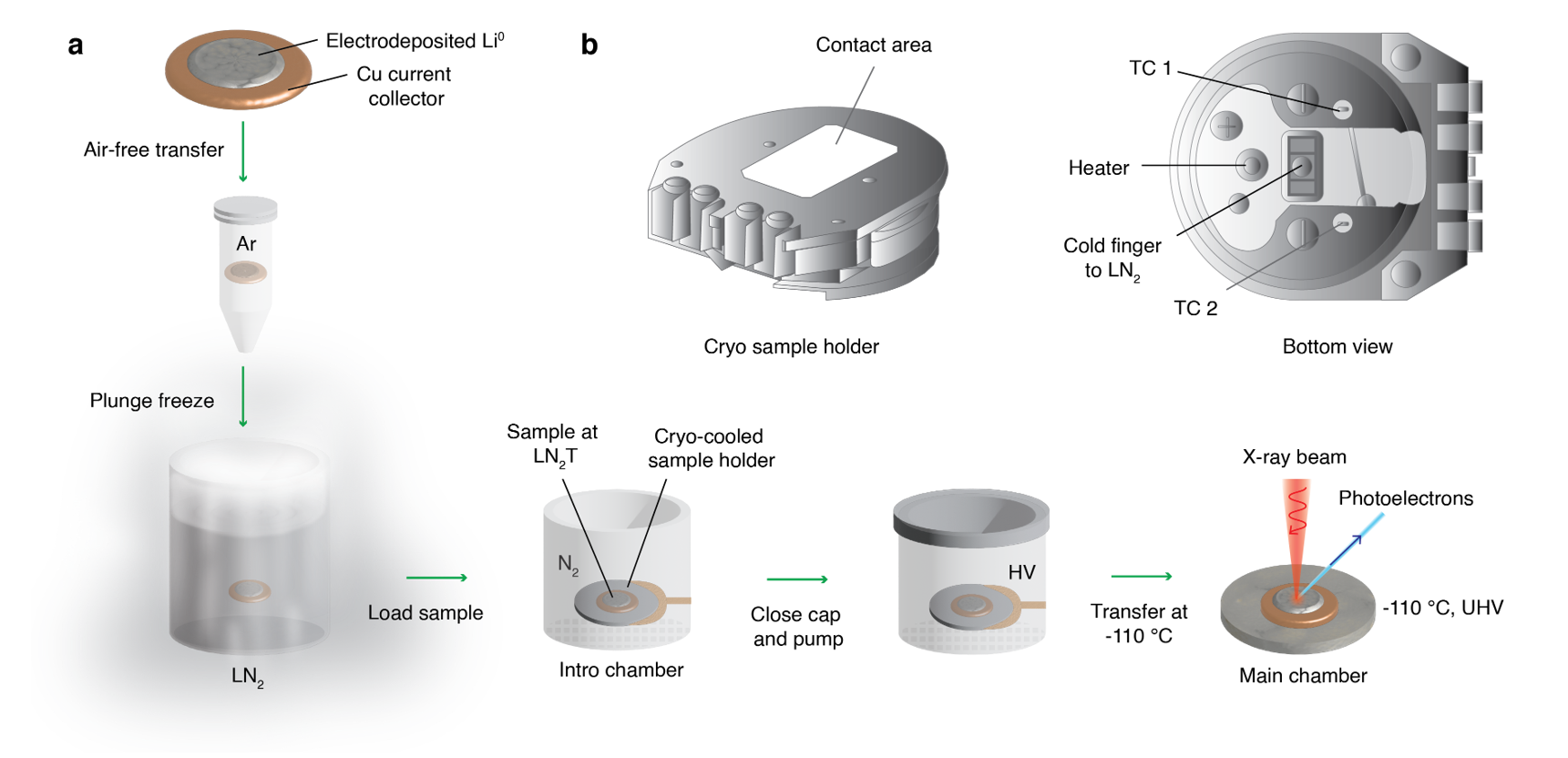
Here, for the first time, we develop a method of cryogenic (cryo)-XPS that employs immediate plunge freezing and demonstrate SEI preservation. We show that cryogenic conditions can halt chemical reactions and freeze UHV-volatile species due to slow reaction and desorption kinetics at these temperatures. We hypothesize that the true SEI thickness can also be retained, benefiting from the lower vapor pressure of different frozen SEI species at cryoT. Indeed, we discover significantly different SEI speciation and a thicker pristine SEI with cryo-XPS. Whereas cryo-XPS ensures SEI preservation over an extended period under UHV, compositions derived from RT-XPS are shown to be inaccurately dominated by stable species only. We confirm the SEI thickness preservation from Li 1s high-resolution spectra of the underlying metal substrate. We carefully analyze and decouple three major effects during SEI analysis: UHV effect, reaction effect, and x-ray beam effect. UHV and reaction are found to be the major drivers for SEI compositional changes.
While RT-XPS-based chemical descriptions can fail to provide performance correlations, pristine SEI composition achieved by cryo-XPS enables better performance correlations across diverse electrolyte chemistries. We expect the technique to enable future studies of sensitive and reactive interface characterization under cryogenic conditions to ensure pristine state preservation.