2025 AIChE Annual Meeting
(437d) CFD Modelling of Fluidised Beds: An Evaluation of Particle Modelling and PEPT Experiments
Authors
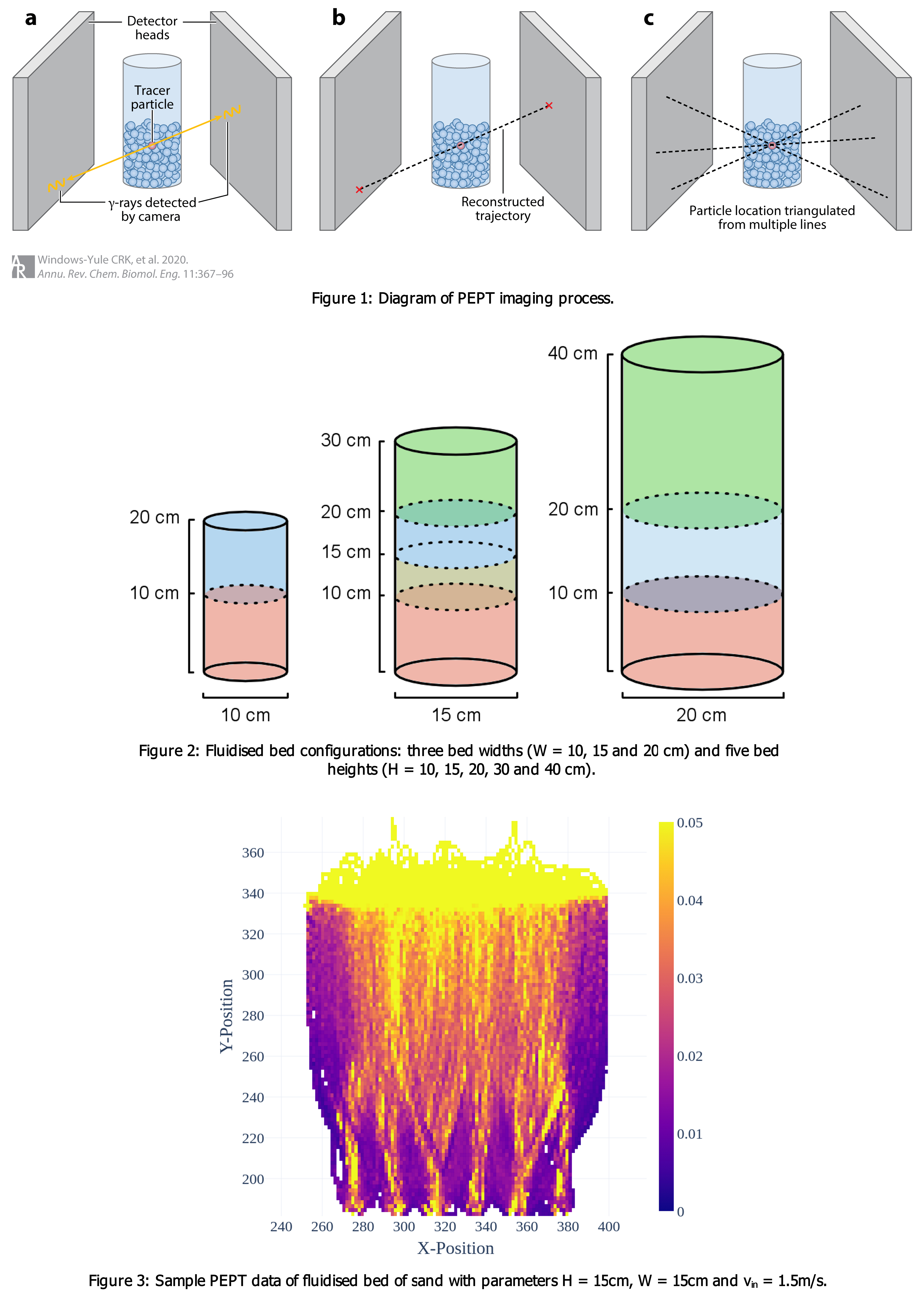
Positron emission particle tracking (PEPT) is a robust technique for imaging particle dynamics within three-dimensional systems (see Fig. 1), ranging from powders to turbulent multiphase flows [3]. It is often difficult to gain experimental data of dense systems, such as fluidised beds, due to the invasive nature of many measurement tools. In particular, obtaining visualisations of such systems proves difficult. PEPT provides non-invasive, high-resolution spatial and temporal data of lab-scale systems that can be used to assess the performance of numerical models, using radiolabelled particles rather than direct imaging. Utilising PEPT as a validation tool to compare and evaluate gas-solid fluidised bed models has previously been studied using CFD-DEM models [4], though the novel evaluation against MPPIC and DPM provides significant insight into the applicability of each particle model.
This study utilises 3D PEPT data from multiple lab-scale bubbling fluidised bed configurations, spanning a range of dimensions and gas inlet velocities (vin = 1.5, 2 and 2.5 m/s) – see Fig. 2 for diagrams of the configurations and Fig. 3 for a sample of the PEPT data used. Modelled counterparts are constructed, using both MPPIC and DPM, and evaluated against the PEPT data – specifically analysing particle occupancy and velocity distributions. MPPIC and DPM are cross compared, considering computational cost, accuracy and practical applicability, drawing conclusions on the strengths and weaknesses of each model in capturing fluidisation dynamics.
The study highlights key computational trade-offs between the two models: while DPM provides more accurate modelling of particle dynamics as a result of directly computing collisions, this comes at the cost of comparatively high computation times, especially in high density systems such as fluidised beds. Conversely, MPPIC models particle collisions statistically, leading to significantly lower computational costs with less accurate particle dynamics modelling. These results can be used to inform decision making for model selection for different particle-fluid systems with a range of particulate loading, e.g. cyclone separators, mixers, calciners. PEPT may also be used to evaluate the performance of each particle model across this range of systems, particularly the particle dynamics and particle-fluid interactions, and allow for validation of the selected model.
References
[1] Andrews, M.J. and O’Rourke, P.J. (1996) The multiphase particle-in-cell (MP-PIC) method for dense particulate flows. International Journal of Multiphase Flow, 22 (2): 379–402. doi:10.1016/0301-9322(95)00072-0.
[2] Zhou, H., Flamant, G., Gauthier, D., et al. (2004) Numerical Simulation of the Turbulent Gas–Particle Flow in a Fluidized Bed by an LES-DPM Model. Chemical Engineering Research and Design, 82 (7): 918–926. doi:10.1205/0263876041596788.
[3] Windows-Yule, C.R.K., Seville, J.P.K., Ingram, A., et al. (2020) Positron Emission Particle Tracking of Granular Flows. Annual Review of Chemical and Biomolecular Engineering, 11 (1): 367–396. doi:10.1146/annurev-chembioeng-011620-120633.
[4] Che, H., Werner, D., Seville, J., et al. (2023) Evaluation of coarse-grained CFD-DEM models with the validation of PEPT measurements. Particuology, 82: 48–63. doi:10.1016/j.partic.2022.12.018.