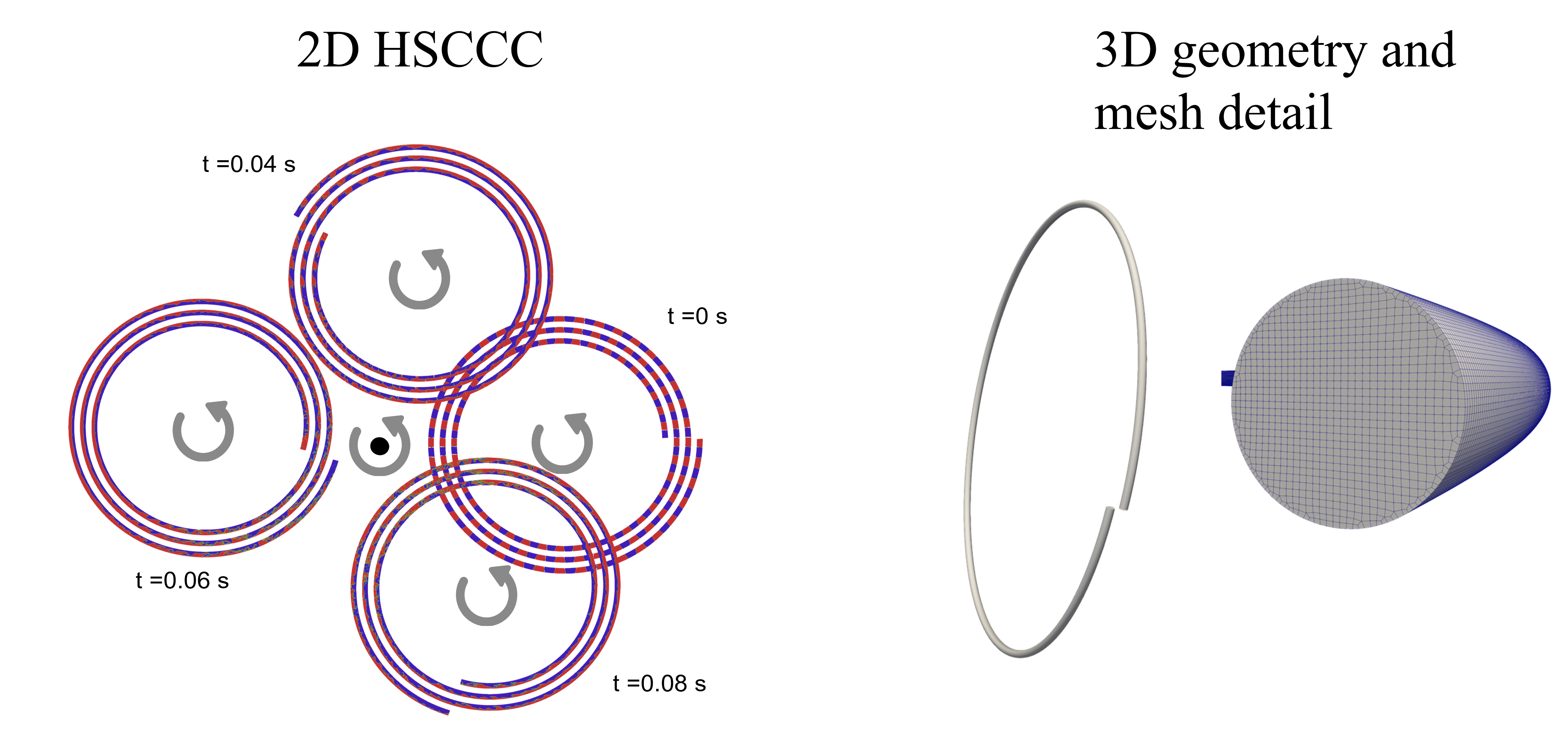
High-Speed Countercurrent Chromatography (HSCCC) is an efficient chromatographic technique for liquid-liquid separation similar to conventional liquid chromatography where compounds separate based on their different affinities (partition coefficients) in immiscible liquids. In this process, a column (or a pipe) is filled with a stationary phase, while another mobile phase is pumped in, which elutes molecules to the stationary phase via interface mass transfer. Hence, maximization of the interface area between the two immiscible liquids is pivotal to ensure the efficiency of the separation process. In HSCCC, this is achieved using centrifugal forces to rapidly mix and separate the two liquids, by flowing the mobile phase into a solenoidal pipe undergoing a fast planetary motion
[1] consisting of simultaneous rotations around the coil axis and around a sun gear axis. Simulating this process using Computational Fluid Dynamics (CFD) is a challenging task because of the fast planetary motion (hundreds of rounds per minute) and the small ratio between the pipe and sun gear radii. These two factors result in large grids and small time steps. Furthermore, CFD modeling of mass transfer between immiscible fluids is still an open research topic. Numerical diffusion induced by the advection schemes causes the species from one phase to leak into the other phase, leading to loss of mass conservation and inaccurate treatment of the interface mass transfer. Furthermore, there is currently no CFD model for interface mass transfer of species with different partition coefficients.
In this talk, we present a method to model HSCCC using a multiphase CFD model. The proposed method is implemented in the open-source finite volume library OpenFOAM and it is based on a geometric approach to advect and reconstruct the interface between the two liquids. We illustrate the details of a face interpolation scheme to mitigate the effects of numerical diffusion in the transport of components, and an approach to model interface mass transport. We first compare the accuracy and mass conservation properties of different approaches on a 2D countercurrent chromatography channel. Subsequently, we show how a reduced version of the HSCCC device in 2D and 3D. We discuss mesh generation and we outline the effectiveness and advantages of using CFD for modeling HSCCC processes.
[1] Ito, Y., “Golden rules and pitfalls in selecting optimum conditions for high-speed counter-current chromatography,” Journal of Chromatography A, Vol. 1065, No. 2, feb 2005, pp. 145–168.