2025 AIChE Annual Meeting
(675c) Cattesthub: Experimental Heterogeneous Catalytic Database and Fundamental Insights
Authors
Lars Grabow, University of Houston
Susannah Scott, University of California, Santa Barbara
Paul J. Dauenhauer, University of Minnesota
Omar Abdelrahman, University of Massachusetts Amherst
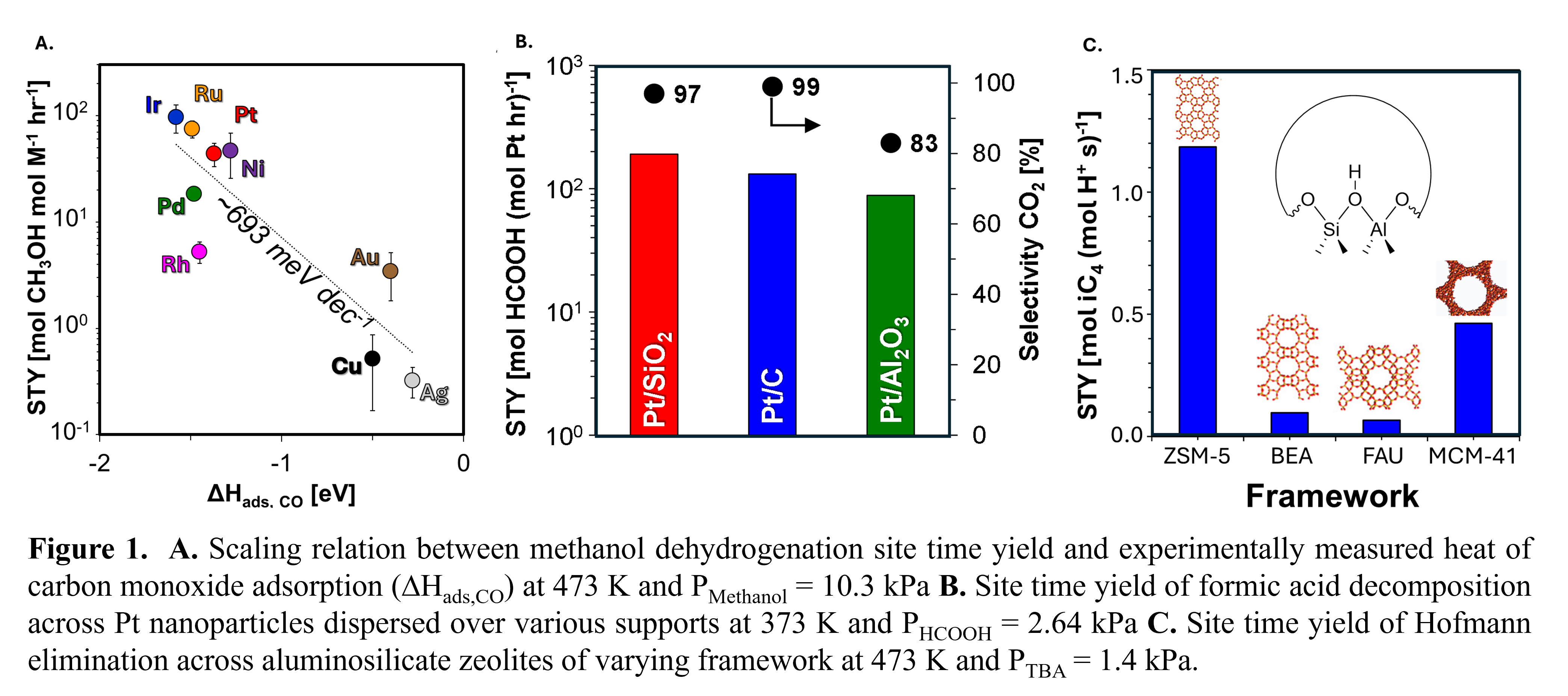
Catalysis research has evolved over the last several decades towards accelerating catalytic turnover through material advances and novel catalytic strategies. Acceleration beyond the state-of-the-art entails the existence of a well-defined state-of-the-art, which continues to blur with growth within the field. A benchmark, as implemented in various scientific applications, represents the evaluation of a quantifiable observable against an external standard and hence helps one define the state-of-the-art. This work proposes a benchmarking database for experimentally measured heterogeneous catalytic reaction data. As a tool, CatTestHub (cpec.umn.edu/cattesthub) seeks to standardize data reporting across heterogeneous catalysis, providing an open-access community platform. Here, we highlight using the database to develop structure-function relations for distinct chemistries. At a temperature of 473 K and 10.3 kPa of methanol, the apparent STY of methanol dehydrogenation increases by an order of magnitude for every 0.7 eV (67 kJ mol-1) increase in the binding energy of carbon monoxide (Fig 1A). Similarly, the selectivity to the formic-acid dehydration pathway over alumina-supported Pt nanoparticle (17%) is significantly distinct from that across carbon and silica supports (1%), despite the insensitive site time yield, indicating the presence of support interactions (Fig 1B). For solid-acid catalyzed tert-butyl amine Hofmann elimination, the catalytic turnover over an MFI/ZSM-5 framework (~ 1.2 mol iC4 mol H+-1 s-1) was larger than other reported mesoporous frameworks by at least a factor of two (Fig 1C), which encourages its selection as the framework to explore the effects of pore environment. The database enables such discussions of insights that form the foundations for probing more complex problems. CatTestHub is a valuable tool for chemical catalysis research, enabling a more community-wide benchmarking effort. The growth of the database promises to enable modeling based on carefully curated data and improve the precision of experimental investigations, ultimately expediting the discovery of efficient catalytic materials.