2025 AIChE Annual Meeting
(584az) Cattesthub: Developing an Experimental Catalytic Database to Promote Rigor and Reproducibility
Authors
Lars Grabow, University of Houston
Susannah Scott, University of California, Santa Barbara
Paul J. Dauenhauer, University of Minnesota
Omar Abdelrahman, University of Massachusetts Amherst
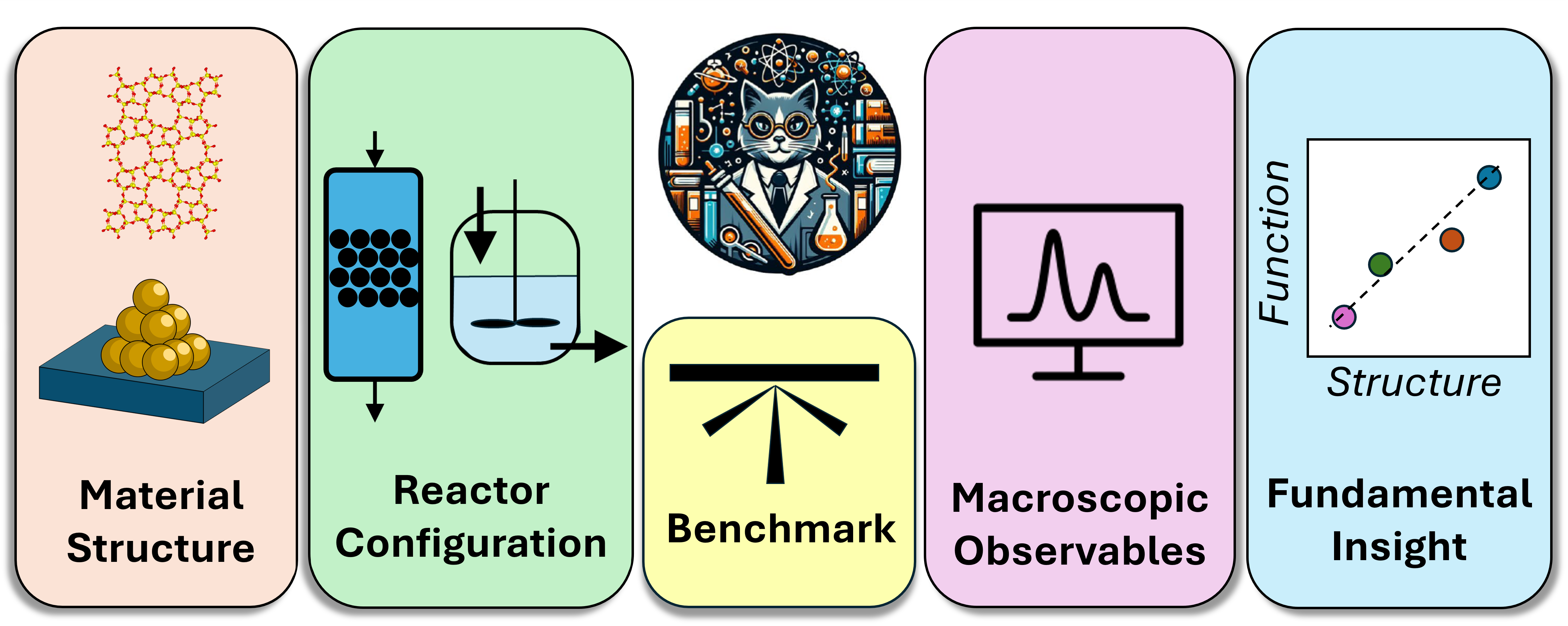
The ability to quantitatively compare newly evolving catalytic materials and technologies is hindered by the widespread availability of catalytic data collected in a consistent manner. While certain catalytic chemistries have been widely studied across decades of scientific research, the ability to quantitatively utilize the available literature information is hindered by variability in reaction conditions, types of reported data, and reporting procedures. Here, we present CatTestHub (www.cpec.umn.edu/cattesthub), a database dedicated to providing benchmarking experimental data for heterogeneous catalysis. Through the selection of probe chemistries, combined with material characterization information and the systematic reporting of kinetic information, the database provides a collection of information that provides a collection of catalytic benchmarks for distinct classes of active sites. We propose that this online and open-access platform could serve as a community wide benchmark, the quality of which is improved through continuous addition of kinetic information on select catalytic systems by members of the heterogeneous catalysis community at large. In this initial iteration, we present benchmarking data relevant to the decomposition of methanol and formic acid over metal surfaces, as well as the Hofmann elimination of alkylamines over aluminosilicate zeolites. Details of the database, the logic of its construction, and the means through which to navigate are presented here, along with examples of catalytic insights readily drawn from the available information. The growth of the database promises to deepen understanding of catalytic behavior, enable modeling based on carefully curated data, and improve the precision of experimental investigations, ultimately expediting the discovery of new, efficient catalytic materials.