2025 AIChE Annual Meeting
(690a) Cation Exchange Strategy for Producing Functional Cellulose Acetate Sulfate Hydrogels and Their Potential Applications As Bio-Inks for 3D Printing
Authors
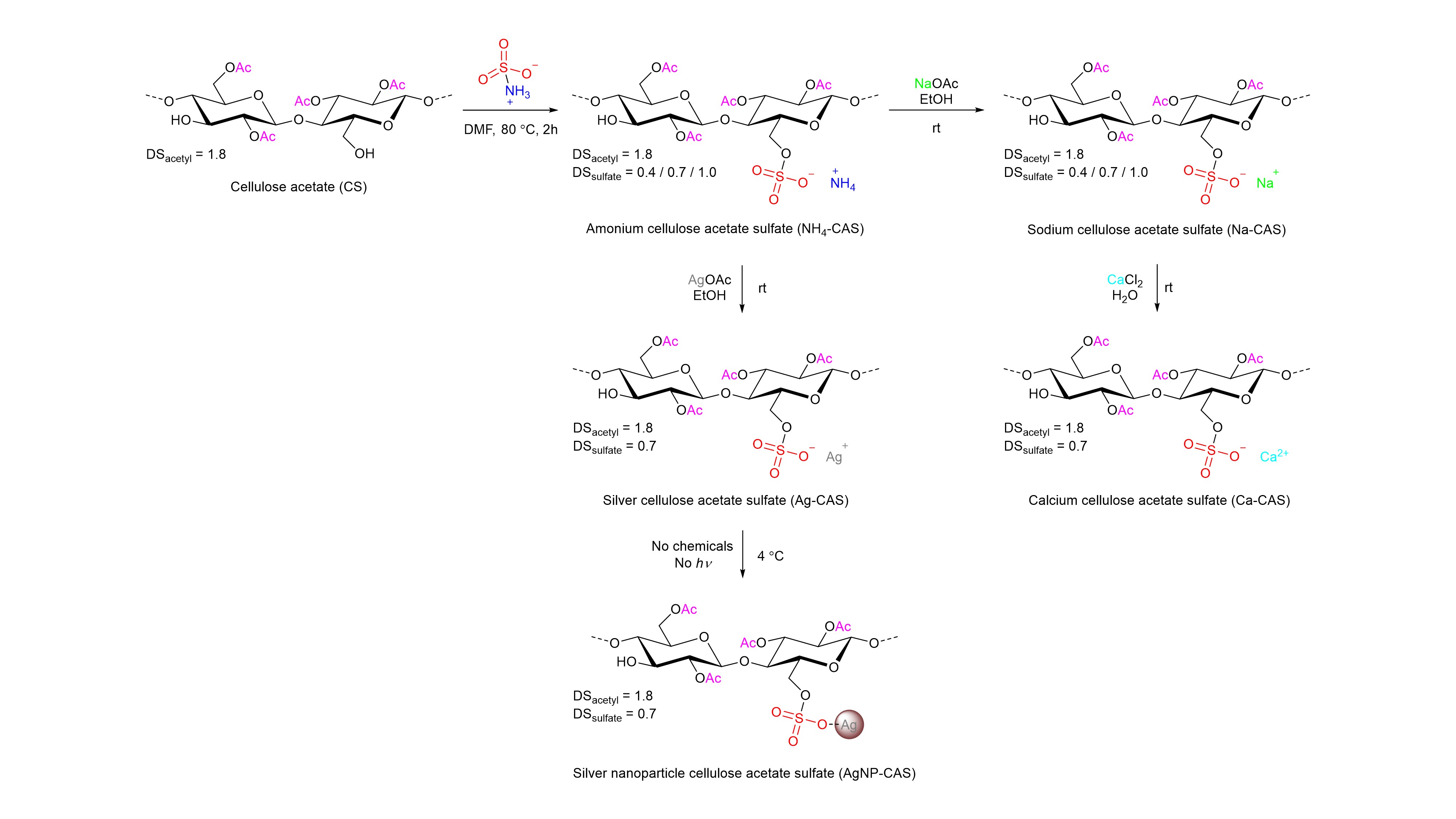
Herein, functional cellulose acetate sulfates have been proposed based on the cation exchange of ammonium cellulose acetate sulfate (NH4-CAS) synthesized from cellulose acetate. Briefly, NH4-CAS was synthesized using cellulose acetate (DSacetyl 1.8) and sulfamic acid as a sulfating agent. Depending on the sulfamic acid dosage, the degree of sulfonyl group of NH4-CAS was controllable from 0.4 to 1.
To prepare sodium cellulose acetate sulfate (Na-CAS), the work-up of synthesized NH4-CAS was carried out using ethanolic sodium acetate solution. The cation exchange of ammonium ion to sodium ion results in water-soluble Na-CAS. After a solvent exchange to water, heating Na-CAS in water at 60 °C allowed complete dissolution. Depending on the consistency of this solution and the degree of sulfonyl group, various Na-CAS hydrogels were fabricated and their rheological properties (shear-thinning, yield stress, and thixotropy) were evaluated. Among Na-CAS hydrogels, hydrogel prepared by 4 wt% of consistency of Na-CAS (DSacetyl 1.8 and DSsulfonyl 0.7) was suitable as a bio-ink for 3D printing. In addtion, because of water solubility, Na-CAS hydrogel cannot maintain its 3D structure when it is exposed to excess water. Soaking Na-CAS hydrogel in an aqueous calcium chloride solution gave further cation exchange from sodium ion to divalent calcium ion, resulting in ionic cross-linked calcium cellulose acetate sulfate (Ca-CAS).
If ethanolic silver acetate solution was employed rather than sodium acetate solution during NH4-CAS work-up, cation exchange gave brownish silver cellulose acetate sulfate (Ag-CAS). Surprisingly, Ag-CAS was converted to silver nanoparticle cellulose acetate sulfate (AgNP-CAS) during storage by auto-reduction of silver ions without external reducing agents, NaOH as AgO2 accelerator, heat, and light. This nature-inspired in-situ AgNP generation in CAS matrix was verified by analyses of the aqueous AgNP-CAS solution (DLS and UV-vis) and AgNP-CAS films (XPS, XRD, SEM-EDS, and TEM). The antibacterial activity of AgNP-CAS against Escherichia coli and Aspergillus niger was also evaluated.