2025 AIChE Annual Meeting
(584cl) Carbonization of Low-Density Polyethylene Waste Films Using Non-Thermal Plasma
Authors
Joshua Schorn - Presenter, University of Massachusetts Lowell
Mihriye Doga Tekbas, University of Massachusetts-Lowell
Hsi-Wu Wong, University of Massachusetts Lowell
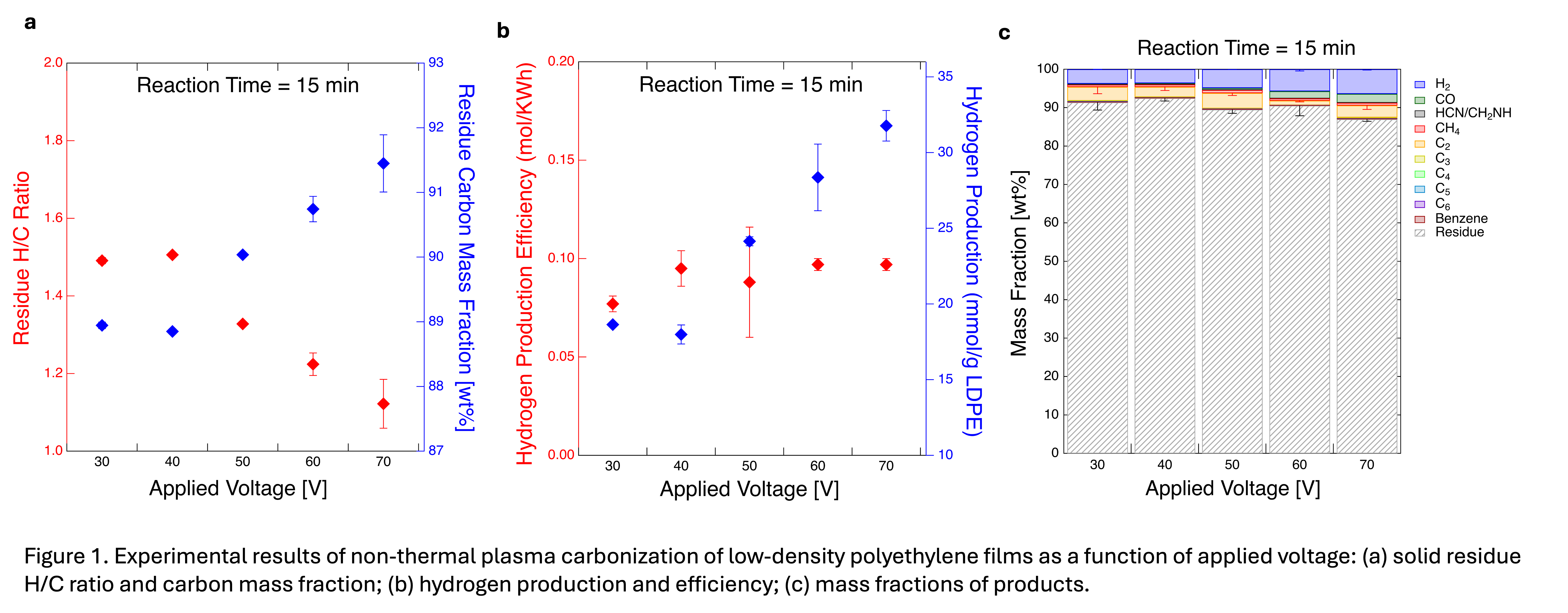
The increase in global plastic production and waste accumulation has intensified the need for more effective recycling methods. Current recycling approaches, however, pose many significant limitations, including large energy consumption and products with low quality and compromised physical properties and durability. This study aims to address both of these issues by utilizing high-voltage non-thermal plasma to upcycle plastic waste. Low-density polyethylene (LDPE) films were selected as the feedstock, and the samples were placed in a custom-made microreactor pressurized with argon gas, where high-voltage argon plasma was directly applied to the sample through the tungsten electrodes for time intervals under 15 min, ultimately carbonizing the film and simultaneously producing hydrogen gas. It was found in our study that higher applied voltage resulted in increased hydrogen production and larger carbon fraction in the solid residue (Fig. 1a). The process was able to extract approximately 40% of the hydrogen atoms from the LDPE films, leading to a yield of more than 30 mmol/gLDPE and a hydrogen production efficiency of approximately 0.1 mol/kWh (Fig. 1b). It was also observed that the major carbon-containing gas-phase product was acetylene (Fig. 1c), suggesting sooting reactions on the surface. Our experiments provided promising results and highlighted the effectiveness of using non-thermal plasma for plastic waste treatment to obtain high-value products.