2025 AIChE Annual Meeting
(710a) Capacity Expansion and Technology Roadmapping Analysis of U.S. Ammonia Manufacturing
Authors
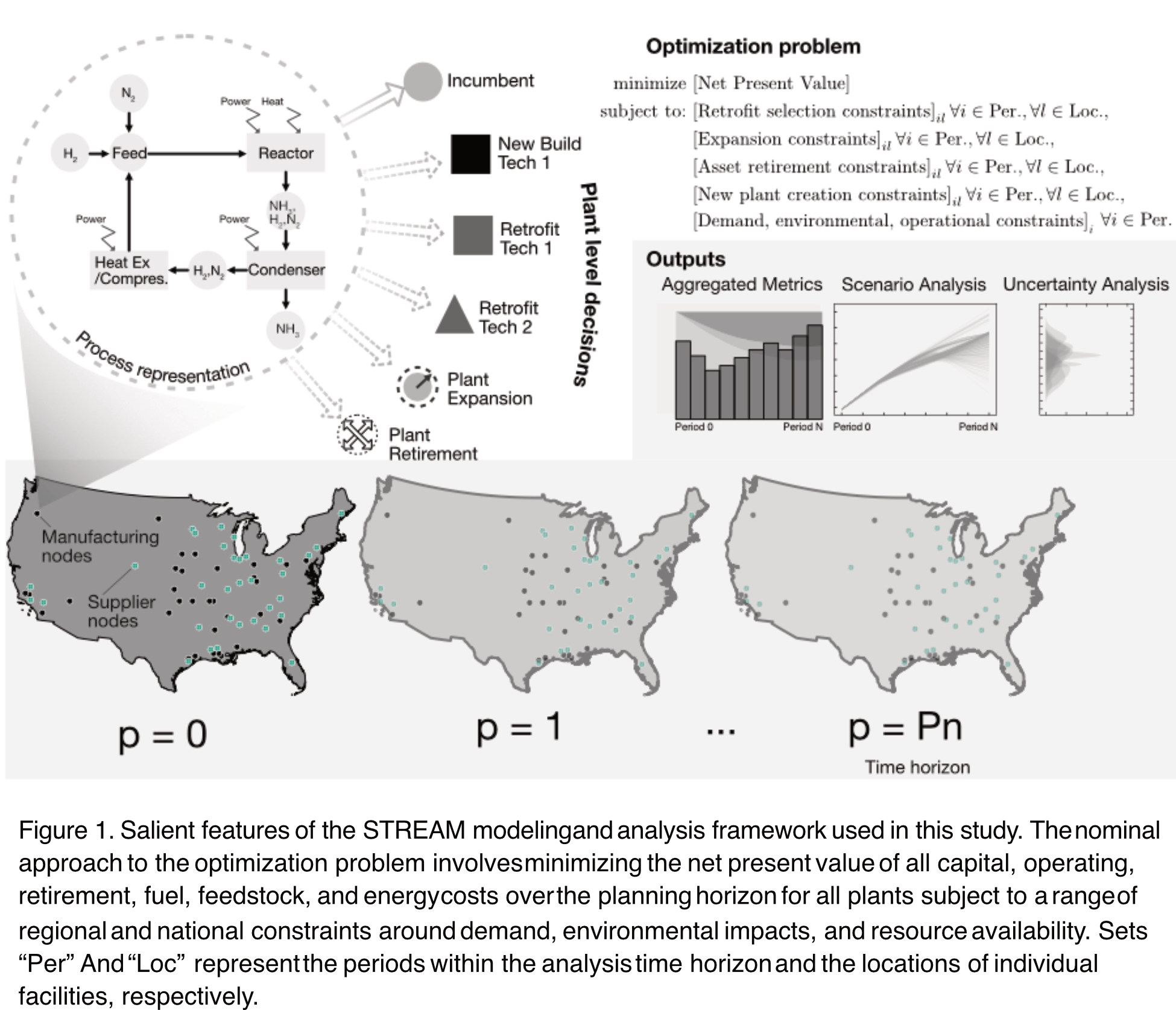
This study examines the existing stock of ammonia plants within the continental U.S. to determine least-cost technology trajectories for ammonia production through 2050 under different scenarios for ammonia demand, technology development, and policy landscape. The analysis uses facility-level performance characteristics such as fuel and feedstock mix, vintage, and built capacity to make decisions around capacity expansion, plant retrofits, new builds and new build technologies, and retirements in the context of existing ammonia production infrastructure and projected demand growth. The spatially-resolved analysis considers regional demands and costs and environmental flows associated with energy and feedstock inputs, capital and operating costs of various ammonia production technologies, and other engineering, operational, and resource constraints related to the manufacture and use of ammonia.
Specific ammonia production technologies that are evaluated include conventional steam methane reforming, coal gasification, autothermal reforming, methane pyrolysis, water electrolysis, and biomass gasification. The study employs the Strategic Technology Roadmapping and Energy, Environmental, and Economic Analysis Model (STREAM) [1] for optimization and scenario and uncertainty analysis. STREAM is an open-source technology planning and capacity expansion model for industry written in Julia, and is formulated as a mixed-integer linear program (MILP). Figure 1shows some of the salient aspects of the modeling framework and decisions. The high-fidelity industrial data for the analysis are developed from the DOE Transformative Pathways for U.S. Industry report [2] and various other literature sources [3,4]. Our presentation will discuss the costs and energy and non-energy impacts associated with various technology trajectories developed through this analysis and their relevance to maintaining robust domestic ammonia production for meeting demand from conventional applications such as fertilizers and chemicals manufacturing and emerging appliations including the use of ammonia as an energy carrier and fuel.
Acknowledgement
Argonne National Laboratory’s work was funded by the U.S. Department of Energy, Office of Energy Efficiency and Renewable Energy, Industrial Efficiency and Decarbonization Office under contract DE-AC02-06CH11357. The submitted abstract has been created by UChicago Argonne, LLC, Operator of Argonne National Laboratory (“Argonne”). Argonne, a U.S. Department of Energy Office of Science laboratory, is operated under Contract No. DE-AC02-06CH11357. The U.S. Government retains for itself, and others acting on its behalf, a paid-up nonexclusive, irrevocable worldwide license in said article to reproduce, prepare derivative works, distribute copies to the public, and perform publicly and display publicly, by or on behalf of the Government.
References
[1] D. Thierry, S. Supekar, STREAM: Strategic Technology Roadmapping and Energy, Environmental, and Economic Analysis Model, (2024). https://www.osti.gov/biblio/2468779.
[2] J. Cresko, C. Dollinger, B. Ray, K. Shimizu, L. Marchetti, S. Gage, S. Supekar, J. Zuberi, S. Nimbalkar, P. Rao, D. Kamath, S. Ma, A. Carpenter, P. Peng, K. Powell, I. Okeke, U. Karki, H. Delgado, Y. Zhu, S. Reese, H. Wikoff, N. Sharma, L. Price, I. Roszell, M. Gainer, C. Kirkbridge, Transformative Pathways for U.S. Industry: Unlocking American Innovation, U.S. Department of Energy, Washington, DC, 2025. https://www.energy.gov/sites/default/files/2025-01/transformative-pathw… (accessed January 17, 2025).
[3] K. Lee, X. Liu, P. Vyawahare, P. Sun, A. Elgowainy, M. Wang, Techno-economic performances and life cycle greenhouse gas emissions of various ammonia production pathways including conventional, carbon-capturing, nuclear-powered, and renewable production, Green Chem. 24 (2022) 4830–4844. https://doi.org/10.1039/D2GC00843B.
[4] C.A. McMillan, C. Schoeneberger, S. Supekar, D. Thierry, The Foundational Industrial Energy Dataset (FIED): Open-Source Data on Industrial Facilities, National Renewable Energy Laboratory, Golden, CO, 2024. https://www.nrel.gov/docs/fy24osti/90442.pdf.