2025 AIChE Annual Meeting
(584ap) Boosting Green Hydrogen: Tailored Ni- and Mo-Based Catalysts for Bio-Oil Upgrading through Computational Modeling
Authors
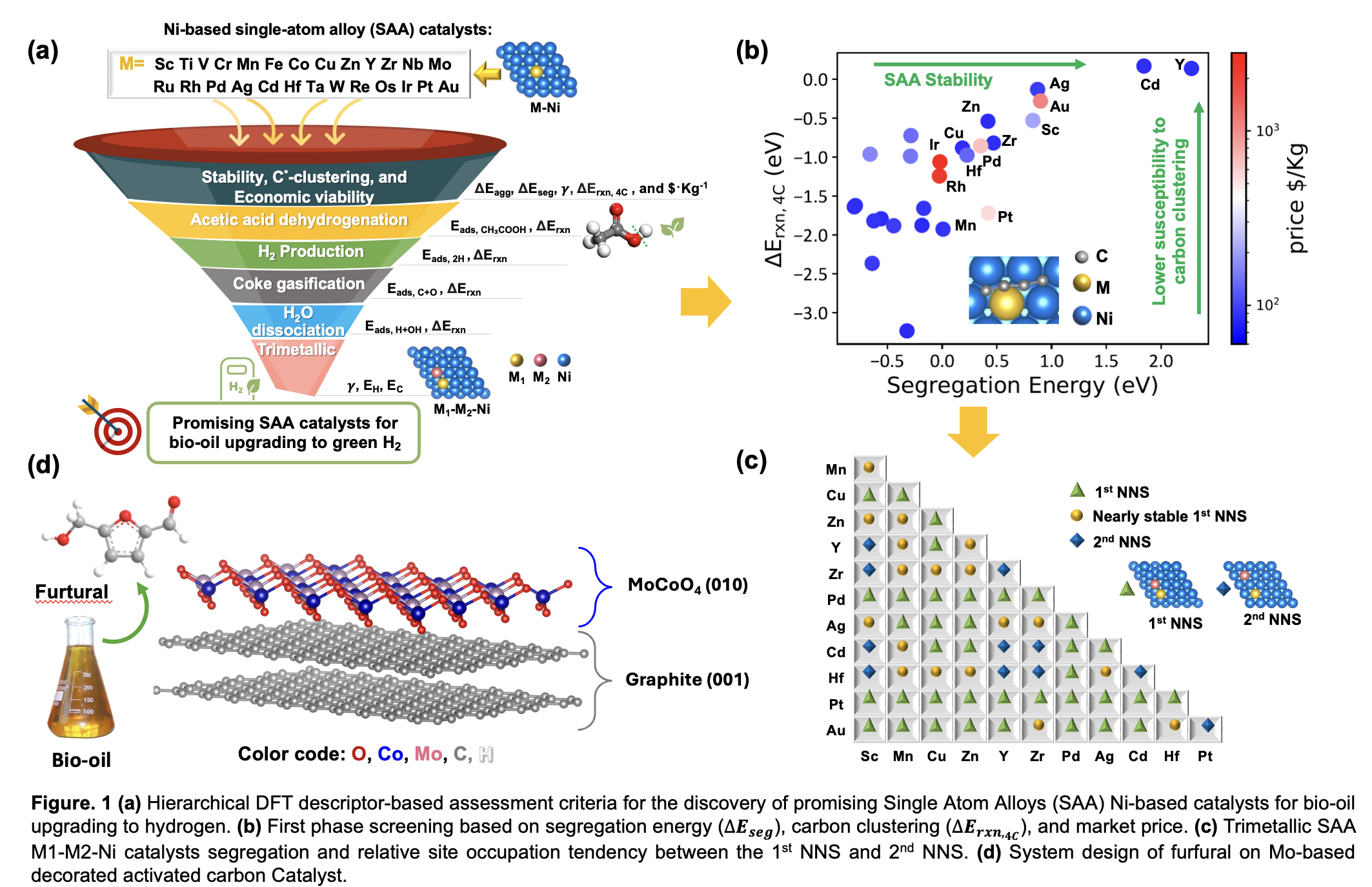
Through density functional theory (DFT) and ab initio molecular dynamics (AIMD) simulations, we designed and screened bimetallic and trimetallic Ni-based SAA catalysts for acetic acid dehydrogenation, identifying twelve promising compositions based on stability, cost, and resistance to C–C clustering [1]. Notably, Cu–Ni demonstrated superior hydrogen desorption and catalytic performance at 700–1000 K, owing to its favorable surface charge distribution. Trimetallic screening further identified six M1–M2–Ni configurations with balanced hydrogen binding and reduced coking tendencies.
In parallel, we investigated Mo-based catalysts for the electrochemical upgrading of biomass-derived furfural, integrating DFT and microkinetic modeling to evaluate activity across CoxMoOy surfaces. Among them, MoCoO₄ exhibited the strongest furfural adsorption, attributed to synergistic interactions between molybdenum and cobalt active sites, which enhance both surface wettability and electron transfer efficiency. These findings support MoCoO₄/activated carbon (AC) as a promising electrocatalyst for producing bio-based chemicals under near-ambient conditions.
This work has been financed by Khalifa University of Science and Technology under the Research and Innovation Center on CO2 and Hydrogen (RICH) (project RC2-2019-007).
[1] AlAreeqi, S., Ganley, C., Bahamon, D., Polychronopoulou, K., Clancy, P., & Vega, L. F. Rational design of optimal bimetallic and trimetallic nickel-based single-atom alloys for bio-oil upgrading to hydrogen. Nat Commun 16, 2639 (2025). https://doi.org/10.1038/s41467-025-57949-6