2025 AIChE Annual Meeting
(344b) Biomolecular Tools Tailored to the Environment: Using Hyperspectral Reporters to Track Engineered Microbiomes across Time and from Space
Authors
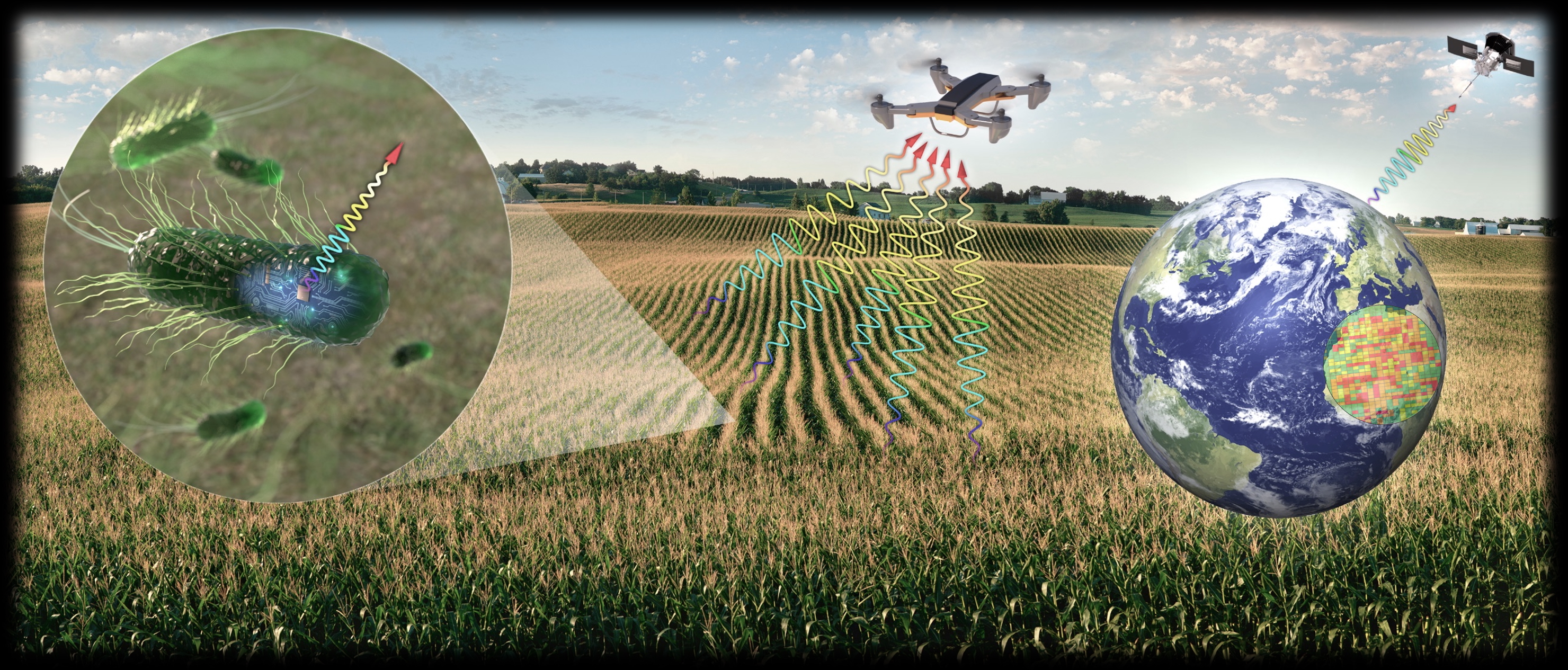
To address this, we developed hyperspectral reporters (HSRs) based on metabolites with unique absorbance spectra detectable via hyperspectral cameras that measure reflected light of 300 wavelengths within each pixel (Chemla and Levin et al. Nature Biotechnology, 2025). Using a molecular discovery approach, we applied time-dependent density functional theory (TD-DFT) simulations to over 20,000 metabolites, identifying biliverdin IXα and bacteriochlorophyll a as optimal HSRs due to their distinct spectral signatures. These reporters were genetically linked to sensor genes within engineered bacteria, such that in the presence of homoserine lactone analytes, the HSR metabolites were synthesized in the cell. When tested in soil, HSR expression could be visualized remotely via drones and satellites. Using computer vision, we collected a quantitative readout of analyte levels from up to 54 meters across one-acre aerial images. Thus, we leveraged computational methods to identify metabolites as hyperspectral reporters, enabling real-time remote biosensing from unprecedented distances. Beyond biosensing, HSRs offer advantages over existing reporters and have direct applications in ecology, agriculture, forensics, defense, and medical imaging. In parallel to this work, we applied biomolecular tools to study past environmental releases, including the first recorded use of engineered bacteria in Estonia (1989) to remediate phenol pollution from an oil shale fire. Taken together, our work demonstrates both the promise and risks of environmental biotechnology, as well as the need for tailored tools, approaches, and models to unlock its full potential. Challenges that I hope to study and help address in my independent career.
Teaching Interests
I am very interested in teaching the core undergraduate curriculum of chemical / biological engineering departments, and similar courses in other departments. Courses like thermodynamics, transport, biochemical engineering, among others. My teaching philosophy, based on a decade of teaching, centers on inspiring students to be interested and engaged with the course material. To do that, I believe an effective teacher should dare to innovate and make the classroom centered around the students, ensuring an inclusive and engaging environment.