2025 AIChE Annual Meeting
(430b) Biohybrid Sustainable Synthesis of Platinum Nanostructures Using Shewanella Oneidensis
Genetic Engineering
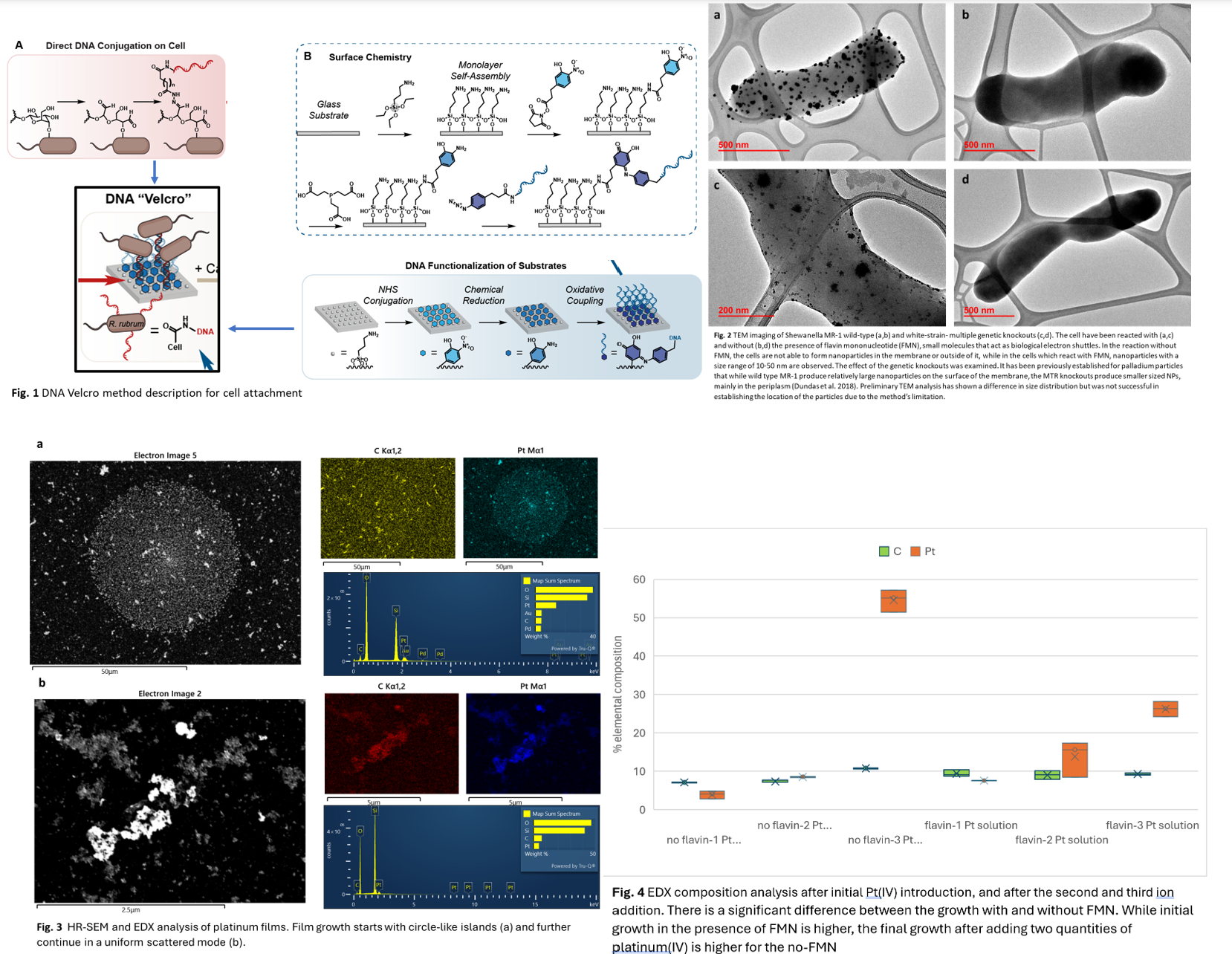
Genetic knockouts targeting key electron transport genes (e.g., MtrCAB, CymA) were employed to modulate nanoparticle size, distribution, and localization. Flavin mononucleotide (FMN) was used as an electron shuttle to enhance extracellular electron transfer. Preliminary results revealed that wild-type strains produced membrane-associated nanoparticles (10–50 nm) in FMN-supplemented reactions, while knockouts yielded smaller periplasmic particles.
Electron transfer mechanisms
Shewanella oneidensis MR-1 bacteria utilized the extracellular electron transfer through direct electron transfer (DET) and mediated electron transfer (MET) via flavins as electron shuttles. By leveraging these mechanisms, we explore the fabrication of hierarchical composites through two configurations: suspended bacterial cells forming nanoparticles and silica-immobilized cells producing nanofilms.
DET relies on direct membrane-to-substrate electron transfer, while MET involves extracellular shuttling facilitated by flavin mononucleotide (FMN). Experimental results reveal that MET accelerates initial nanoparticle nucleation (10–50 nm) on bacterial membranes, whereas DET promotes localized reduction within periplasmic spaces in strains lacking MtrCAB genes. Advanced electron microscopy was employed to overcome limitations of traditional TEM imaging, providing high-resolution 3D characterization of nanoparticle growth mechanisms and cell-to-film interactions. Nanofilms exhibited FMN-dependent growth kinetics, transitioning from circular islands to uniform layers, as validated by HR-SEM and EDX analysis.
Mass transport through flavins significantly influenced deposition rates, with MET systems showing rapid initial growth but lower final deposition compared to DET-dominated systems after multiple platinum(IV) additions.
Conclusions
Nanofilms exhibited FMN-dependent growth kinetics, transitioning from circular islands to uniform layers, as confirmed by HR-SEM and EDX analysis. This biohybrid synthesis method is scalable, eco-friendly, and eliminates the need for toxic chemical reductants, aligning with green chemistry principles. The resulting composites demonstrate potential as catalytic interfaces, conductive biofilms, and biocompatible scaffolds for biomedical applications.
This research advances the field of bio-inspired materials by integrating genetic engineering with advanced imaging techniques to design sustainable, multifunctional composites. It highlights a transformative approach to nanotechnology that merges biological precision with industrial scalability, opening new opportunities in energy systems, biomedicine, and biodegradable electronics.