2025 AIChE Annual Meeting
(641f) Beyond Langmuir-Hinshelwood: Analytical Rate Theories for Non-Mean Field Surface Kinetics
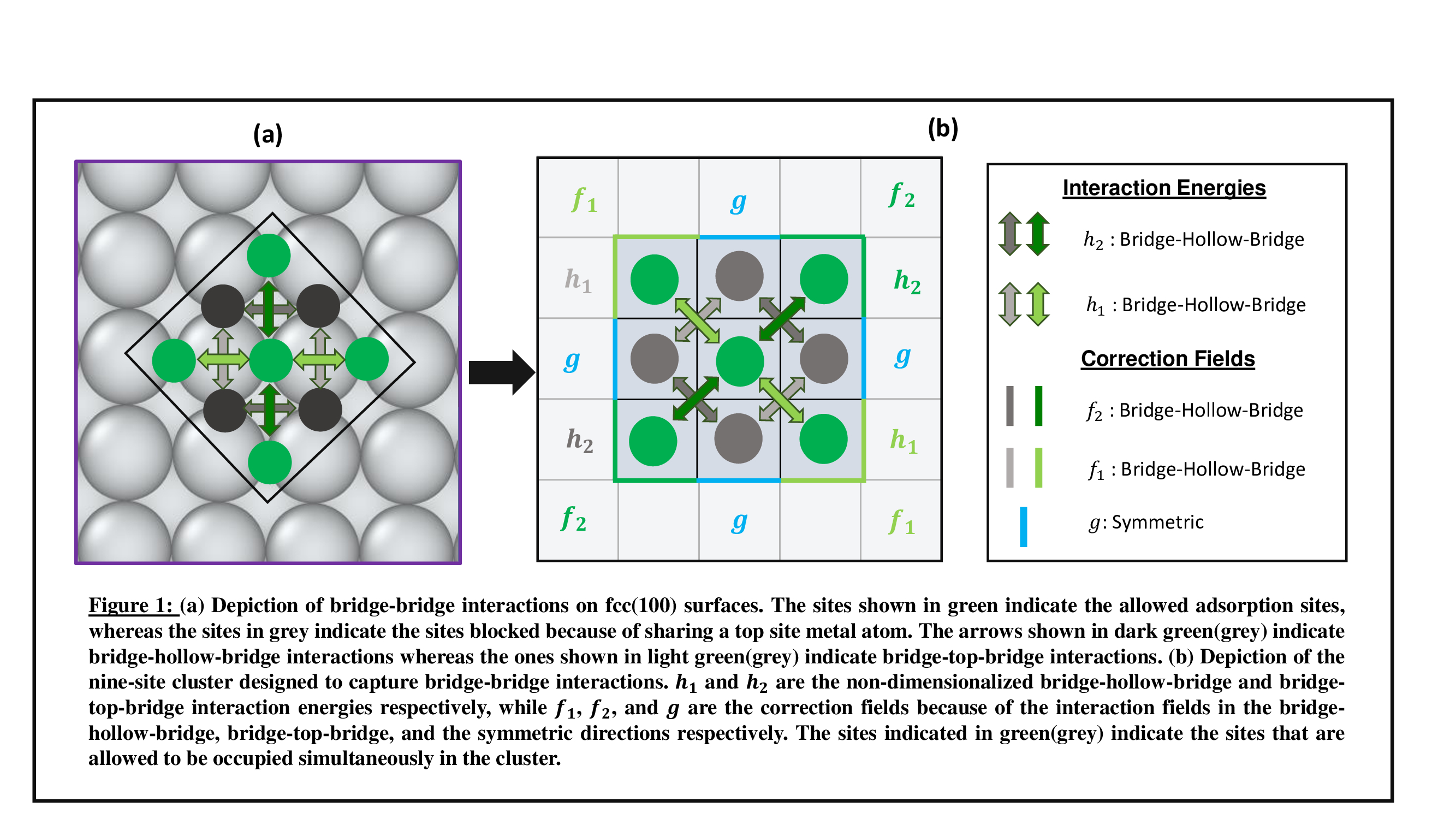
In this work, we introduce a strategy that combines the usefulness of analytical rate expressions with the descriptive power that comes from explicitly analyzing how adsorbate-adsorbate interactions lead to deviations from the mean field approximation. In particular, we treat non-mean field effects by utilizing approximations to the grand canonical partition function with the Cluster Variational Method (CVM). Assuming pairwise nearest neighbor interactions, we derive rate expressions for interacting adsorbates on both top/hollow and bridge sites on square symmetry fcc(100) surfaces. The interactions between bridge-bound adsorbates, in particular, are extremely rich, due to the combined effects of anisotropic interactions, where bridge-bound adsorbates may interact differently depending on whether a top or hollow site lies between neighboring bridge sites, and site-blocking, where adsorption on neighboring bridge sites with an intervening top site is inhibited by strong repulsion (Figure 1(a)). With the CVM approach, we obtain analytical adsorbate activities, as well as corresponding rate expressions for simple mechanisms, that describe a rich spectrum of non-mean field effects. We close by demonstrating how this formalism is applicable to realistic chemistries, such as reduction, which primarily occur on bridge sites on Pt (100) surfaces.