2025 AIChE Annual Meeting
(614c) Atom Thin Porous Graphene Membranes: Scalable Fabrication Methods
Authors
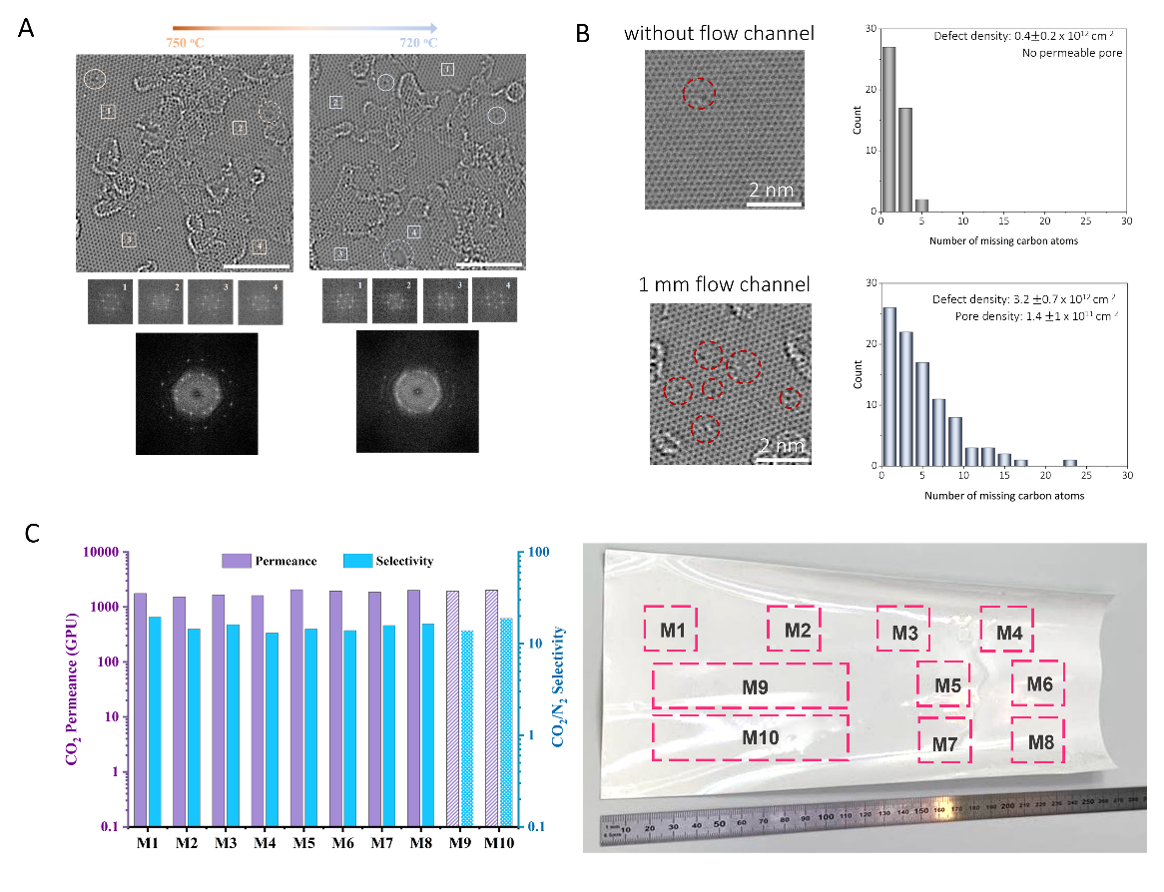
We first demonstrate the direct synthesis of nanocrystalline porous graphene via low-temperature chemical vapor deposition (CVD). By tuning growth temperature, growth time, and the CH₄/H₂ ratio, we achieved continuous single-layer graphene films composed of nanometer-scale grains (Figure 1A). These grain-boundary defects yield sub-nanometer vacancy pores, resulting in high H₂/SF₆ selectivity (>2000) from centimeter-scale membranes, consistent with microscopy-based structural analysis.[1]
To further tune the pore size distribution and overcome limitations of traditional high-temperature chemical etching[2], [3], we developed a novel room-temperature oxidation process for pore incorporation. By enhancing mass transfer through custom micro-channeled flow reactors, we enabled efficient oxidation at ambient temperature using ozone (Figure 2B). Pores were incorporated into the lattice via photonic gasification, resulting in an attractive pore size distribution for CO₂/N₂ separation. A brief post-treatment further refined pore structure and improved gas separation performance, enabling the fabrication of large-scale, scalable membranes with high CO₂/N₂ selectivity and CO₂ permeance.
Finally, we address a key bottleneck in the industrial deployment of two dimensional inorganic membranes: scalable transfer to target support. Using electrochemical delamination, we achieve defect-free transfer of porous graphene onto porous supports over areas exceeding 250 cm². These membranes exhibit CO₂ permeance up to 17,500 GPU and demonstrate stable performance during pilot-scale testing under real post-combustion conditions.
Altogether, this work offers an end-to-end solution for designing and scaling high-performance atom-thin porous graphene membranes, advancing the field of two-dimensional membrane science and enabling practical applications in carbon capture and hydrogen separation.
References
[1] C. Kocaman, L. Bondaz, M. Rezaei, J. Hao, and K. V. Agrawal, “Direct synthesis of nanocrystalline single-layer porous graphene for hydrogen sieving,” Carbon, vol. 221, Mar. 2024, doi: 10.1016/j.carbon.2024.118866.
[2] S. Huang et al., “In Situ Nucleation-Decoupled and Site-Specific Incorporation of Å-Scale Pores in Graphene Via Epoxidation,” Adv. Mater., vol. 34, no. 51, Dec. 2022, doi: 10.1002/adma.202206627.
[3] S. Huang et al., “Millisecond Lattice Gasification for High-Density CO2- and O2-Sieving Nanopores in Single-Layer Graphene,” Sci. Adv., vol. 7, no. 9, pp. 1–13, 2021, doi: 10.1126/sciadv.abf0116.