2025 AIChE Annual Meeting
(401s) Analysis of Water Vapor Permeation Characteristics in Perfluorosulfonic Acid Capillary Membranes Considering Latent Heat Effects
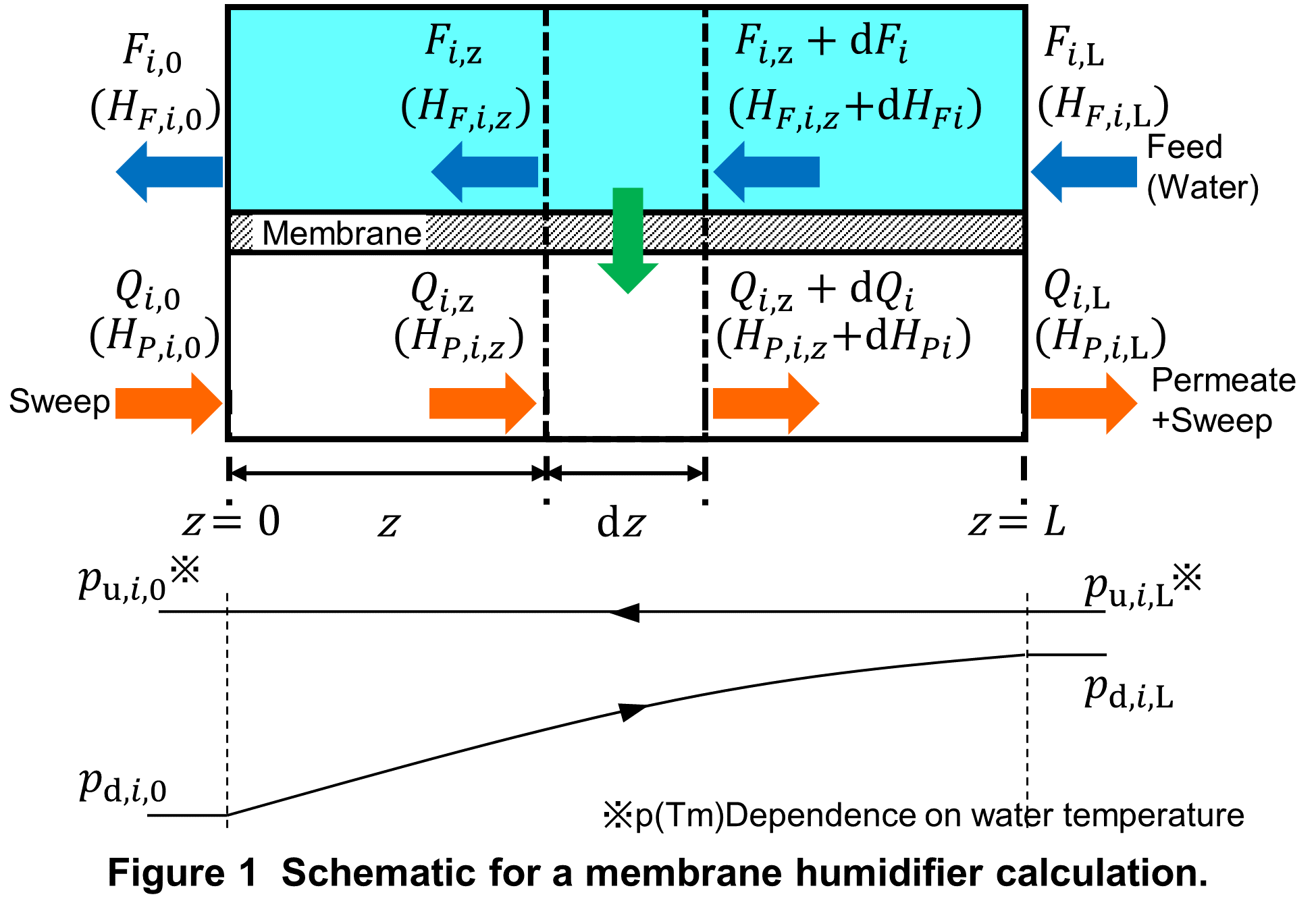
In the water-to-gas process, latent heat transfer through evaporation occurs, causing temperature reductions at the interfaces between water and membrane, within the water, and in the gas phase, thus affecting water vapor permeation. To investigate this phenomenon, we performed an analytical evaluation of water vapor permeation considering temperature variations induced by latent heat. The vapor permeation was modeled assuming plug flow conditions on both the high-pressure (feed water) and low-pressure (gas permeation) sides, as illustrated in Figure 1, to estimate the outlet vapor flux. A model was developed to predict the interfacial permeation temperature based on the latent heat, considering its impact on the vapor pressure at the high-pressure feed side.
The water vapor permeability through the perfluorosulfonic acid membrane was modeled by the solution-diffusion mechanism, with solubility derived from experimental data and the diffusion coefficient determined as a fitting parameter, normalized by membrane thickness.
Calculated results agreed well with water vapor permeation experimental measurements, successfully elucidating the water vapor permeation characteristics and associated heat transfer phenomena in the water-to-gas humidification process.