2025 AIChE Annual Meeting

(199b) Alloying Effects in Pt-Ag Catalysts Towards Selective Ethylene to 1-Propanol Direct Conversion Via Tandem Catalysis

Authors

Verónica Recio, Institute of Chemical Technology (ITQ)
Raúl Arenal, Laboratorio de Microscopias Avanzadas (LMA), Universidad de Zaragoza 50018
Gonzalo Prieto, Institute of Chemical Technology (ITQ UPV-CSIC)
Light alcohols (C3-C4) play a pivotal role in the chemical industry, although state-of-the-art production routes face some issues such as the reliance on homogeneous catalysts, which is associated to energy-intense separations. In this context, reductive hydroformylation (RedHF), which combines hydroformylation and aldehyde hydrogenation in a single conversion, has emerged as a promising pathway although it has been only succesfully realized using molecular catalysts due to the lack of selective solid catalysts. Our recent findings on a Rh1/SnO2 hydroformylation catalyst could enable gas-solid RedHF processes. This opportunity calls for the design of optimized aldehyde hydrogenation catalysts combining high activity, chemoselectivity and CO tolerance under syngas atmosphere. In this work, we have explored alloying effects in Pt-Ag systems for the design of novel carbonyl hydrogenation catalysts. The best catalyst has been integrated with the Rh1/SnO2 catalyst in a tandem RedHF process which enables the direct conversion of ethylene to 1-propanol with excellent selectivity at mild conditions.

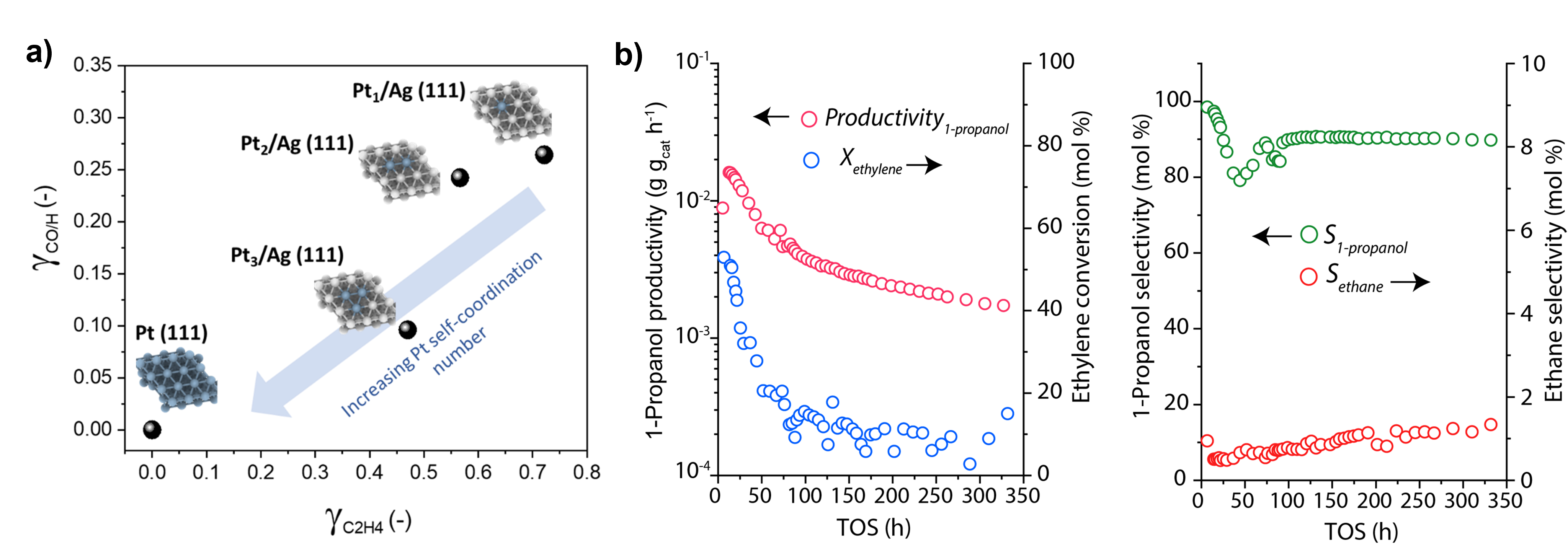
Firstly, we have computationally screened diluted and single-atom Pt-Ag alloys for the selective hydrogenation of propanal to 1-propanol in the presence of ethylene and CO. Isolated Pt1 centers and Pt2 dimers are predicted to provide the most advantageous features, with barrierless H2 dissociation, low ethylene adsorption energies and lower CO/H binding energy ratio (Figure 1a), in good agreement with the results obtained experimentally. For the optimal hydrogenation catalyst identified (i.e. 1 at% Pt), ethylene reductive hydroformylation tests were performed in combination with Rh1/SnO2. As illustrated in Figure 1b, the system can reach very high 1-propanol selectivity (>90%) at high ethylene conversion levels (>50%) for more than 300 hours on-stream with negligible ethane formation. These results showcase the potential of atomically precise active sites and tandem catalysis approaches to attain a gas-solid reductive hydroformylation process with selectivity levels comparable to those thus fur restricted to homogeneous catalysis.