2025 AIChE Annual Meeting
(250c) Alkaline and Alkaline Earth Metals (AAEMs) Tolerance of Zeolite Supports for Processing Contaminated Renewable Biomass Feedstock
Authors
Calvin Mukarakate, National Renewable Energy Laboratory
Theodore Walker, University of Wisconsin - Madison
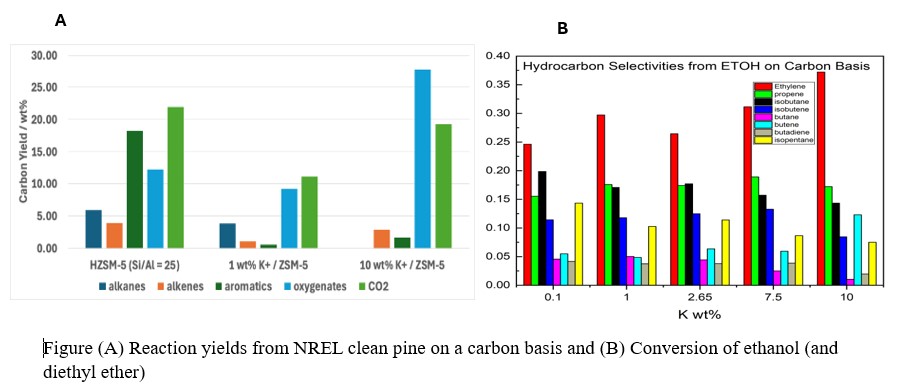
The deactivation of HZSM-5 catalysts due to alkali metal contamination (e.g., K⁺) remains a significant challenge in biomass pyrolysis, as these metals neutralize Brønsted acid sites and hinder hydrocarbon conversion pathways. While gas-phase deposition methods have been traditionally employed to study metal-induced catalyst deactivation, recent advances in liquid-phase ion exchange techniques provide a complementary approach to precisely control metal loading while enabling systematic acid site characterization. However, discrepancies between liquid- and gas-phase deposition methodologies, particularly in acid site density quantification and speciation, complicate direct comparisons due to differences in solvation effects and metal-framework interactions. Here we report different characterization techniques to like the NH3 TPD, N2 physisorption, XRD, XRF and SEM/EDS to comprehend the effect of this metal poison. Liquid-phase ion exchange using KNO₃ precursors is employed to introduce controlled K loadings, and the resulting acidity trends are benchmarked against catalysts doped via conventional gas-phase exposure. We evaluate these modifications in terms of acid site accessibility, framework stability, and catalytic performance, as measured by ethanol dehydration and subsequent hydrocarbon transformations using GC-MS analysis. Our findings reveal that K⁺ deposition preferentially neutralizes Brønsted acid sites, shifting product selectivity toward unsaturated hydrocarbons while suppressing aromatic formation, consistent with deactivation trends observed under realistic biomass processing conditions. Furthermore, we explore catalyst regeneration strategies via nitric acid leaching, demonstrating partial recovery of active sites and potential valorization of metal contaminants as potassium-based fertilizers. This study provides new insights into metal-zeolite interactions in biomass pyrolysis, bridging the gap between liquid-phase and gas-phase deposition methodologies, and enabling the development of more resilient catalytic systems for sustainable biofuel production.